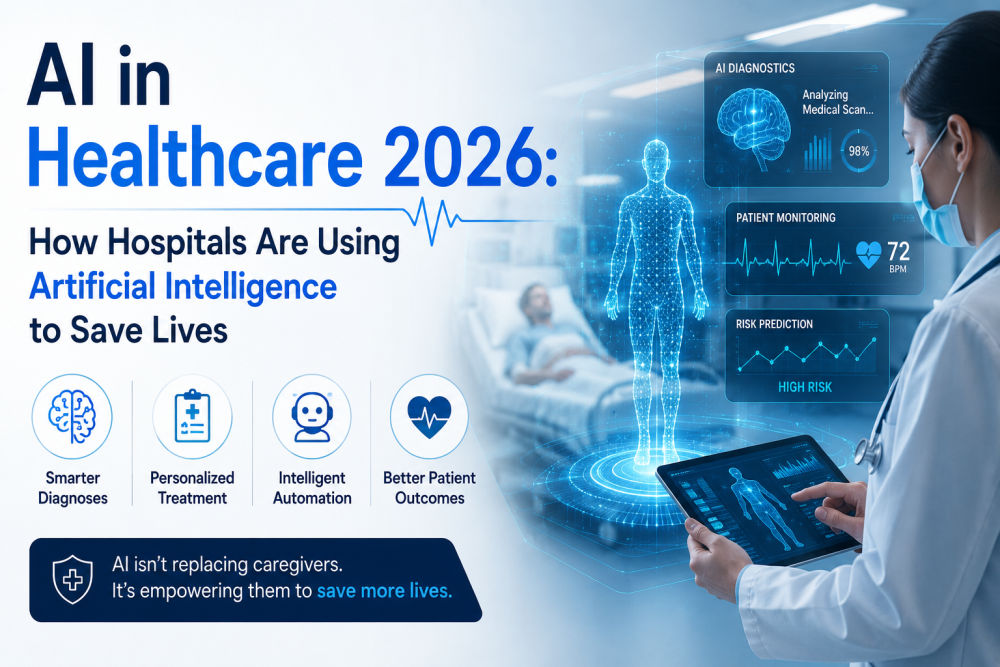
There's a version of this story that writes itself: AI is revolutionizing medicine, doctors are being replaced by algorithms, and the hospital of the future looks like something out of a science fiction film. That version is easier to write but significantly less useful than what's actually happening.
The reality in 2026 is both more modest and more genuinely impressive than the headlines suggest. AI isn't replacing physicians. What it's doing—quietly, in emergency departments and radiology suites and hospital administrative systems across the country—is making doctors faster, more accurate, and less exhausted. It's catching things humans miss. It's flagging patients who are about to deteriorate before nurses or physicians have noticed the warning signs. It's handling documentation that used to consume hours of a clinician's day.
Some of this saves money. Some of it saves time. And some of it, without much exaggeration, saves lives.
Here's what that actually looks like in practice.
Catching Sepsis Before It Kills
Sepsis is one of the most dangerous conditions treated in hospitals and also one of the most time-sensitive. It's a systemic infection response that can spiral from "patient looks unwell" to organ failure within hours. Roughly 270,000 Americans die from sepsis every year, and the single biggest driver of those deaths is delayed recognition. By the time a patient is clearly septic, the window for intervention is often already closing.
This is exactly the kind of problem AI handles well. Not because the algorithms are magical, but because sepsis prediction depends on picking up subtle patterns across dozens of variables simultaneously: vital signs, lab values, medication history, time since last assessment, patient age, and comorbidities. A busy nurse managing eight patients at once genuinely cannot hold all of that in her head and synthesize it in real time. A well-trained model can.
Duke Health has been running a deep learning sepsis prediction system called Sepsis Watch since 2018, and the results have been striking. After integrating the real-time system in their emergency department and ICU, Duke saw a 27% reduction in sepsis deaths, and a 2025 multisite validation study confirmed its strong predictive accuracy across different hospital settings.
More recently, researchers at Northeastern University pushed the boundaries further. Using medical data from patients while they were still at home, traveling in an ambulance, and receiving care in the emergency room, they built an AI model that predicts life-threatening septic shock with 99% accuracy—a figure that sounds almost implausible but reflects how much predictive power becomes available when you feed a model continuous data from multiple points in the care journey rather than a single snapshot.
The FDA has also authorized the Sepsis ImmunoScore, the first-ever AI diagnostic authorized specifically for sepsis, which uses machine learning across 22 parameters—including vital signs, demographics, and clinical lab tests—to generate a composite risk score categorizing patients into one of four sepsis risk groups within 24 hours. It plugs directly into a hospital's electronic health record, appearing like any other lab test. No special interface, no additional workflow step. The result just appears, flagging who needs urgent attention.
What's notable about all of these tools is that they don't replace clinical judgment—they inform it. The physician still makes the call. The AI just makes sure that call happens earlier, when the antibiotics and fluids can actually change the outcome.
AI Is Listening in the Exam Room (And Doctors Are Relieved About It)
Here's something that doesn't get nearly enough attention: physician burnout is a patient safety issue, not just an HR problem. When doctors spend two hours on documentation for every one hour of patient care, they're distracted, fatigued, and less present with the people who need their full attention. As UCLA Health's chief AI officer put it, the documentation burden has become a major contributor to physician burnout—with doctors often spending two hours on paperwork for every hour of patient care.
Ambient AI scribes are changing this. The technology works by listening to the conversation between a clinician and a patient during an appointment, then automatically generating a draft clinical note that the doctor reviews and edits before signing. No dictating, no typing during the visit, and no catching up on charting at 10pm.
The results from recent randomized trials are genuinely encouraging. A study at UW Health found that the use of an ambient AI scribe system correlated with a clinically meaningful reduction in burnout scores, while also reducing documentation time by 30 minutes per day per provider. That's 30 minutes returned to every doctor, every day—time that goes back to patients or back to the physician's own well-being.
The burnout data is particularly striking. At Mass General Brigham, use of ambient AI scribe technology was associated with a 21.2% absolute reduction in burnout prevalence, dropping from 52.6% to 30.7%. At Emory Healthcare, ambient AI scribe use was associated with a 30.7% increase in the proportion of clinicians reporting a positive impact on their documentation practice and overall well-being.
In another study that analyzed data from UChicago Medicine's ambient documentation pilot, researchers found that clinicians who used the AI scribe spent 8.5% less total time in the electronic health record than matched controls, with a more than 15% decrease in the time spent specifically composing notes.
That 8.5% sounds small until you do the math on a doctor seeing twenty patients a day. It adds up to meaningful hours per week—and crucially, the hours saved tend to be the most draining ones: late-night catch-up charting; the note backlog that eats into lunch breaks; and the clerical grind that made smart, dedicated people start wondering whether medicine was worth it.
These tools aren't perfect. Studies report frequent documentation omissions and occasional clinically significant errors, and implementation remains a genuine challenge involving workflow redesign, medico-legal considerations, and the need to preserve the patient-clinician relationship. Every AI-generated note still needs physician review. But as a co-author of one of the main review studies noted, the technology is maturing quickly, and the direction of travel is clear.
Radiology: Where AI Has Been Proving Itself for Years
If you want to see AI that's genuinely battle-tested in clinical settings, radiology is the place to look. AI-assisted image analysis has been developing for longer than most people realize, and by 2026, it's embedded in workflows at hospitals ranging from large academic medical centers to smaller community facilities.
The basic capability is pattern recognition—AI models trained on millions of scans learn to identify abnormalities: tumors, fractures, bleeds, pneumonia, diabetic retinopathy, and early signs of cancers that might be missed on a first read. In some specific tasks, well-trained models now match or exceed the accuracy of experienced radiologists, particularly for detecting subtle findings that can get lost in a high-volume reading environment where a radiologist might be reviewing hundreds of images in a shift.
Consider what this means practically. A radiologist working overnight covers emergency cases as they come in—a car accident, a stroke presentation, a possible pulmonary embolism. AI tools flag the urgent cases in real time, prioritizing the worklist so that the images most likely to require immediate action rise to the top. Studies have consistently shown this triage capability reducing time-to-diagnosis for conditions like intracranial hemorrhage, where minutes genuinely determine outcomes.
The honest caveat here is that AI in radiology still generates false positives and false negatives—it's not infallible, and in practice it functions as an additional set of eyes rather than a replacement for human expertise. What it does remarkably well is provide a safety net: flagging the findings that might have been missed on an exhausted read, or adding confidence to a correct diagnosis.
For patients in rural hospitals with limited specialist access, this has particular value. An AI tool that can flag a probable stroke on a CT scan at 3am in a facility without an on-site neurologist—and transmit that finding to a remote specialist immediately—is closing genuine access gaps.
Predicting Who's About to Get Worse
Beyond sepsis, hospitals are deploying AI for a broader category of problem: early deterioration prediction. Patients in general wards sometimes decline rapidly before the clinical signs become obvious to busy staff. Catching this decline early—before it becomes a code blue or an emergency ICU transfer—is better for patients and significantly less resource-intensive for hospitals.
Systems like the Epic Early Warning Score (part of the widely used Epic electronic health records platform) use machine learning to continuously score every patient's deterioration risk based on their current vitals, lab trends, and nursing assessments. Today, 77% of healthcare professionals lose time due to incomplete or inaccessible data, and nurses spend 15 to 20 minutes every hour on administrative tasks—which means the last thing an overstretched floor nurse needs is another system demanding attention. Done well, these early warning tools don't add noise; they cut through it, surfacing the one or two patients whose risk scores have changed significantly so the nurse can prioritize.
The ambition extends further. Hospital systems are starting to use predictive models for staffing and resource planning: forecasting which days will see high ED volume, predicting ICU bed demand, and anticipating surgical complications before they occur. AI voice agent platforms can also automate reminder calls and make it easy for patients to confirm or reschedule, helping clinics reduce their no-show rates by around 30%. That's a meaningful operational gain, but it also means more patients actually showing up for appointments that could catch problems early.
Drug Discovery and Clinical Research: The Long Game
The most consequential applications of AI in healthcare might not be the ones happening in hospitals right now—they're the ones happening in pharmaceutical research labs, where AI is beginning to compress timelines that were previously measured in decades.
AI models can now help scientists simulate virus behavior and test thousands of drug compounds in days—a process that used to take years. This isn't theoretical anymore. AI-assisted drug discovery has moved from proof-of-concept to active clinical trials for several conditions, with AI-generated drug candidates for diseases including cancer and fibrosis now being tested in humans.
The practical implication for patients is still mostly in the future—the regulatory process doesn't move at AI speed—but the pipeline is filling up in a way it wasn't five years ago. The drugs that AI is helping design today could be reaching patients in the next five to ten years.
The Trust Problem (Which Nobody Is Solving Fast Enough)
Here's the uncomfortable part of this story. AI in healthcare is genuinely producing results, but it's doing so against a backdrop of real and legitimate concerns about trust, transparency, and accountability—and those concerns haven't been resolved.
The 2026 Future Ready Healthcare survey found that while AI use is increasingly part of patients' and clinicians' daily experience, trust is struggling to keep pace. When AI lacks transparency, reliable sourcing, or proper oversight, the risks are too high to ignore.
The specific concerns aren't abstract. AI models trained on historical medical data can embed historical biases—if certain patient populations were historically underdiagnosed or undertreated, a model trained on that history may perpetuate those patterns. There are real questions about liability when an AI-assisted decision leads to a poor outcome. And there's the very practical problem of what happens when a clinician becomes over-reliant on an AI alert system and stops trusting their own judgment when the algorithm and their instincts disagree.
Healthcare leaders note that if clinicians are constantly needing to recheck AI outputs and validate them against other sources, it raises legitimate questions about whether these tools are actually effective productivity aids—or whether they're adding a new layer of work while giving the appearance of efficiency.
These aren't reasons to slow down adoption, but they're reasons to be thoughtful about it. The hospitals getting the most value from AI in 2026 tend to be the ones that picked specific, well-defined use cases, trained their staff properly, maintained physician oversight, and built feedback loops to catch when models drift or underperform.
What Patients Should Actually Know
If you've had a CT scan recently, there's a reasonable chance an AI tool reviewed it alongside your radiologist. If you've been hospitalized, your vital signs have probably been continuously scored by an algorithm monitoring for deterioration. If your doctor types notes during your appointment on a laptop, they may have been using an AI scribe that listens and generates a draft—or that's coming to their practice soon.
About 52% of patients now say they use AI to research health conditions or diagnoses, and 54% use these tools to look up potential side effects or drug interactions. Patients are already in this ecosystem, whether they realize it or not.
What that means practically: it's worth asking your healthcare provider what AI tools are being used in your care and how they're being overseen. Good institutions will be transparent about this. It also means that the AI-generated information patients find online is only as good as the models producing it—not a substitute for an actual conversation with a clinician.
Where This Is Actually Going
The honest answer to "Where is AI in healthcare heading?" is deeper integration, more clinical tasks, more administrative automation, and a growing body of evidence about what actually works versus what was just well-marketed.
The tools that are proving themselves—sepsis prediction, ambient documentation, radiology flagging, early deterioration alerts—have something in common: they're doing one specific thing well, with human oversight, rather than trying to replace clinical judgment wholesale. That pattern is likely to continue. AI in healthcare isn't going to look like robots performing surgery unsupervised; it's going to look like every step of the care process being a little faster, a little more accurate, and a little better supported than it was before.
That's less dramatic than the headlines usually promise. But for the patient whose sepsis gets caught four hours earlier, or the physician whose documentation burden drops enough that she stops considering leaving medicine entirely—it's the difference that actually matters.
The best version of AI in healthcare isn't AI doing medicine. It's AI making it possible for doctors and nurses to do medicine better. In 2026, that version is, piece by piece, starting to arrive.