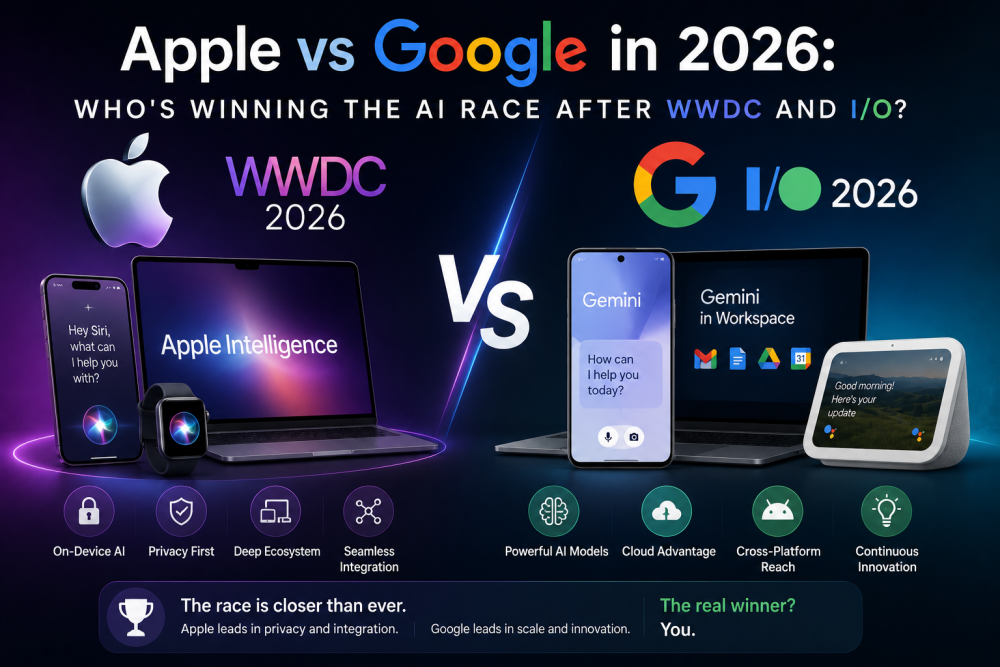
The question assumes they're competing on the same terms. They're not, and understanding why that's true is actually the most interesting thing to come out of both WWDC and Google I/O this year.
Google's 2026 I/O event, held in May, was a sprawling two-hour demonstration of how deeply Gemini has been embedded across every product the company makes. Android. Search. Gmail. Maps. Drive. Workspace. Even smart glasses. CEO Sundar Pichai was proud enough of the scale of AI deployment that one commentator counted 143 mentions of "AI" across the keynote. Monthly token usage on Google's AI products has reached 480 trillion—a figure Pichai cited with visible pride.
Apple's WWDC keynote followed in June, the last one hosted by CEO Tim Cook before he hands the reins to John Ternus in September. Apple didn't mention AI once. Not because they weren't talking about it — every single announcement was AI-adjacent. But because Apple never says "AI." It says "the new Siri" and "Apple Intelligence" and demonstrates what users can do rather than how the technology works. This is a deliberate strategy that has defined Apple's approach since before these events, and it explains a lot about why comparing the two companies in an AI race is more complicated than it sounds.
The Bombshell: Apple Is Running on Google's Model
Let's start with what's actually new, because there's a genuine strategic revelation buried inside Apple's WWDC announcements.
Apple has signed a deal — reportedly worth approximately $1 billion annually — to license a custom version of Google's Gemini model to power the rebuilt Siri and next-generation Apple Intelligence. That $1B/year figure is significant. It means Apple looked at the state of frontier AI models, assessed what it would cost to build and maintain one competitive with GPT-5, Claude, and Gemini, and concluded that licensing was cheaper and faster than building.
This is a striking strategic choice, and not everyone agrees it's the right one. But it reflects a coherent thesis: the AI model layer is commoditizing. As GPT-5, Claude 4, and Gemini 3.5 converge in raw capability, the company that controls the interface where users access models—not the models themselves—captures the long-term value. Apple has two billion devices. That distribution advantage is the moat, not whatever model happens to be running underneath.
The new Siri isn't just a more responsive voice assistant. It has visual intelligence and on-screen awareness. It exists simultaneously as a standalone app and a system-level presence that works across apps. It can look at a photo and split a dinner bill. It can turn a conversation thread into a playlist. It can orchestrate multi-step tasks across different applications without the user having to switch contexts. Critically, iOS 27 pushes these capabilities all the way back to the iPhone 11—Apple's widest software rollout in the company's history.
And in a move that either signals remarkable confidence or remarkable pragmatism, iOS 27 will let users choose their default AI provider: ChatGPT, Claude, Gemini, Grok, Copilot, or Perplexity. Apple is essentially becoming a platform for AI rather than an AI company — the same way it became a platform for apps through the App Store rather than trying to build all the apps itself.
What Google Actually Announced at I/O
Google's I/O event was technically impressive and, if you're honest about it, somewhat exhausting to watch. The demonstrations leaned heavily on developer tooling—command-line interfaces, token usage statistics, and technical capability showcases that would matter enormously to engineers and comparatively little to the average person trying to understand whether Google's AI is better than what they're currently using.
The headline AI advances from Google I/O 2026:
Gemini 3.5 — An upgrade to the underlying model, now with improved speed, cost efficiency, and agentic capabilities. "Agentic AI" means the system can take sequences of complex actions autonomously rather than just answering questions—booking appointments, building custom app interfaces, and automating multi-step workflows. This is the direction all major AI companies are moving, and Google has substantial infrastructure advantages in deploying it at scale.
AI Overviews and Search redesign—Google called this a "radical AI-based redesign of search." The practical implementation looks like a larger, more prominent AI summary box above traditional search results. Whether this represents a fundamental reimagining of search or an incremental interface change with aggressive marketing language around it is a matter of perspective. The underlying concern — that AI search results are sometimes confidently wrong — didn't get addressed directly, though the upgrade to Gemini 3.5 is implicitly meant to improve accuracy.
Android AI integration — Google's advantage with Android is its ubiquity and the depth of integration Gemini can achieve across the operating system and Google's own services. For users who live in Google's ecosystem—Gmail, Calendar, Drive, Photos, and Maps—the AI integration is genuinely seamless. Gemini can surface relevant email content, suggest calendar entries, organize photos automatically, and handle tasks that span multiple services.
Project Astra and AI agents — Google's multimodal AI assistant that can understand and respond to what a phone camera is seeing in real time. Genuinely impressive in demonstration. The gap between impressive demonstration and reliable everyday utility remains a real question for all AI assistants, but the technology being shown at I/O represents genuine capability advancement.
The Presentation Gap (Which Matters More Than You'd Think)
Here's something worth acknowledging, even if it sounds superficial: the quality of the two companies' presentations was dramatically different, and that gap matters for how these announcements land with consumers and the press.
Google's I/O is a live in-person event, which in theory should create more energy and impact than a pre-produced Apple keynote video. In practice, observers noted significant issues: presenters checking their marks on stage, a CEO who departed before the show ended, demonstrations focused on developer-centric details while the potential consumer excitement was underplayed, and an overall production quality that felt amateurish compared to Apple's polished videos.
Apple's WWDC keynote is exceptionally well-produced. The demonstrations are designed around user outcomes rather than technical specifications. The narrative arc from announcement to announcement is carefully constructed. Tim Cook's final WWDC keynote as CEO was well-received, and the focus on what users can do with the new capabilities—rather than how many trillion tokens Gemini processes—reflects Apple's consistent philosophy that technology should be in service of human experience, not the other way around.
None of this changes what the underlying technology can do. But consumer technology is partly a confidence game — users adopt features they believe will work and understand why they'd want them. Apple is significantly better at communicating the "why you'd want this" than Google is at communicating anything other than technical skill.
Who's Actually Winning? It Depends on the Scorecard
If you're judging by model capability — the raw intelligence of the AI system — Google is almost certainly ahead. Gemini 3.5 is a frontier-level model built and maintained by a company that has been investing in AI research longer and more deeply than almost anyone. Apple doesn't even try to compete on this dimension.
If you're judging by ecosystem integration for existing Google users — people who use Gmail, Calendar, Maps, Chrome, and Android as their primary digital infrastructure — Google's I/O announcements are genuinely exciting. The depth of integration achievable when the AI, the services, and the operating system are all made by the same company is real, and it's an advantage Google has that Apple can't easily replicate in the Google services layer.
If you're judging by reach and distribution — the sheer number of people whose devices will run these AI features — Apple's approach has significant advantages. Two billion active devices, the widest software rollout in the company's history back to iPhone 11, and a deal structure that lets users choose their preferred AI model (while keeping Apple as the platform) means Apple's AI features will reach an enormous installed base very quickly.
If you're judging by trust and privacy, Apple's reputation for treating user data with more care than Google has been maintained through the AI era. Apple's on-device processing emphasis and the framing of AI as serving the user rather than serving advertisers matter to the significant portion of the market that cares about privacy.
If you're judging by the long-term strategic position, this is where the most interesting argument happens.
The Deeper Strategic Question
Google's thesis is the company that builds the best AI model and distributes it through the products people use most wins the AI era. The model is the moat. Build it, improve it, put it everywhere.
Apple's thesis—articulated most clearly through analysis of the Gemini deal—is that the model layer will commoditize as multiple frontier models converge in capability. The company that controls the 2 billion device interfaces where people access AI captures the value. The distribution is the moat.
Which thesis is correct depends on something neither company fully knows yet: whether AI models will continue to differentiate significantly (in which case Google's advantage in building frontier models matters enormously) or whether capability differences between the top models will become too small for users to care about (in which case Apple's interface and distribution control matter more).
There's a reasonable case for the commoditization argument. GPT-5, Claude 4, and Gemini 3.5 are all capable enough to handle the tasks most users actually do with AI assistants. The incremental capability differences between them are real but rarely decisive for everyday use. If that convergence continues, the question of "which AI" becomes less important than "Where does the AI live and how does it fit into my existing experience?" That's a question Apple is positioned to answer for two billion iPhone, iPad, and Mac users.
There's also a reasonable case that Google's thesis holds. Search is still where enormous amounts of computing activity begin. Android runs on about 72% of smartphones globally. The depth of integration possible when Google owns the model, the services, and the operating system creates compound advantages that Apple — with its dependence on a licensed model — can't fully match.
The Tim Cook Legacy Angle
It's impossible to discuss Apple's WWDC 2026 without noting that it was Tim Cook's last as CEO. He hands the role to hardware chief John Ternus on September 1, completing a 15-year run that doubled Apple's revenue and built the services business from essentially zero to $109 billion annually.
The decision to license Gemini rather than build a frontier model will be one of Cook's last major strategic calls. It's a bet that Apple's moat has always been distribution, integration, and user experience—not the underlying technology—and that the AI era doesn't change that fundamental reality.
John Ternus inherits a company in a complicated but potentially advantageous AI position: not leading the frontier model race, but positioned to benefit from it regardless of which model company wins, while owning the device and interface layer that everyone uses to access AI. Whether that turns out to be the right positioning for the next decade is the question that will define the early years of Ternus's tenure.
The Honest Verdict for Users Right Now
If you want the most capable AI assistant integrated into the most comprehensive set of productivity services, and you're already living in Google's ecosystem, the I/O announcements are genuinely meaningful upgrades.
If you're an iPhone user wondering what AI means for your device, WWDC 2026 delivered the most substantive AI upgrades Apple has announced. The rebuilt Siri, coming with iOS 27, represents a real step forward—even if the model powering it was built by Google.
For most users, the most relevant question isn't who's winning the AI race. It's whether the AI features on their existing devices actually work reliably for the things they actually want to do. On that question, both companies have more work to do. Impressive demos are easier to produce than consistently useful, everyday AI that earns people's trust by working correctly when it matters.
The race continues past the event keynotes. The interesting part is what ships in the fall.