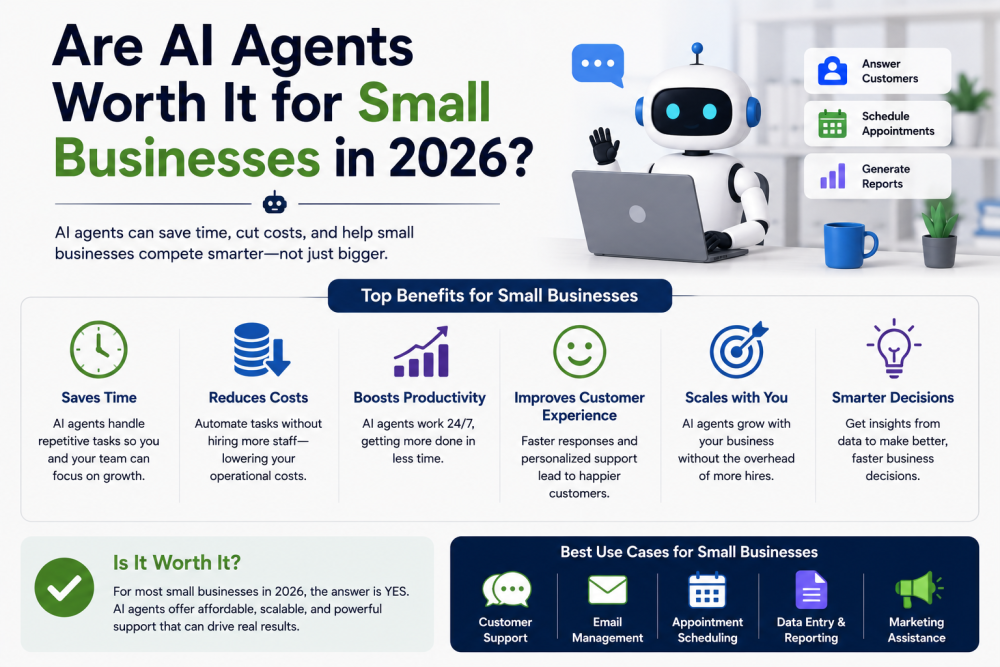
Yes for some businesses, no for others, and the line between them is not what the vendors claim, so here's the honest verdict up front: AI agents are clearly worth it for small businesses with high-volume, repetitive, rule-shaped work, the same twenty customer questions, the invoice chasing, the scheduling tennis, where the ROI math is almost embarrassing. They're clearly not worth it, yet, for low-volume businesses, judgment-heavy work, and owners hoping software will supply the process their business doesn't have. And for everyone between, the answer isn't an opinion, it's a 30-day experiment this article will hand you.
One housekeeping note: this is the decision article, is it worth it, for whom, by what math. The implementation side, what agents actually do, which tools, the guardrails, lives in our AI agents automation guide, and the two are meant to be read as a pair. Right, the math.
The ROI Arithmetic, Done Honestly
Strip the hype and agent ROI is three numbers: hours the agent genuinely saves per month, what your hour is actually worth, and the true monthly cost, subscription plus the human time spent checking its work, because our hidden costs guide's verification tax applies to agents double.
Worked example, deliberately conservative. A small business drowning in customer messages deploys a support agent that resolves, say, sixty percent of routine questions, freeing eight hours a month of the owner's time. At even a modest valuation of the owner's hour, that's several hundred in recovered value against a tool cost typically in the tens of dollars plus per-resolution fees, and roughly an hour of weekly spot-checking. The math clears by multiples, and that's the honest shape of the win when volume is real: the tool costs tens, the recovered time is worth hundreds, and the gap is the ROI.
Now the same math where it fails. A consultant with four clients and six customer emails a week deploys the same agent: two hours saved monthly, an afternoon of setup amortizing slowly, the checking overhead eating half the savings, and the honest verdict is a rounding error wearing a subscription. Same tool. Different volume. Opposite answers, which is why "are agents worth it" has no universal answer and why anyone selling you one universally is selling.
The one refinement that changes borderline cases: value the hours by what you'd do with them, not just what you'd bill. Eight hours redirected into sales calls or the marketing flywheel from our organic growth guide compounds; eight hours redirected into scrolling doesn't, and the agent's ROI is really the ROI of whatever the freed time becomes.
Where the Verdict Is Already In
The clearly-worth-it column, by workflow rather than industry, volume being the qualifier throughout. Repetitive customer contact at real volume: the mature category, per-resolution pricing that scales with use, and the closest thing to a sure bet, the e-commerce store, the salon's booking questions, the busy service business's twenty standard emails. Invoice chasing for anyone with recurring receivables: politeness automated, cash flow improved, awkwardness deleted, arguably the fastest payback on the entire list. Scheduling-heavy calendars: the back-and-forth is pure agent food. And inbox triage for genuinely drowning inboxes, the drafting-and-flagging layer that returns the first hour of every morning.
The clearly-not-yet column, stated with equal confidence. Low-volume everything, the math above, no volume, no ROI. Judgment work, the client strategy, the custom proposal, the sensitive conversation, agents draft, humans decide, and businesses whose product IS judgment save less than they hope. Businesses without process: an agent automates your workflow, and if the workflow lives in your head in six inconsistent versions, the agent faithfully automates the chaos, process first, agent second, always. And anything where an error is expensive and hard to catch, medical, legal, big-money quotes, where the verification tax runs so high it eats the savings.
The Failure Modes That Destroy Real ROI
Agents that should have paid off and didn't share the same three autopsies. Set-and-forget: the owner who stopped checking in week three, met a quiet failure in week seven, and spent the year's savings on the cleanup, the weekly skim of agent activity is not optional overhead, it's the insurance premium built into the ROI. Wrong first workflow: starting with the complex, high-stakes automation instead of the boring high-volume one, stalling in setup, and concluding agents don't work, when the sequencing did the failing. And tool sprawl, the same disease our hidden costs guide diagnoses: three overlapping agent platforms doing one job's work at three subscriptions' cost, because each demo was individually convincing.
The pattern across all three: agents fail as purchases and succeed as practices. The businesses with great agent ROI didn't buy better software, they ran a better process around the same software, which is also why the worth-it question is answerable in advance far less reliably than it's answerable by testing. Hence:
The 30-Day Test That Settles It for Your Business
Skip the forecasting, run the experiment, total cost of a free trial and some attention. Week zero: pick the one workflow by the boring criteria, most repetitive, highest volume, lowest stakes, and write down your baseline, honestly, how many hours it eats now. Weeks one and two: deploy on training wheels, agent drafts, you approve everything, logging the time it takes and the errors you catch, this is data collection, not the verdict yet. Weeks three and four: loosen approval on the low-stakes cases, keep the weekly check, and record the new time cost of the workflow.
Day 30, the arithmetic: hours saved monthly, times your honest hourly value, minus tool cost, minus the checking time that remains. Clears convincingly: worth it, scale to workflow two, the implementation guide takes over from here. Clears barely: worth it only if the freed hours have a compounding destination. Doesn't clear: genuinely not worth it for your business at your volume, cancel without ceremony, and recheck in a year, because the capability curve on these tools has been moving one direction and this year's "not yet" keeps becoming next year's "obviously."
The Bottom Line
Are AI agents worth it for small businesses in 2026? Worth it, clearly and by multiples, for high-volume repetitive workflows, customer questions, invoice chasing, scheduling, triage, in businesses with real process and an owner who'll spend the weekly five minutes checking. Not worth it, equally clearly, for low volume, judgment-first work, and process-free chaos, where the same tools produce rounding-error savings or automated mess. And for the wide middle: thirty days, one workflow, honest arithmetic, and your own answer instead of anyone's forecast, this article's included.
The tools cost tens of dollars and the test costs a month of attention. The upside is the five-to-ten weekly hours our automation guide describes, returned indefinitely. On those stakes, the only clearly wrong answer in 2026 is deciding without testing.
FAQs: AI Agent ROI for Small Business
How do I calculate if an AI agent is worth it?
Three numbers: hours the agent saves per month (measured, not hoped), your honest hourly value, and the true cost, subscription plus the human checking time that never fully disappears. When saved-hours-times-value clears the true cost by a comfortable multiple, it's worth it; when it barely clears or the volume isn't there, it isn't. A 30-day trial with a written baseline settles it empirically.
What's the best first AI agent for a small business?
The one aimed at your most repetitive, highest-volume, lowest-stakes workflow, for most businesses either routine customer questions or invoice chasing, both mature categories with fast, measurable payback. Starting with the complex, high-stakes automation is the classic way to stall in setup and misjudge the whole category.
How much do AI agents cost compared to what they save?
Typical small-business agent stacks run tens of dollars monthly, with support agents often priced per resolved conversation, while the recovered time at real volume is worth hundreds monthly at any honest valuation of an owner's hour. The gap is the ROI, and it inverts at low volume, where saved hours shrink toward rounding error while costs and checking time stay fixed.
When are AI agents NOT worth it?
Four reliable cases: low-volume workflows where there's little to save, judgment-heavy work where humans must decide anyway, businesses without consistent process for the agent to automate, and high-stakes domains where verifying every output costs more than the output saves. In those cases the honest move is skipping or waiting, and retesting yearly as capabilities improve.
Can AI agents replace an employee at a small business?
That's usually the wrong frame and the wrong math: agents absorb the repetitive layer of work, hours, not roles, and the observed pattern in small businesses is owners and staff reclaiming time for judgment, relationships, and growth rather than headcount cuts. The ROI case stands on recovered hours redirected productively, which is both more realistic and, run properly, more valuable.
Do AI agents actually work reliably in 2026?
Within bounded, repetitive workflows under light supervision, yes, reliably enough that the mature categories like customer support carry years of production track record. What they don't do is run unsupervised without quiet failures accumulating, which is why every honest ROI calculation includes the weekly check, and why "reliable" in practice means "reliable as a supervised system," the same standard you'd apply to any capable new hire.