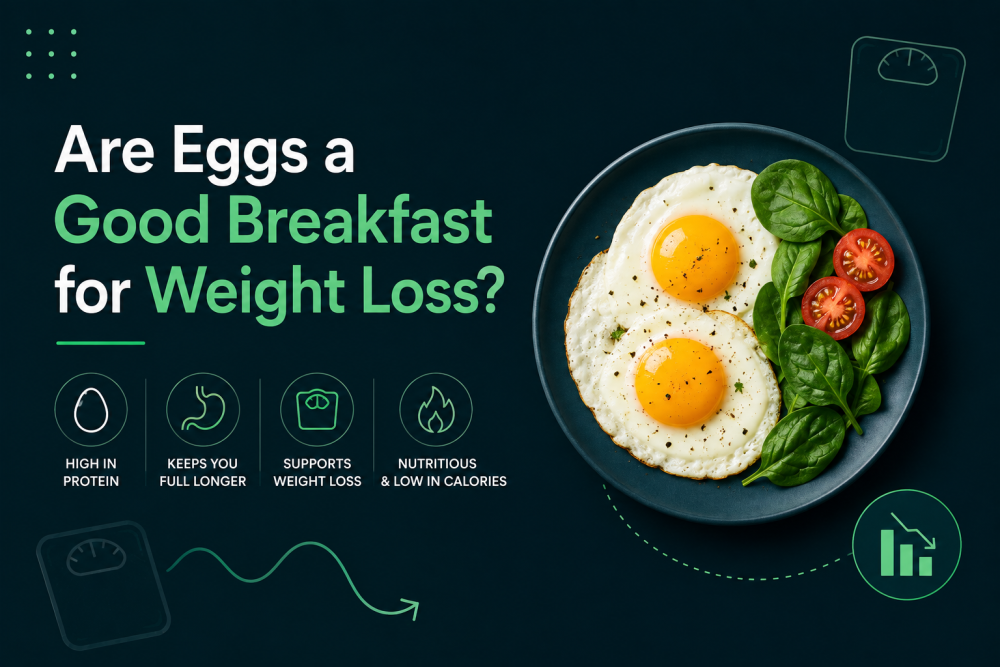
Eggs are possibly the most underrated weight loss breakfast tool in existence. The reason is simple: they're cheap, fast, shelf-stable, and protein-dense, and they hold you through to lunch better than almost anything else at the same calorie count. When you're trying to lose fat, the only real job breakfast has is to make you not hungry at ten in the morning. Eggs do that job better than most foods.
Good for weight loss needs actual numbers, not celebrity testimonials. So here's the honest breakdown: what eggs actually deliver in a breakfast context, the arithmetic of why they work, the honest exceptions (they're not magic, there are people and situations where they don't land), and the companion foods that make them sing.
This is specific to the fat loss angle. Our full breakfast guide covers the meal's timing and format questions. Our complete weight loss eating guide covers the protein anchors that make fat loss possible. This article owns the egg-specific piece for the fat loss goal.
The Numbers: What One Egg Actually Is
One large egg is roughly 70 calories. It carries 6 grams of protein, about a gram of carbs, which is negligible, and 5 grams of fat. The fat splits between saturated and unsaturated in a ratio that honestly isn't worth worrying about for breakfast purposes.
Three eggs land at roughly 210 calories total and 18 grams of protein. That's the standard breakfast anchor in our eating guides. That's the number that matters for fat loss. At that scale, eggs are directly competing against oatmeal bowls, which run 250 to 350 calories and deliver only 5 to 10 grams of protein. Granola runs over 400 calories easily for 8 to 10 grams of protein. Toast with spreads runs 200+ for 2 to 4 grams of protein.
The protein density is the actual differentiator. You get 6 grams of protein per 70 calories with eggs. Versus 2 grams per 100 calories in most grain breakfasts. That density is what makes you full until noon instead of hunting in the kitchen at ten in the morning.
And the research on satiety is consistent. Protein-forward breakfasts consistently outperform carb-forward breakfasts on the single metric that decides whether fat loss diets actually work. That metric is staying under your calorie targets without misery. Eggs sit at the high end of that ranking. They're rivaled only by Greek yogurt and thick legumes, both of which cost more or require more setup.
The Weight Loss Breakfast Template With Eggs
The shape comes from our breakfast guide filled with eggs. You need a protein anchor. That's three eggs, or two eggs plus extra-thick Greek yogurt. Then vegetables. Tomatoes, peppers, spinach, mushrooms, and onions. The cheap fresh stuff that adds volume and literally zero fat. Then optionally one slice of toast or a small portion of carbs if the day earned it, per the calorie guide's deficit math, and coffee or tea.
The total comes to roughly 250 to 320 calories depending on the vegetable and oil. Easily 18 to 22 grams of protein. The satiety that keeps you at your desk instead of negotiating with your hunger.
The actual variations matter because people like different things, and boring breakfast becomes abandoned breakfast. The scramble with peppers and onions and hot sauce works well. The frittata works if you have twenty minutes to cook once weekly. The veggie-loaded omelet works if you want to fold protein around vegetables. The boiled eggs with fresh fruit works if you want something cold. The poached eggs on toast work if the toast fits the day's numbers. The fried eggs with spinach works if you're cooking in oil that day. All land in the same caloric space.
The science part: the protein arrival in your bloodstream from eggs happens relatively slowly compared to fast carbs. That slow metabolization is literally what creates the hunger signal resistance. You're not full because your stomach is stretched. You're not hungry because your body is still metabolizing the protein from breakfast. That's why eggs beat carbs at the same calories. The breakfast is still working at ten am, while the toast breakfast is already metabolized and demanding more.
The departure from the template is instructive. The two-egg breakfast plus juice plus toast plus butter is a misallocation. 350 plus calories. Under 12 grams of protein. Hunger at 10 am. The day's deficit gets burned on a snack the template wouldn't have produced. Eggs work because they're the protein vehicle. They stop working when they're not the center of the meal. The companion foods are secondary. The eggs are primary.
The Exceptions: When Eggs Aren't the Answer
The honest list needs naming, and it's important because the exceptions are real even if they're not common. High cholesterol or the family history of it. Medical consensus says eggs don't worsen it for most people. The cholesterol myth is genuinely old. Eggs contain dietary cholesterol, but dietary cholesterol has weaker effects on blood cholesterol than saturated fat intake. Most aren't everyone. Conditions requiring monitoring belong with professionals. For the general case, eggs are fine and weight-loss effective. The protein and satiety are the relevant facts. If your doctor has told you to watch cholesterol specifically, ask them about eggs specifically rather than assuming based on internet articles.
Egg allergies obviously mean eggs aren't on the table. Severe egg allergies are legitimate medical issues. Mild sensitivities exist too where eggs cause minor digestion issues. That's worth noting and adjusting for individually.
Gallbladder conditions where high fat intake is sometimes contraindicated need professional guidance. The yolk carries fat. If you have gallbladder concerns, ask about egg whites specifically versus whole eggs. It's a real thing, not imaginary, and not all gallbladder conditions require avoiding eggs entirely.
Budget situations where a dozen eggs costs double the porridge oats per pound of protein and the math shifts. In genuinely poor situations, eggs might not be the cheapest play. Dried beans or oats might work better. That's a real constraint, and it matters. The guidance changes when the price difference is significant.
Genuine disgust at eggs. Some people are revolted by them. The texture bothers them. The taste is wrong to them. The sulfur smell turns them off. No breakfast principle is worth forcing. Find the protein anchor you actually like rather than choking down something repulsive.
And the breakfast skipper whose body simply doesn't hunger before eleven am. The template still works as a 10 am snack or nine pm dinner. But forcing it as breakfast costs discipline, where the goal was saving discipline. That's a valid exception too.
For everyone else, eggs are the play. The exceptions are genuinely the exceptions, not the rule.
Cooking Methods and the Calorie Line
Boiled or poached stays at roughly 70 calories per egg. Done. Scrambled with a splash of milk still runs 70 to 75 per egg. Fried in oil or butter, it hits 100 to 120 per egg. The added fat is real, and calories are the game. Baked, scrambled without added fat, any preparation without added oil stays honest. The distinction matters. Three fried eggs with butter are 330-plus calories before the bread. Three boiled eggs are 210. Same satiety. Massively different calorie budget.
Pick your cooking method by the deficit you're running, not by tradition. And the seasoning, which is the free move. Salt, pepper, hot sauce, vinegar, garlic, and fresh herbs. Everything that makes food actually delicious costs nothing and adds nothing to the calorie line. The "eggs taste boring" complaint is almost always the "eggs cooked plain" problem solved by spice.
The Companion Pattern That Works
Eggs alone at breakfast is fine. Eggs plus thick vegetables is the template that actually matters. Eggs plus vegetables plus one fruit is the upgrade for the training day breakfast. Eggs plus vegetables plus carbs plus tiny pinch of added fat is the weekend brunch version, slightly higher calorie, still protein anchored. The pattern across all of them: protein first, vegetables second, carbs third or absent, and added fat last and small.
That stacking order is what our eating guide's whole architecture runs on. Eggs fit it perfectly. They're genuinely breakfast specialists. They're less efficient as an afternoon snack, where bulk food satiety matters less than a compact protein hit. Breakfast is their role. Use them there.
Why Eggs Work Better Than The Alternatives
The honest comparison requires looking at every protein-forward breakfast option available. Greek yogurt works. It has the same protein per calorie ratio as eggs. But yogurt costs roughly double the price per pound of protein. Cottage cheese works similarly. It's cheaper than yogurt but less convenient because fewer people keep it stocked and fewer restaurants serve it. That convenience matters when breakfast needs to be fast and reliable.
Lean meat works. Chicken breast, turkey, and lean beef. All have higher protein density than eggs. But they require actual cooking time, more planning, and slightly higher cost. Eggs cook in five minutes. Eggs require no thawing. Eggs can be stored in any temperature-controlled space for three weeks. Ground turkey requires planning, thawing, cooking, and cleanup. The friction difference is real, and friction matters for consistency.
Protein powder works, and it's compact and portable. But powder tastes like powder even in the best versions. It triggers less satiety than actual food because your brain doesn't register it as food the same way. Satiety is about actual meal texture and the ritual of eating actual food. Powder fails at that, and you end up hungry an hour later despite the calorie match.
Tofu works if you genuinely like it. Most people don't like tofu at breakfast. It's culturally native to countries that eat it at all times of day. In Western contexts it's a lunch protein. Breakfast tofu feels wrong to most people even if the macronutrients work.
Cheese works. It's higher calorie than eggs, but the fat drives satiety. The problem is the price point. Cheese costs more than eggs per ounce of protein. The entire advantage of eggs evaporates.
Legumes work. Beans are cheap and protein-rich. But the quantity required to hit 18 grams of protein at breakfast is large enough to be uncomfortable. You're eating a bowl of beans, not a simple breakfast. That's a legitimate meal. It works. It's less convenient than eggs.
Eggs win on the combination of factors. Cost is low. Shelf life is long. Cooking time is five minutes. Protein density is high. Satiety is exceptional. Taste is neutral enough that seasoning works powerfully. They cook easily with minimal skill. They're portable if you need to eat at work. They require no special equipment. They work in any kitchen anywhere.
That combination is why eggs show up in fat loss guides repeatedly. Not because there's something magic about eggs themselves. But because the practical reality is that they hit all the boxes that matter for breakfast in a fat-loss context.
The Real-World Gotcha: Breakfast Skipping
The honest thing nobody talks about: some people lose weight faster by skipping breakfast entirely. They're not hungry in the morning. Forcing eggs into their system means eating when not hungry, which defeats the purpose of listening to hunger signals. The eggs template is for people who are hungry at breakfast and need something that won't turn into hunger again at ten am.
If you're not hungry at breakfast, don't eat. The template is optional. It's not mandatory. It's just incredibly effective for the people who need it, which is most people trying to lose fat.
The Bottom Line
Are eggs good for weight loss? Yes, to the numbers that matter. Eighteen to 22 grams of protein per breakfast. Satiety that holds until lunch. A calorie profile that doesn't eat the whole deficit before ten a.m.. Three eggs plus vegetables is the template. The cooking method controls the calorie line. Boiled or poached at 70 each. Fried at 100+. The exceptions are genuine but rare enough that they're exceptions, not the rule. For the cost, shelf stability, protein density, and satiety per calorie, eggs are among the highest-return breakfast tools available at any price point.
The weight loss math from our complete fat loss eating guide runs on exactly this protein anchor applied to every meal and builds the daily total that decides whether the week moved the scale. Eggs at breakfast are the easiest first step. Once the breakfast plays, the lunch and dinner slots follow the same pattern. That's where the compound effects begin, and that's where fat loss becomes possible.
FAQs: Eggs and Weight Loss
How many eggs should I eat for a weight loss breakfast?
Three eggs as the standard anchor land around 210 to 240 calories depending on the cooking method with 18 grams of protein, which holds until lunch without hunger hijacking the afternoon. Two eggs plus Greek yogurt is the lighter version if three feels too much. Four eggs is the heavier version for training day breakfasts. The protein total matters more than the egg count. The anchor is to hit 18 to 20 grams of protein per breakfast per our eating guide.
Are fried eggs bad for weight loss?
Not inherently, but the cooking method adds calories. Boiled or poached stay at 70 per egg. Fried in butter or oil hits 100 to 120°F. That matters at a deficit. Three fried eggs is 330 calories before anything else. Three bowls are 210. Same food, different budget. Pick the method your deficit allows, not the method you prefer. Add fats deliberately, not by default.
Can I lose weight eating eggs every day for breakfast?
Yes, and most people in fat loss do exactly that. Eggs are the rotating default breakfast across our eating guides for this exact reason. Cheap, fast, protein-dense, reliably satisfying. The variation comes from the vegetables and carbs, not the eggs themselves. Rotation in companions keeps the meal fresh without changing the anchor.
Do eggs raise cholesterol and hurt weight loss?
The cholesterol myth is old and mostly debunked. Eggs don't worsen cholesterol for most people. Most aren't everyone. Conditions requiring monitoring belong with professionals. For the general case, eggs are fine and weight-loss effective. The protein and satiety are the relevant facts, not the fat content of the yolk.
What should I eat with eggs for weight loss?
Vegetables first. Tomatoes, peppers, spinach, mushrooms, and onions. The volume foods that add fullness for near-zero calories. Then per the day's deficit math, a starch if it fits. Toast, potatoes, and rice in small portions. Then optionally fruit if the breakfast is a training day breakfast and carbs have earned their space. The pattern is protein, volume, carbs, always in that order.
Can I eat eggs at other meals for weight loss or just breakfast?
Breakfast is where eggs shine because satiety durability matters most. Lunch and dinner hit different needs. Eggs at lunch work fine. At dinner they're adequate but not the highest-return protein source. As a snack, they're overkill. The satiety machinery is wasted. They're breakfast specialists. Deploy them there.