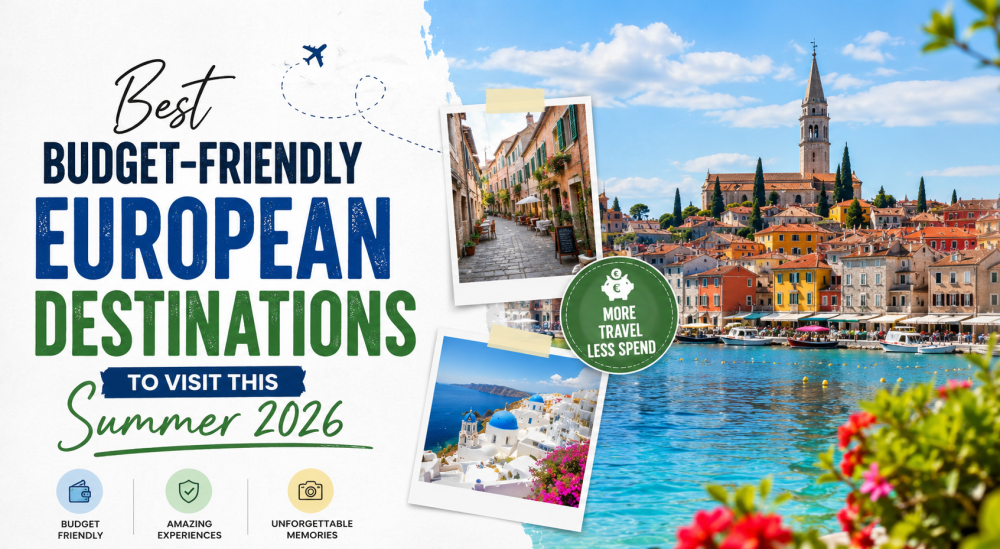
Every summer, the same conversation plays out in group chats and office break rooms across the world: everyone wants to go to Europe, but nobody wants to check their bank account afterward. The thing is, Europe's reputation as an expensive destination is only partially deserved. Yes, a week in Zurich or a long weekend in Paris can drain your budget faster than you'd expect. But Europe is big—and wildly varied. There are corners of it where you can eat well, sleep comfortably, explore seriously interesting cities, and still come home with money left over.
Summer 2026 is shaping up to be a bumper travel year. The FIFA World Cup hosted across North America has actually worked in European travellers' favour—many transatlantic tourists are routing elsewhere, which means some classic European hotspots are marginally quieter. Combine that with a handful of lesser-known destinations that have been slowly building their tourism infrastructure, and you've got a genuinely good moment to plan something smart.
What follows is not a list of places to visit on a shoestring while eating instant noodles in a hostel dorm. These are real destinations where the food is good, the culture is rich, and the cost of doing things properly is just... lower than elsewhere. That's a different thing entirely.
Porto, Portugal — Western Europe's Best Value City
Porto has been on travellers' radar for a while now, but it still hasn't fully crossed over into mainstream tourist overload the way Lisbon has. That gap is closing—so if you've been sitting on the idea of visiting, this summer is the time.
The city sits on the Douro River in northwest Portugal, and it's legitimately beautiful in a slightly crumbling, charismatic way. Azulejo-tiled buildings, narrow streets, port wine caves across the river in Vila Nova de Gaia, and a food scene that punches well above its price point. A francesinha—Porto's absurdly indulgent layered meat sandwich smothered in a beer-and-tomato sauce—costs around €8–10 at a proper local café. A glass of decent port wine can be €2. A full dinner for two at a good restaurant, with wine, rarely hits €40.
Accommodation is where you save the most compared to other western European cities. Mid-range hotels in the historic centre run €60–90 per night in summer. Flights from most European hubs are cheap, and budget carriers like Ryanair and easyJet serve Porto regularly from the UK and across the continent.
What makes Porto stand out beyond the budget angle is its personality. It doesn't feel like a city performing for tourists. The neighbourhoods—Bonfim, Cedofeita, Foz do Douro—each have their own character. You can spend a day doing nothing but walking and eating and drinking and come away feeling like you actually experienced something.
What to Budget: €60–80/day for a comfortable, full experience
Kraków, Poland — History, Architecture, and Excellent Pierogi
Poland is probably the single best value country in Europe for travellers from the UK, western Europe, or North America. And within Poland, Kraków is the destination that earns the most consistent praise. The Old Town is a UNESCO World Heritage Site, the castle is genuinely impressive, and the city has a student population of nearly 200,000 that keeps its food and nightlife scene lively year-round.
Eating in Kraków is an exercise in pleasant disbelief. A full sit-down lunch—soup, main course, drink—at a milk bar (bar mleczny) runs about 25–35 Polish złoty, which is roughly €6. Even at the nicer restaurants around the Rynek Główny, you're looking at €15–25 per head for a proper meal. Beer at a bar is typically €1.50–2.50. These aren't tourist traps—these are just everyday prices.
The city is also one of the best-preserved medieval city centres in all of Europe, which is no small thing. Because it was largely unharmed during World War II, Kraków gives you a sense of what pre-war Central Europe looked like that cities like Warsaw, which had to be completely rebuilt, simply can't offer.
One thing worth knowing: Kraków gets genuinely warm in July and August—often over 30°C—and the Old Town can feel crowded midday. The trick is to start your days early, retreat for a long lunch and an afternoon rest, and come back out in the evening when it cools down and the square takes on a totally different atmosphere. It's the kind of city that rewards slow travel.
Day trips from Kraków are also exceptional. Auschwitz-Birkenau is about 70 kilometres away and is, obviously, a sobering but important visit. The Wieliczka Salt Mine—where miners carved entire chapels underground over centuries—is about 14 kilometres from the city centre and one of the more genuinely unusual things you can do in Europe.
What to Budget: €40–60/day, including accommodation at a decent hotel
Albania — Europe's Most Underrated Coastal Destination
Albania is having a moment, and for good reason. It spent decades largely closed off from the rest of Europe, and that isolation left it with a coastline, a mountain interior, and a culture that feels distinct in a way that's increasingly rare as European cities blur together. The Albanian Riviera—the stretch of coast between Vlorë and Sarandë—has clear water that rivals anything in Greece, at a fraction of the price.
To give you a concrete example: a couple who spent two weeks in the Riviera in summer 2025 reported spending around €55 per day total—covering a private room at a well-reviewed guesthouse, three meals a day including fresh fish, local wine, and all transportation. That's not backpacker-mode; that's genuinely comfortable travel.
Sarandë is the main hub and has grown quickly as a tourist town—it's got a decent café scene and easy ferry access to Corfu (Greece) if you want to do a combination trip. Himara is quieter and feels more authentically Albanian. The village of Dhërmi, perched above a beautiful bay, is where a lot of independent travellers end up spending more time than they planned.
Inland, Berat and Gjirokastër are UNESCO-listed 'museum cities' with Ottoman-era architecture and a genuinely friendly local population that hasn't yet grown weary of tourist questions. The national parks in the north—Valbona, Theth—are increasingly popular with hikers and offer some of the most dramatic mountain scenery in the Balkans.
The main trade-off is infrastructure. Roads can be rough. English is less widely spoken outside tourist areas. Some guesthouses take cash only. None of this is a dealbreaker—it's just worth knowing before you arrive so it doesn't become a frustration.
What to Budget: €35–55/day, or €50–70 in more developed coastal towns
Tbilisi, Georgia — Technically Europe, Completely Unique
Georgia sits at the crossroads of Europe and Asia, and Tbilisi—its capital—reflects exactly that. The old town is a genuinely beautiful tangle of carved wooden balconies, sulphur bathhouses, and Orthodox churches, backed by a fortress hill that looks like something from a fantasy novel. The wine is natural, the food is excellent, and the hospitality is the kind that can occasionally feel overwhelming because it's so sincere.
Georgian cuisine alone is worth the trip. Khinkali—juicy dumplings that you eat by biting the top and drinking the broth—are €0.40–0.60 each. Khachapuri, the cheese bread that comes in various regional forms (the Adjarian version, with an egg and butter on top, is spectacular), costs €3–5. A bottle of local natural wine at a restaurant might be €8–12. Dinner for two at a proper restaurant, well fed and with wine, rarely exceeds €25.
The flight situation has improved significantly—direct flights from several European cities operate regularly, and prices are generally reasonable. Once you're there, getting around is cheap. The metro in Tbilisi costs about 50 tetri (roughly €0.17) per journey.
Outside the capital, the country rewards exploration. The wine region of Kakheti is a few hours east. The mountain village of Kazbegi—with the famous Gergeti Trinity Church set against the Greater Caucasus mountains—is one of the most photogenic spots in the entire region. The Black Sea coast at Batumi is a resort city that feels like a slightly surreal mix of European beach town and Soviet modernism, which is its own kind of interesting.
One note for summer travellers: Tbilisi gets hot. Very hot. July can hit 38–40°C. The mountains are cooler and many locals actually escape there in midsummer. It's worth planning around this rather than fighting it.
What to Budget: €35–55/day, including comfortable mid-range accommodation
Sofia, Bulgaria — The Underdog Capital That's Been Quietly Getting Good
Sofia doesn't have the postcard beauty of Kraków or the dramatic setting of Tbilisi. It's a working Balkan capital that was heavily rebuilt under communist rule and still has some of that architectural legacy to deal with. But it has three things going for it that matter: it's genuinely cheap, it's improving fast, and it's starting point for some excellent day trips.
The city has developed a real café and food scene over the last several years. The area around Vitosha Boulevard and the streets around the National Palace of Culture have turned into a stretch of wine bars, specialty coffee shops, and restaurants serving everything from traditional Bulgarian cuisine to modern European cooking. A three-course meal at a good local restaurant costs €12–18 per person. A craft beer is typically €2–3.
Sofia's free walking tour—one of the better ones in Europe—covers the main sights well and gives you context for the city's layered history: Thracian, Roman, Byzantine, Ottoman, and Soviet all left marks. The Alexander Nevsky Cathedral is properly impressive. Vitosha Mountain, which you can see from almost anywhere in the city, can be hiked from a bus stop within the city limits—that kind of accessibility to nature is unusual for a capital city.
The real draw for using Sofia as a base is Plovdiv—Bulgaria's second city, with a gorgeous old town, a thriving arts scene, and arguably more charm than Sofia itself. It's 130 kilometres away and reachable by bus or train in about two hours for €3–5. Rila Monastery, one of the finest examples of Bulgarian National Revival architecture and a UNESCO site, is about 120 kilometres south and easily done as a day trip.
What to Budget: €40–60/day, with good-quality accommodation at €30–50/night
Kotor, Montenegro — Adriatic Views Without the Croatian Price Tag
Montenegro is one of those countries that surprises people. It's tiny—smaller than Connecticut—but it packs in a dramatic bay, a walled medieval city, mountains that rise steeply behind the coast, and a general sense that it hasn't quite figured out it's supposed to be expensive yet.
Kotor's old town is genuinely lovely. It's walled, car-free, and hugs the edge of the Bay of Kotor—which is technically a fjord-like inlet, not a bay, and is one of the most dramatic coastal landscapes in Europe. The town fills up in peak summer, particularly with cruise ships, so mornings and evenings are when you want to be in the old town. The hike up to St. John's Fortress above the city takes 30–40 minutes and gives you a view that's worth every sweaty step.
Montenegro uses the euro despite not being in the EU, so there's no currency confusion. Food prices are noticeably lower than across the border in Croatia. A grilled fish dinner at a good restaurant overlooking the bay costs €12–18. Local wine is cheap and better than its reputation suggests.
Getting there requires a little more planning than some destinations—Tivat has an airport (Podgorica is the main hub), and bus connections from Dubrovnik are frequent if you're combining the two. Which, honestly, is a great option if your budget allows: do Kotor and the Bay properly, then cross into Croatia for the end of the trip.
What to Budget: €55–80/day depending on whether you're staying in Kotor itself or nearby
A Few Things That Actually Make the Budget Difference
Across all of these destinations, a few things consistently separate travellers who come home pleasantly surprised from those who overspend.
Eat where locals eat, not where the signs are in five languages. Every city on this list has a tourist dining belt where prices are inflated and quality often isn't. Walking one or two streets back from the main square routinely halves your restaurant bill.
Book accommodation early, but check refund policies. Summer 2026 is busy. Mid-July through August is the peak of peak season in most European destinations. Properties that were bookable last-minute in previous years are filling up faster now. That said, the weather in June and early September is often just as good—or better—with smaller crowds and lower prices. If your schedule has any flexibility, use it.
Use the train and bus network. Renting a car in European cities is usually more expensive and more stressful than it's worth. Intercity buses in the Balkans and Eastern Europe are cheap, reasonably comfortable, and go everywhere. In Portugal, the train system is reliable and affordable. Save the car rental for if you're going deep into the Albanian mountains or exploring the Georgian countryside—places where it genuinely makes sense.
Don't underestimate the free stuff. The walking tours, the public parks, the beaches, the markets, the architecture you see just by walking around—these are often the best parts of a trip and cost nothing. Budget destinations on this list are not budget because they're lacking. They're budget because the cost of living is lower. That means the free things are just as good.
Where to Actually Go
If you want western Europe with great food and manageable costs: Porto. If you want a city break with history and near-zero food costs: Kraków. If you want beaches and sun without Greek island prices: Albania. If you want something genuinely different from anything else on this list: Tbilisi. If you want a reliable, improving city with excellent day trip options: Sofia. If you want dramatic Adriatic scenery at a discount: Kotor.
None of these destinations require you to rough it. They don't require you to stay somewhere uncomfortable or eat food you don't enjoy. They just require choosing somewhere that hasn't priced itself out of reach—and there are more of those places in Europe than most people think.
Summer 2026 is a real opportunity to travel well without the financial hangover that follows a lot of European holidays. The destinations above have earned their places on this list not because they're cheap alternatives, but because they're genuinely good. The price is just a bonus.