A guy I used to work with spent years talking about "the idea"—the one big thing that would let him quit his job. He never started anything, because nothing ever felt big enough. Meanwhile, his sister started selling handmade candles from her kitchen table, mostly as a hobby. Three years later, she's running it as a real business with wholesale accounts at two local shops. She never had "the idea." She just started with what she had.
That's really the theme running through 2026's best low-investment business opportunities. None of them are revolutionary. What's changed is how cheap and fast it's become to test something small, see if people actually want it, and grow from there—without needing a business loan or a wealthy uncle.
This isn't a list of "side hustles that'll make you rich by Friday." It's a practical look at businesses real people are running on shoestring budgets, what they actually cost to start, and what it really takes to make them work.
What "Minimal Investment" Really Means in 2026
Let's get something straight before diving in: minimal investment doesn't mean minimal commitment. Most things on this list can be started for a few hundred dollars or less. None of them can be started with zero time, zero learning, or zero patience.
The good news is that the financial risk is genuinely low. If freelance graphic design doesn't work out after three months, you're out maybe $200 in software subscriptions and some unpaid hours—not a mortgaged house. That changes the entire equation. You can afford to try, fail quietly, adjust, and try again. That's the real advantage of starting small.
1. Service-Based Freelancing (Still the Most Reliable Starting Point)
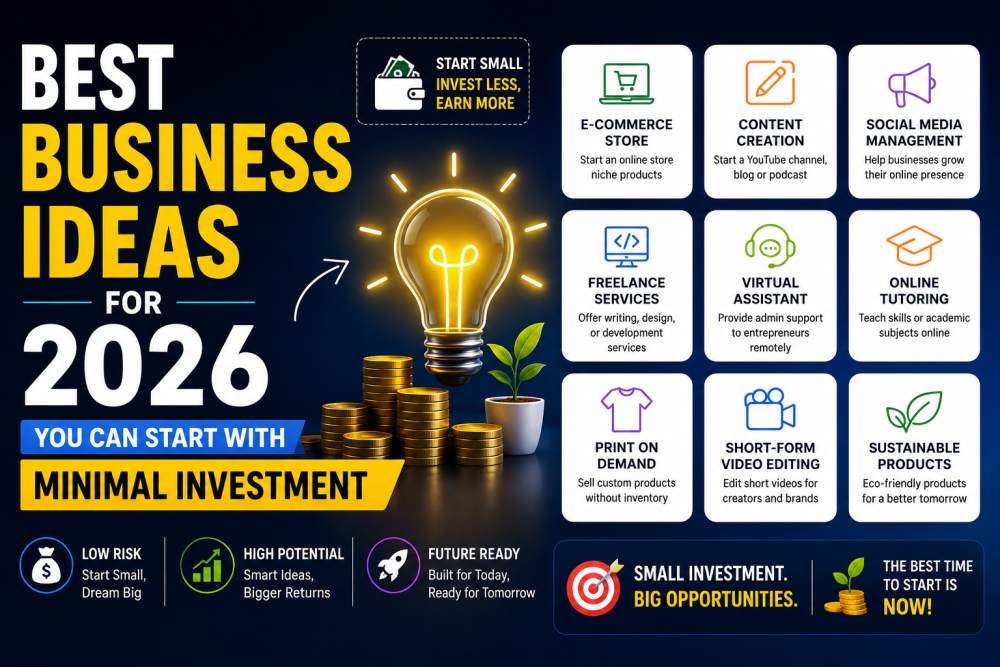
If you have a skill someone would pay for—writing, design, video editing, virtual assistance, social media management, bookkeeping—freelancing remains the lowest-barrier way to start earning.
What it costs: Realistically $0–$150. A laptop you already own, maybe a paid tool subscription (Canva Pro, an accounting app, etc.).
What's different in 2026: There's a lot of noise about AI replacing freelancers, and in some narrow tasks, that's true. But it's also created a strange new demand: businesses need people who can take AI-generated drafts and turn them into something that doesn't sound like AI wrote it—adding voice, accuracy, and judgment. A freelance writer who's good at editing and fact-checking AI output, on top of writing from scratch, is arguably more employable now than three years ago, not less.
Where people go wrong: They wait until they feel "ready" or "expert enough." Honestly, most freelancers I know got their first clients before they felt qualified, and the qualification came from doing the work, not before it. Set up a simple portfolio—even three sample projects you create for yourself—and start reaching out.
2. Mobile and On-Demand Services
This category covers things like mobile car detailing, dog walking, house cleaning, handyman work, and pressure washing. It's not glamorous, and it won't make for an exciting answer at a dinner party. But it's consistently one of the most dependable ways to generate real income with very little upfront cost.
What it costs: Varies—dog walking can start at literally $0 (just a phone and good shoes), while mobile detailing might need $300–$500 for basic supplies before you scale up to better equipment.
A scenario worth thinking about: Picture someone who works a 9-to-5 but has Saturday mornings free. They start offering driveway and patio pressure washing in their neighborhood—just posting in a local Facebook group with before-and-after photos. The first few jobs are basically word-of-mouth. Within a few months, they're booked most Saturdays, charging $100–$200 per job, with maybe $40 in costs (water, fuel, occasional equipment maintenance). That's not life-changing money on its own, but it's a legitimate $400–$800 extra a month for a few hours of weekend work—and some people scale it into something much bigger from there.
The honest part: Local services live and die on reliability and communication. Show up when you say you will, respond to messages promptly, and do decent work—and you'll outperform a surprising number of competitors who don't bother with the basics.
3. Niche E-commerce Through Print-on-Demand or Dropshipping
Print-on-demand (POD) lets you design products—apparel, mugs, posters, phone cases—that get printed and shipped only when someone orders. Dropshipping is similar but covers a broader range of physical products sourced from suppliers who ship directly to customers.
What it costs: Often $0 to start. Shopify runs about $29/month if you want your own storefront, though Etsy integration with POD tools can avoid even that initial cost.
The key insight people miss: Broad appeal is actually a disadvantage here. A generic "motivational quote" shirt competes against an enormous amount of similar content. But a design that speaks to, say, people who restore vintage motorcycles, or competitive birdwatchers, or amateur beekeepers—that's a small market, but it's a market with almost no competition and customers who feel like the product was made specifically for them.
The catch nobody mentions: Margins per item are usually thin—often $5–$15 profit per sale after printing and shipping costs. You need either consistent sales volume or higher-ticket items (framed prints, premium apparel) to make this meaningful. It's also genuinely competitive to get noticed, even in niches, so some marketing effort—even just consistent social posting—matters.
4. Tutoring and Skill-Based Coaching
This one's been around forever, but 2026 has made it more accessible than ever. Online tutoring platforms, video call tools, and a generally more "remote-comfortable" world mean you can teach almost anything to almost anyone, anywhere.
What it costs: Close to nothing if you're using free video call tools and word-of-mouth or social media to find students.
What works best: Specific, in-demand skills tend to outperform general subjects. Math tutoring is reliably in demand, but so is teaching specific software (Excel, Photoshop, and coding basics), test prep for standardized exams, language conversation practice, or even niche skills like resume writing and interview coaching.
Something worth noting: Coaching and tutoring businesses often grow through referrals more than any marketing. One happy parent or client telling two friends does more than most paid ads at this scale. That means your first handful of clients matter disproportionately—treat them well, even if the pay is modest at first.
5. Content Creation With an Actual Business Behind It
Saying "start a YouTube channel" as business advice has become almost meaningless because so few creators ever turn views into income. But content creation paired with a clear underlying business is a different story entirely.
What it costs: A smartphone is genuinely enough to start. No fancy camera, no studio, no editing software beyond free options like CapCut.
A relatable example: Say someone runs a small bakery. Instead of just posting photos of finished cakes (which everyone does), they start filming short videos of mistakes—a cake that collapsed, a frosting technique that went wrong, how they fixed it. People are drawn to authenticity and process, not just polished results. Over time, this builds a local following that translates into actual orders, plus occasional brand partnerships with local suppliers once the following is large enough.
The realistic timeline: This is slow. Most people see little to no traction for the first several months, and that's normal—it's also exactly when most people quit. If you're treating content as a marketing channel for something else (rather than the whole business), the pressure is lower and the patience required is easier to sustain.
6. Reselling, Sourcing, and Flipping
Buying low and selling higher isn't new, but apps and marketplaces have made it dramatically more efficient. Thrift stores, garage sales, clearance racks, and online marketplaces are full of items priced below what they're worth to the right buyer.
What it costs: As little as $50–$100 to get started with your first batch of inventory.
What's changed: Barcode scanner apps let you instantly check resale values on certain categories—electronics, books, and toys—turning what used to require deep expertise into something a beginner can do reasonably well from day one.
The catch: This is genuinely time-intensive. Sourcing, cleaning, photographing, listing, packing, shipping—it adds up to real hours. People who do well here usually specialize. A person who becomes genuinely knowledgeable about, say, vintage cameras or specific sneaker brands develops an edge that's hard for casual resellers to match, because they know what's actually valuable and what just looks valuable.
7. Selling Digital Products From What You Already Know
If you've solved a specific problem for yourself, there's a decent chance other people have the same problem and would pay for a shortcut.
What it costs: Essentially $0. Platforms like Gumroad or Etsy take a small cut of sales but charge nothing upfront.
What this actually looks like: It's rarely a big flashy course. More often it's something small and specific—a spreadsheet template for tracking freelance income and estimated taxes, a guide to negotiating rent in a specific city, or a Notion dashboard for planning a wedding on a budget. The smaller and more specific the problem, the more likely someone searching for a solution finds exactly what they need and feels like it was made for them.
The real challenge: Making the product is often the easy part. Getting it in front of people who'd actually want it is harder and usually means you need some existing audience—even a small one—or a plan to build one alongside the product.
How to Pick One Without Overthinking It
Here's a filter that's more useful than "what's most profitable": what do you already have access to?
If you have a marketable skill, freelancing is the fastest path to your first dollar. If you have a few spare hours and reliable transportation, local services are remarkably forgiving for beginners—low barrier, immediate demand. If you've already solved a problem for yourself in a specific, niche way, a digital product might be sitting right there, half-finished, in your own notes or spreadsheets.
The mistake I see most often is choosing based on what sounds impressive to other people rather than what actually fits your week. Someone working full-time with two young kids isn't going to sustain a daily content schedule, no matter how good the idea is. But they might genuinely manage two tutoring sessions a week after the kids go to bed, and that's a completely real, sustainable starting point.
A Few Practical Things Worth Knowing Upfront
Track your income from day one, even if it's small. Once you're earning anything beyond a hobby amount, taxes apply. Setting aside roughly a quarter of your earnings and keeping basic records saves a massive headache later.
Your pricing will probably be too low at first. Almost everyone underprices their first offers out of nervousness. It's worth looking at what others charge and adjusting—even if it feels uncomfortable to ask for more.
The "boring" version usually wins. The flashiest idea isn't usually the one that sticks. The business that gets built quietly and consistently over months, while everyone else is chasing the next trend—that's the one still standing a year later.
Expect the first few months to feel like nothing's happening. This is normal, not a sign of failure. Almost every low-investment business has a quiet runway period before momentum builds. The people who make it through usually aren't the most talented—they're the ones who kept showing up during the unremarkable middle stretch.
Final Thoughts
There's no single "best" business idea for 2026, despite what headlines like this one might suggest. The honest answer is that the best idea is the one that matches your actual skills, your actual schedule, and your actual tolerance for risk and slow progress.
What's genuinely true about this moment is that the cost of testing an idea has never been lower. You can start something on a weekend, with money you wouldn't miss if it didn't work out, and learn more in a month of doing than in a year of planning. That guy who never started his "big idea"? He's still talking about it. His sister, who just started selling candles because she liked making them, built something real—not because her idea was better, but because she actually began.
Pick something from this list that fits where you are right now. Start smaller than feels impressive. Give it the months it actually needs. That's not flashy advice, but it's the kind that tends to be true.