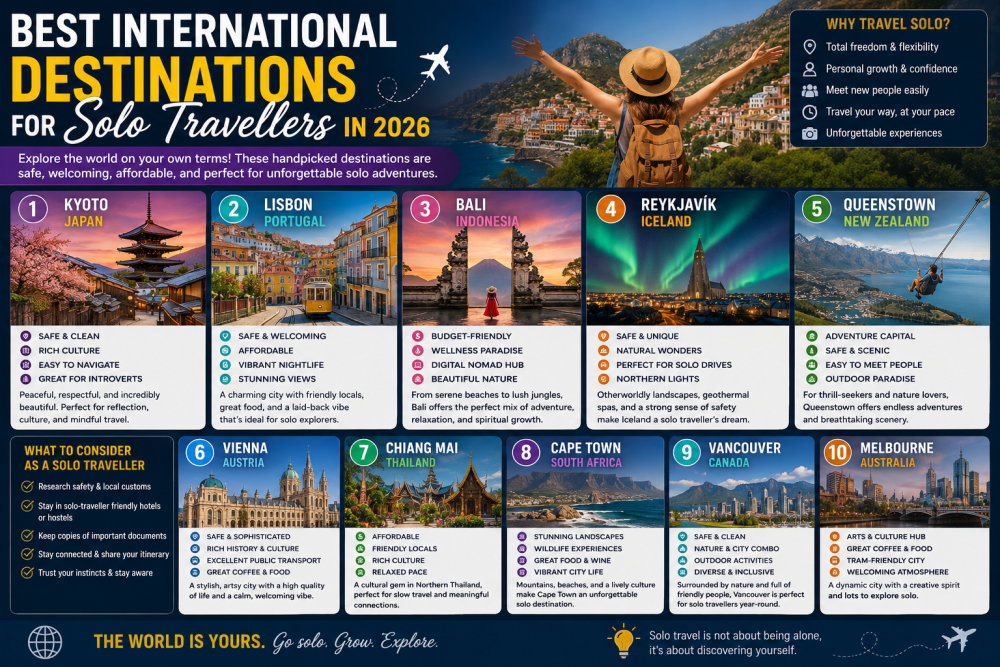
Solo travel has gone from slightly unusual to genuinely mainstream. In 2026, single travelers outnumber traditional tourist groups in most major cities, according to destination data from multiple hospitality sources. The infrastructure exists, the community exists, and the fear of going somewhere alone has quietly faded for a large portion of the traveling public.
The three things that still matter most when choosing a solo destination — particularly for first-timers — are safety, cost, and how easy the place is to actually navigate on your own. Beautiful and interesting isn't enough if getting between places is confusing, if you feel unsafe walking around at night, or if the costs add up faster than your budget allows.
Here's an honest country-by-country breakdown of where to go this year. These aren't just safe — they're destinations where being alone is either culturally normal, practically easy, or actively great.
Japan: The Global Standard for Solo Travel
There's a reason Japan appears at or near the top of every credible solo travel list. It's not just safety, though crime is virtually nonexistent by international standards. It's the entire ecosystem around going somewhere alone.
Solo dining is built into Japanese culture. You'll find ramen shops with individual booths and counter stools designed specifically for one person eating without feeling awkward about it. Convenience stores provide high-quality, affordable meals at any hour. Capsule hotels were invented here and remain excellent value—clean, private, and well-located in city centers. Business hotels at modest price points are everywhere and specifically designed for lone travelers.
Public transport is the best argument for solo travel in Japan that nobody mentions loudly enough. The train system is not just punctual — it's comprehensively logical. IC cards (Suica, Pasmo) work across the entire country. Navigation apps guide you to the right platform, the right exit, and the right direction without requiring Japanese language knowledge. Most signage in major cities and tourist areas is in English, Korean, Chinese, and Japanese.
Tokyo is the obvious base. But the real discovery for solo travelers who've already done Tokyo is the regional networks—Kyoto for traditional culture; Osaka for food and nightlife; Hiroshima and Miyajima for the emotional and historical depth that makes Japan more than just aesthetics; and the increasingly accessible rural north (Tohoku, Hokkaido) for landscape and quiet.
Budget estimate for 7–10 days: $1,000–$2,500 depending on accommodation and pace. Budget hostels, convenience store meals, and rail passes at the lower end; business hotels, restaurant dining, and bullet train access at the upper end.
Portugal: The European Solo Travel Sweet Spot
Portugal sits in a particular sweet spot that's hard to replicate elsewhere in Western Europe: genuinely affordable for European and North American travelers, consistently ranked as safe for solo visitors, including women; walkable cities that don't require car hire or complex transport navigation; and a cultural environment where solo travel is comfortable rather than conspicuous.
Lisbon is the obvious anchor. The tram network, the hills, the waterfront, the neighborhood variety—Alfama's traditional fado culture, Bairro Alto's nightlife, Belém's monuments—make it rich for days of solo exploration. Meals from sit-down restaurants in non-tourist areas frequently run $10–15 USD. Hostels in central neighborhoods average $25–35 per night for a bed. Mid-range hotels are $80–120 per night in comfortable central areas.
Porto—about three hours north by train—is Porto Lisbon's counterpart, and many experienced travelers prefer it. Less polished, more authentic, cheaper. The Douro River valley, wine culture, and the combination of historic architecture with a genuinely local neighborhood feel make it excellent for four or five days.
Smaller towns extend the value: Óbidos is a medieval walled village that takes half a day and costs almost nothing to explore. Coimbra has a functioning medieval university and a café culture worth settling into for a few days. The Algarve coast offers beach solitude in the off-season and crowded beach towns in July and August—time your visit based on what you want.
Solo female travelers consistently rate Portugal as one of Europe's most comfortable destinations. Locals are known for their hospitality, and the social atmosphere in hostels and guesthouses makes it easy to meet people without trying very hard.
Japan vs. Portugal: Which One for First-Time Solo Travelers?
Both are excellent. Japan is more logistically seamless; Portugal is more spontaneous and significantly cheaper. If the budget is the primary constraint, Portugal. If you want the most structured, low-stress introduction to solo international travel, choose Japan.
Iceland: Small, Safe, and Unforgettable
Iceland has ranked as the world's safest country for 15 consecutive years. Reykjavík is small — about 130,000 people in the capital area — and easy to navigate alone. English is spoken everywhere without exception. The crime rate is among the lowest on earth.
The trade-off is cost. Iceland is genuinely expensive. Accommodation, food, and car hire (essential for accessing the Ring Road and most natural attractions) all run significantly higher than European continental equivalents. A week in Iceland at a comfortable but not luxurious level will cost $2,500–4,000 all in, depending on season.
What you get for that is singular. The landscape — volcanic, glacial, geothermal, and dramatic — exists nowhere else in the Northern Hemisphere. The Northern Lights in winter, the midnight sun in summer, waterfalls, hot springs, and lava fields are accessible without technical equipment. Summer 2026 offers 20+ hours of daylight and milder temperatures. It's the time of year when everything is accessible and the country is at its most dramatic.
Solo travelers without a car can access Reykjavík easily and join day tours to the Golden Circle, South Coast, and Blue Lagoon without driving themselves. The tours attract a genuinely international mix of solo travelers, so social interaction happens naturally.
Thailand (Chiang Mai and Bangkok): The Budget Solo Standard
Bangkok has been the unofficial capital of solo travel for thirty years, and in 2026 it still holds that position. The hostel and budget hotel infrastructure is better developed here than almost anywhere on earth—every neighborhood, every price point, and every style of accommodation is covered with strong review histories to guide choices. Sky train and subway navigation is straightforward and English-signposted. Street food from $1.50 provides genuinely excellent meals. A daily budget of $30–50 covers accommodation, food, transport, and activities comfortably.
Chiang Mai, in northern Thailand, is the city digital nomads and long-term travelers keep returning to. Slower, cooler, cheaper, surrounded by mountains rather than concrete. Temples, cooking classes, elephant sanctuaries (choose ethical ones carefully), and a social scene built around guesthouses and café culture. Daily budget: $30–50 also applies here, sometimes less.
Thailand's safety record for solo travelers is generally strong, though the usual city awareness is recommended. The US State Department travel advisory is at Level 1 (Exercise Normal Precautions) — the cleanest category available.
Japan, Portugal, Iceland, Thailand Compared
|
Destination |
Daily Budget (est.) |
Safety |
English |
Solo-Friendliness |
|---|---|---|---|---|
|
Japan |
$80–150 |
Excellent |
Good in cities |
Exceptional |
|
Portugal |
$70–120 |
Very Good |
Good |
Very Good |
|
Iceland |
$200–400 |
World-leading |
Everywhere |
Good with tours |
|
Thailand |
$30–50 |
Good |
Patchy |
Exceptional |
Georgia (the Country): 2026's Most Underrated Destination
Georgia — the country in the South Caucasus, not the US state — has been building steadily on every solo travel radar and 2026 may be the year it reaches mainstream awareness.
Tbilisi is a genuinely striking city. Colorful wooden balconied buildings overhanging narrow streets; ancient churches alongside Soviet-era architecture; a wine culture that predates recorded history (8,000 years of winemaking, if local historians are to be believed); and a food scene centered on khinkali (dumplings) and khachapuri (cheese bread) that represents some of the most distinctive cuisine in the entire Caucasus region.
The affordability is remarkable by European standards. Hostels run $10–15 per night. Restaurant meals are $5–10. A full day's meals from local restaurants costs what a coffee costs in Stockholm.
The country is considered very safe for solo travellers with a safety rating of 9/10 by most travel safety indices. The Caucasus Mountains to the north—accessible via marshrutka (shared minivan) from Tbilisi—provide hiking territory that puts many more famous European mountain destinations to shame.
Cable car up to Narikala Fortress at sunset over the Kura River: genuinely one of the great solo travel moments available anywhere.
Berlin: For Solo Travellers Who Want a City With an Edge
Berlin operates on a different emotional register from most European capitals. It doesn't look neat or polished. What it does is raw, honest, historically layered, and spectacularly good at nightlife.
The city is enormous, and the public transport network is comprehensive—the S-Bahn, U-Bahn, trams, and buses cover everything efficiently. English is widely spoken in the tourism and hospitality infrastructure. Hostels in Berlin are among the best in Europe—well-maintained, socially vibrant, and often in interesting buildings.
The museums are extraordinary and most run long opening hours. The street art in Kreuzberg and Friedrichshain is a walking experience rather than just something to photograph. Beer gardens in summer, techno clubs in basements that have been running since the early 1990s, Turkish market culture in Neukölln — the city's personality is singular.
Budget for 7–10 days: $700–1,500 depending on accommodation choices and nightlife spending. Berlin is notably cheaper than London, Paris, or Amsterdam for comparable quality.
Practical Solo Travel Tips Worth Taking Seriously in 2026
Connectivity first. Modern solo travel is meaningfully safer and easier when you have reliable data. International eSIMs have become the standard solution — they work across 200+ countries, avoid roaming charges, and keep Google Maps, WhatsApp, and emergency contacts active at all times. Set this up before you leave rather than trying to buy a local SIM at the airport.
Share your itinerary. Whoever you trust at home should have your accommodation details and a rough daily schedule. This isn't paranoia — it's the baseline responsible solo practice that makes everything else easier.
Travel insurance is not optional. Medical evacuation from Japan to the UK costs upwards of £50,000. Travel insurance costs £30–80 for a two-week trip. This is one of the clearest financial calculations in travel.
Start slow. First-time solo travelers consistently report that slower itineraries—fewer destinations, more time in each place—produce better experiences than packed multi-city schedules. Solo travel is most rewarding when you're not in transit.
The loneliness question. People who haven't done solo travel are often most worried about loneliness. People who have done it consistently report the opposite experience. Hostels, walking tours, cooking classes, and the simple openness that comes with traveling alone create social contact that group travel doesn't. You're not alone in Bangkok at 8pm in a hostel common room. You're in a room with thirty other people who all came there by themselves.