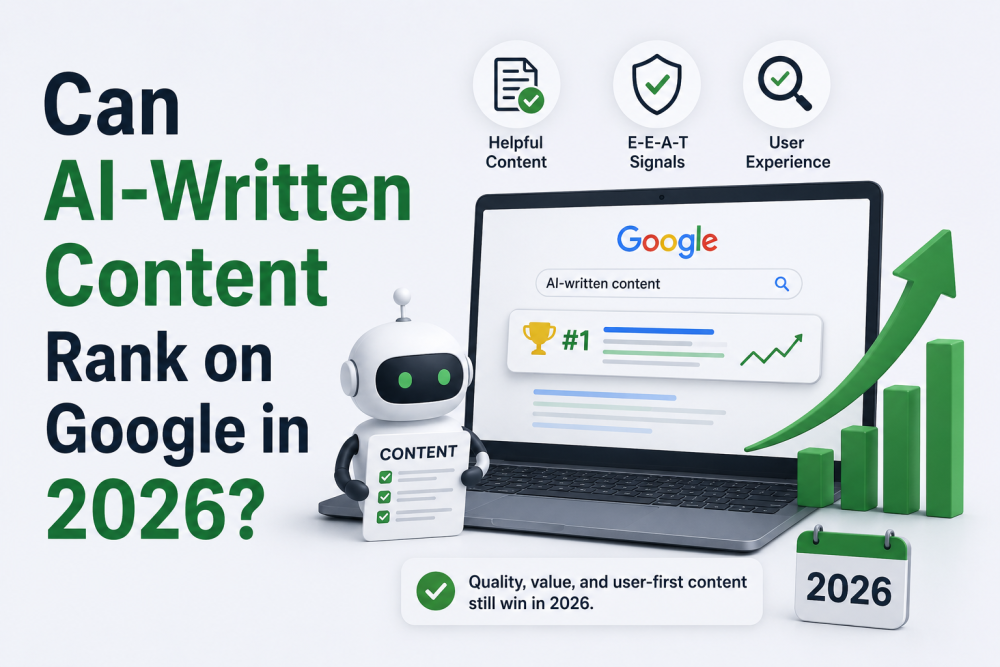
Yes. AI-written content ranks on Google in 2026; it's ranking right now, at scale, across every niche, and pretending otherwise requires ignoring half the current search results. And the sentence that matters more: AI-written content also gets buried at scale, entire sites of it vaporized in core updates, and the difference between the ranking half and the buried half has nothing to do with detection and everything to do with a question Google has been asking since before AI could write: Did this page add anything?
That's the whole article in one paragraph, and the rest is the detail worth actually knowing: what Google's policies literally say versus what the panic merchants claim; what the updates of the past two years actually punished; why "Will Google detect my AI content?" is the wrong question wearing a scary mask; and the workflow that separates the AI-assisted content ranking today from the AI-generated content that got sites deindexed. Full disclosure, doubly relevant on this topic: this article's own drafting workflow used AI, edited and fact-shaped by the site, which is precisely the workflow it describes.
What Google Actually Says, Minus the Panic
Google's public position has been consistent and is worth stating plainly: it rewards high-quality content, however it is produced—that's near-verbatim from its own guidance—and its ranking systems aim at helpfulness, originality, and E-E-A-T (experience, expertise, authoritativeness, and trust), not at the authorship method. Appropriate use of AI is explicitly not against its guidelines.
What is against them: their spam policies' name, "scaled content abuse," producing large volumes of content with little to no value added, regardless of whether humans or machines made it; and the fact that "regardless" is the load-bearing word the panic merchants skip. Google's war isn't with AI. It's the same war it's fought since the content-farm era: against pages that exist to occupy a keyword rather than to help the person who typed it. AI just made those pages cheaper to mass-produce, so the enforcement got louder.
And the enforcement was real: the core and spam updates of the past two years hit the pure-play AI content farms hard, sites publishing hundreds of unedited posts weekly with zero authorship, zero experience, and zero editing, with some de-indexed entirely, while sites using AI inside a genuine editorial process sailed through the same updates. Same tool. Opposite outcomes. The tool was never the variable.
Why "Will Google Detect It" Is the Wrong Question
Here's the reframe that saves people money and sleep: Google does not run your article through an AI detector and rank the verdict. The commercial detector scores that content operators anxiously chase measure statistical word-pattern likelihood, are famously noisy, flag human classics and polished professional prose constantly, and, most importantly, measure nothing Google's systems are built to care about. Google ranks pages by signals of usefulness, originality, and trust; a page can be 100% human-written slop and get buried or be AI-drafted, heavily edited, genuinely useful, and rank for years. Both happen daily.
The question that actually predicts ranking is the one Google's own helpful content guidance hands you: would a reader who lands here feel they've had a satisfying experience and learned something they couldn't get from the ten other results? That's called information gain in SEO circles, and it, not paternity, is the whole game. AI raises the floor of competence and simultaneously commoditizes it; when everyone can generate the same fluent summary of the same known facts, the ranking rewards flow to whatever's on the page that the model couldn't have written alone.
What the Ranking AI Content Has in Common
Study the AI-assisted content that survives updates and ranks, and the shared traits are unglamorous. Something the model didn't know: original data, first-hand experience, a real example, a tested opinion, an actual photo, and the first E in E-E-A-T, experience, exist precisely to reward what generation can't fake. Human editing that earns its name: facts verified (models invent confidently; always assume it), structure reshaped for the actual reader, and the generic phrasing that models default to replaced with a voice—the full discipline our AI blog-writing guide walks through. Accountability signals: a real author, an about page, a site that demonstrably specializes rather than shingpublishes everything about everything, and topical authority being the site-level version of expertise. And restraint at the volume dial: the sites that got hurt publish at machine pace; the ones that thrive publish at editorial pace, using AI to raise quality per piece rather than pieces per day.
None of this is secret. It's Google's stated criteria, observed working well. The uncomfortable version for anyone hoping otherwise: AI removed the writing bottleneck, so the ranking competition moved to everything that isn't writing, expertise, experience, evidence, and editing, which is exactly where Google always claimed it wanted the competition to be.
The Honest Risk Section
Balance requires naming what's genuinely risky in 2026. Thin AI sites live at the mercy of core updates, sites built on volume without value have absorbed catastrophic, sometimes terminal, traffic losses, and recovery from scaled content classification is slow and uncertain; this is the real risk, and it's a business model risk, not a detection risk. YMYL topics, health, money, and legal, carry a higher bar: Google weights trust signals hardest exactly where bad content does harm, so AI-assisted content there needs genuine expertise in the loop, not just editing. And the search landscape itself is shifting under everyone: AI overviews and answer engines now sit atop many results, which changes the prize; the emerging goal is being the source those answers cite, and citation flows to pages with original, specific, trustworthy information—the same virtues but with higher stakes. Generic content's reward is heading to zero from two directions at once.
What's not on the risk list, stated once more for the cheap seats: using AI in your writing process, disclosed or not, edited into genuine usefulness. That's the present tense of how professional content is made across newsrooms, marketing teams, and yes, the sites outranking the worriers.
The Workflow That Ranks, Compressed
The operational answer, five steps, expanded fully in our writing guides: brief the AI with real specifics rather than a bare keyword. Draft fast. Then the human passes that decision to everyone, verifies every fact against sources (the models' confident inventions are the single fastest way to torch trust), injects what only you have—the experience, the example, the data point, and the opinion with reasons—and edits into a voice a reader could recognize. Publish at a pace your editing genuinely covers, on a site that specializes, under a name that stands behind it. Run that loop, and the AI question dissolves into what it always was underneath: a productivity detail inside an editorial operation.
The Bottom Line
Can AI-written content rank on Google in 2026? It can; it does, and yours can, under the conditions that were always the conditions: the page adds something, a fact, an experience, a synthesis, or a voice that the searcher couldn't get elsewhere; the facts are verified; a real operation stands behind it; and the volume never outruns the editing. Google's systems punish valueless scale regardless of author and reward usefulness regardless of author; the detector scores measure neither, and the sites that internalized this are quietly winning the exact updates that vaporized the shortcut takers.
AI made competent content free, which made valuable content the entire competition. That's not a threat to anyone doing real editorial work with these tools. It's the biggest advantage they've ever been handed, wearing a scary headline.
FAQs: AI Content and Google
Does Google penalize AI-generated content?
No, not for being AI-generated: Google's guidance explicitly rewards quality "however it is produced," and appropriate AI use is within its guidelines. What its spam policies penalize is scaled content abuse, mass-produced pages with little added value, whether humans or machines wrote them, and its updates have enforced exactly that line: AI content farms are buried, and AI-assisted editorial sites are unaffected.
Can Google detect AI-written content?
Google doesn't rank pages by running AI detectors; it ranks by signals of usefulness, originality, and trust, and commercial detector scores measure statistical word patterns that correlate with neither penalty nor ranking. The predictive question isn't whether text scores "AI" on a checker; it's whether the page gives a searcher something the other results don't.
What kind of AI content actually ranks in 2026?
AI-assisted content with human value added: verified facts; first-hand experience or original examples the model couldn't generate; real editing into a distinct voice; a credible author and specialized site behind it; and publishing volume the editing genuinely covers. The pattern across sites surviving core updates is consistent: AI as the drafting layer inside an editorial process, never as the whole process.
Why did some AI content sites lose all their traffic?
They matched the profile Google's scaled content-abuse policy names: huge volumes, minimal editing, no experience or accountability signals, and sites existing to occupy keywords rather than help readers. Core and spam updates of recent years hit that model catastrophically, with some sites deindexed, a business-model failure, not a detection event, since edited AI-assisted sites passed through the same updates intact.
Do I need to disclose that content is AI-written?
Google doesn't require disclosure for ranking purposes; its systems evaluate the page, not its production notes, though transparency norms are evolving and some publishers disclose as a trust choice, as this site does on relevant articles. What matters for both rankings and readers is the same: accuracy, added value, and a real operation standing behind the words.
Will AI overviews and AI search kill content sites?
They're changing the prize rather than ending the game: answer engines sit atop results and cite sources, so the emerging win is being the cited source, which flows to pages with original, specific, trustworthy information, the same qualities classic rankings reward, at higher intensity. Generic summary content loses value from both directions; content with genuine information gain becomes more valuable, not less.