Introduction: A Market at a Crossroads
Canada's housing market has rarely sat still for long. Over the past two decades it has delivered staggering price gains, heart-stopping corrections, and whiplash-inducing recoveries, sometimes all within the span of a few years. By the time June 2026 arrived, Canadians found themselves looking at a market that felt different from anything they had seen before, not dramatically crashing, not wildly surging, but doing something arguably more confusing: hovering in a state of tense, unresolved uncertainty.
The Canada housing market 2026 story is one of competing forces. Interest rates have been falling from their recent peaks, which should normally lift buyer confidence and push prices upward. But affordability is still stretched to historic extremes in major cities, population growth is exerting constant pressure on supply, and a growing number of Canadians are simply priced out of ownership regardless of what rates do. Whether this market is heading toward a new boom, a long-awaited correction, or something more nuanced depends on who you ask and which part of the country you are looking at.
This article takes a thorough look at where things stand in mid-2026, with particular attention to the two markets that tend to set the national tone: Toronto and Vancouver. It examines the forces shaping prices, the prospects for buyers and sellers, the government policies trying to reshape affordability, and the scenarios that could push this market in very different directions over the next 12 to 18 months.
Where Things Actually Stand Right Now
To understand Canadian real estate in June 2026, it helps to start with the most recent data rather than the most recent headlines. The two tend to diverge more in Canadian housing than almost anywhere else, partly because sentiment can move faster than underlying numbers and partly because the market is genuinely national in name but deeply local in practice.
At the national level, the Canadian Real Estate Association's composite benchmark price sits roughly 4 to 6 percent below its early 2022 peak. That sounds like a significant correction, but it follows price gains of 50 to 60 percent in the pandemic years, which means homes are still dramatically more expensive than they were in 2019. In that context, a 5 percent dip is less a crash and more a modest exhale after years of breathless appreciation.
Sales volumes are recovering. After a sharp pullback in 2023 and 2024 when the Bank of Canada's rapid rate hikes effectively froze the market, transactions have been picking up again through late 2025 and into 2026. The rate cuts that began in the second half of 2024 have been gradual but consistent, and with the Bank of Canada's key lending rate now sitting around 3.25 percent, the mortgage affordability calculation has improved meaningfully from its worst point, even if it remains far tougher than the near-zero era that many buyers were hoping to see return.
Toronto Home Prices in 2026: Still Eye-Watering, but Shifting
Toronto has occupied its position as Canada's most-watched and most-debated housing market for so long that it can be easy to overlook how genuinely extraordinary the numbers remain. The average home price in the Greater Toronto Area in mid-2026 sits in the range of $1.08 million. That figure has declined from the $1.33 million peak reached in early 2022, but it represents a price point that is simply out of reach for a large and growing share of the population without significant help from family wealth or a very high household income.
The Toronto-Vancouver home prices 2026 story in Toronto specifically involves a market that is healing unevenly across its different segments. Detached homes in the 905-area suburbs, which saw some of the most extreme pandemic-era appreciation, have experienced the sharpest corrections, in some cases down 15 to 20 percent from their peak. Condominiums in the core, meanwhile, have held up somewhat better in price terms, partly because they represent the most accessible entry point to ownership and partly because rental demand continues to put a floor under investor-held units.
Who Is Actually Buying in Toronto Right Now?
The buyer profile in Toronto in mid-2026 is notably different from the frenzy of 2021 and early 2022. Speculators and investors who were active when prices seemed to have no ceiling have largely stepped back, particularly in the pre-construction condo segment where completion risk and carrying costs have made the math work poorly. The buyers who are active tend to be end users, people who genuinely need somewhere to live and who have been waiting patiently for the right combination of price, rate, and opportunity.
First-time buyers remain deeply challenged despite the improved rate environment. A household earning $150,000 a year, which puts them in the top 15 percent of Toronto earners, still faces significant affordability stress when buying even a modest townhouse. This reality is reshaping where people choose to live, with continued movement to smaller cities within commuting distance of Toronto, including Hamilton, Kitchener-Waterloo, and Barrie, as buyers seek better value without fully abandoning access to the city's economic opportunities.
The Condo Oversupply Question
One of the more specific risks facing the Toronto market in 2026 involves the large volume of pre-construction condos that are completing and entering the resale and rental market simultaneously. Many of these units were purchased by investors during the low-rate years, and with carrying costs now higher, some are choosing to sell rather than hold. This is adding supply to a segment of the market that already has elevated inventory, and it is creating genuine downward pressure on condo prices in certain Toronto neighborhoods. The scale of this completion wave is expected to continue through 2026 and into 2027 before tapering.
Vancouver: Supply Constraints Meet Softening Demand
Vancouver's housing market has always operated by its own rules, shaped by geography, international capital flows, and a cultural attachment to real estate as the defining asset class of the city. In June 2026, the Vancouver story is one of a market that has softened in some ways while remaining structurally resistant to a true correction in others.
Toronto-Vancouver home price 2026 comparisons show that Vancouver's benchmark price for all residential properties sits around $1.16 million, holding up somewhat better in relative terms than Toronto despite similar rate headwinds. The detached home segment on Vancouver's west side and north shore remains extraordinarily expensive, with prices that are essentially insulated from rate sensitivity because the buyers in that segment are often not primarily mortgage-dependent.
The International Capital Factor
Vancouver's relationship with international capital, particularly from Asia, has been a source of both genuine housing pressure and considerable political controversy for well over a decade. The various foreign buyer taxes and vacancy levies introduced by both the provincial and federal governments have reduced, but not eliminated, the flow of overseas investment into the market. In 2026, with some of those restrictions having been in place for several years, the market has adjusted around them without the dramatic price collapse that some had predicted as their result.
What remains is a market where the supply side is structurally constrained by geography on one side and regulatory complexity on the other. Building anything in Metro Vancouver takes longer and costs more than in virtually any comparable Canadian city, and that fundamental supply bottleneck continues to set a floor under prices that is difficult to dislodge through demand-side policy alone.
The Rental Market's Relationship with Ownership Prices
One dynamic that shapes the Vancouver market in ways that are sometimes underappreciated is the tightness of the rental market. With vacancy rates stubbornly low and rents high by any Canadian standard, the ownership market receives constant support from tenants who are motivated to buy simply to escape rental insecurity and cost, even when ownership is expensive in absolute terms. This demand floor from renters-hoping-to-buy is a meaningful structural feature of the Vancouver market that helps explain why corrections there tend to be shallower than the headline price levels might suggest they should be.
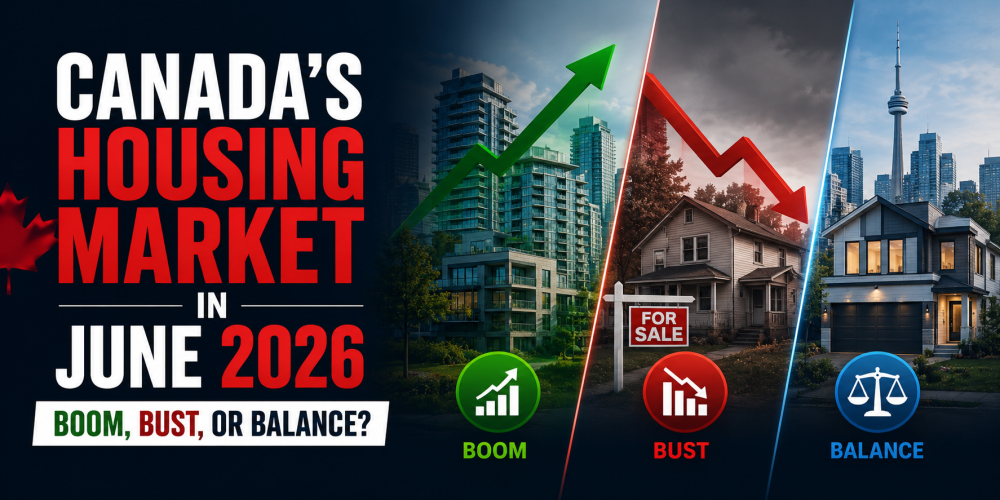
The Three Scenarios: Boom, Bust, or Balance?
With the stage set, it is worth examining each of the three possible directions the Canadian housing market 2026 could take over the next year or so, looking honestly at the conditions that would need to be present for each outcome.
Scenario One: A New Boom
The boom scenario is not as far-fetched as it might seem. Canada's population growth rate remains among the highest in the developed world, driven by a deliberate immigration policy that continues to bring in hundreds of thousands of new permanent residents and temporary workers each year. These arrivals need housing, and a large proportion of them settle in Toronto and Vancouver. If the Bank of Canada continues to cut rates through the second half of 2026, bringing the typical 5-year fixed mortgage rate toward 4 percent or below, the pent-up demand that has been sitting on the sidelines could re-enter the market with enough force to reignite meaningful price appreciation.
The conditions most likely to trigger a boom scenario would be another two or three Bank of Canada rate cuts before year end, combined with continued strong population growth and no significant increase in new housing supply. In that environment, Canadian real estate in June 2026 could mark the beginning of the next appreciation cycle rather than a pause in the middle of a correction.
Scenario Two: A Meaningful Correction
The bust scenario centers on affordability math that simply does not work for most Canadians at current price levels, regardless of where rates go. Even at 4 percent mortgage rates, a million-dollar home requires a down payment of at least $200,000 and monthly mortgage payments in the range of $4,000 to $4,500, before property taxes, maintenance, and strata fees. For the median Canadian household, this is not possible without an inheritance, a second income earner, or both.
A correction could be triggered by a meaningful rise in unemployment, which several economists consider a genuine possibility given global economic uncertainty in 2026. If job losses mount, forced sellers enter the market, and buyer confidence retreats, the current thin layer of market stability could crack. The condo completion wave in Toronto adds a specific downside risk in that city's market. The bust scenario is more likely to be a prolonged period of gradual price declines, perhaps 10 to 15 percent over 18 months, than a sudden crash.
Scenario Three: An Extended Balance
The most likely outcome, in the assessment of most independent housing economists, is neither boom nor bust but an extended period of market equilibrium with significant variation by city, neighborhood, and housing type. Prices in the national composite may move sideways or drift modestly higher as rate cuts counterbalance affordability constraints. Sales volumes will likely continue their gradual recovery without returning to the frenzied pace of 2021. New supply will increase in some markets and remain constrained in others.
This balanced scenario is in some ways the least satisfying narrative, but it may be the most accurate. Canadian real estate in June 2026 appears to be in the early stages of exactly this kind of normalization, where neither buyers nor sellers hold a decisive advantage and where the market moves more on individual property merit and neighborhood specifics than on the tide of enthusiasm or fear that characterized both the 2021 peak and the 2023 trough.
Government Policy: What Ottawa and the Provinces Are Doing
No discussion of the 2026 Canada housing market would be complete without addressing the policy environment, which has been unusually active at both the federal and provincial levels.
Federal Affordability Measures
The federal government has introduced a range of measures aimed at improving affordability and boosting supply over the past two years. The expansion of the First Home Savings Account, which allows eligible Canadians to save up to $40,000 tax-free toward a first home purchase, has been well received. Changes to mortgage amortization rules that allow insured mortgages to extend to 30-year terms for first-time buyers purchasing new construction have also helped at the margins by reducing monthly payment obligations for entry-level buyers.
On the supply side, the federal Housing Accelerator Fund has distributed billions of dollars to municipalities that commit to removing zoning barriers and fast-tracking building approvals. The results have been real but slow, as supply-side interventions always are. Zoning changes need to flow through local planning processes, then into developer decisions, then into building permits, and finally into completed units, a cycle that typically takes three to five years from policy change to new homes on the market.
Provincial and Municipal Actions
Ontario's push to allow higher density in areas close to transit corridors has opened up significant new development potential in the 905 belt around Toronto, though the translation from policy permission to actual housing units remains slow. British Columbia has moved aggressively on transit-oriented development rules that allow three to six storeys of residential construction near major transit stops without requiring individual rezoning, a reform that housing economists have broadly praised as genuinely impactful in the medium term.
The challenge for all of these supply-side interventions is timing. The Canada housing market 2026 affordability crisis is happening now, and the supply response will not be felt at scale for years. Policy can shift the trajectory, but it cannot quickly undo two decades of under-building relative to demand.
What This Means for Buyers, Sellers, and Investors
Advice for Prospective Buyers
If you are considering buying in the current market, the June 2026 environment offers some genuine advantages compared to where things stood 18 months ago. Rates are lower, competition is less frenzied, and there is more time to make considered decisions. The risk of dramatically overpaying in a bidding war is lower than it was at the peak. At the same time, the expectation that rates will return to pandemic lows and trigger another major appreciation cycle is probably not realistic planning.
The most sensible approach for buyers in mid-2026 is to focus on properties where the fundamentals are sound regardless of where the market goes: a good location with strong rental demand, a property type with long-term utility, and a purchase price that the household can comfortably carry even if rates do not fall further. Buying for the long term and ignoring the short-term noise is still the most reliable path to good outcomes in Canadian real estate.
Considerations for Sellers
Sellers in mid-2026 face a market that requires realistic pricing. Buyers who are active are generally well-informed and not inclined to chase properties aggressively. Homes that are priced at or slightly below market value are selling. Those priced optimistically are sitting. In Toronto specifically, the condo segment requires particular attention to comparable sales, because the volume of new completions is affecting pricing in ways that vary block by block.
The Investor Perspective
For investors, the Canada housing market 2026 calculation has changed significantly from the pre-correction period. Rental yields in most major cities are still below the cost of financing, which means most rental properties operate at a monthly cash flow deficit when purchased today at current prices and rates. Investors betting on the Canadian real estate market in 2026 are generally making a long-term capital appreciation play rather than an income play, which requires confidence in the country's long-term housing demand fundamentals, which remain solid given population growth trends.
Conclusion: Cautious Optimism With Eyes Open
The Canada housing market 2026 is not the wild place it was in 2021, and it is not the frozen, anxious place it was in late 2023. It occupies a middle ground that is genuinely difficult to read and which different participants are experiencing very differently depending on where they live, what they are trying to do, and how long their time horizon is.
Toronto and Vancouver home prices in 2026 remain among the most expensive on the continent by any income-adjusted measure. That reality is not going to change quickly regardless of rate movements or government programs. But the conditions for continued gradual normalization are in place, and the longer-term forces of population growth, limited land, and Canadian households' deep cultural preference for homeownership suggest that the market's underlying demand story is not going away.
For anyone navigating this market right now, whether as a buyer, a seller, a renter hoping to eventually own, or an investor reviewing a portfolio, the most useful posture is probably clear-eyed pragmatism. The easy money era is gone. The crash that many have predicted repeatedly has not materialized and may not. What Canadian real estate June 2026 offers instead is a market that rewards patience, research, and realistic expectations over speculation and panic. In the long run, that is probably a healthier place for the market to be.