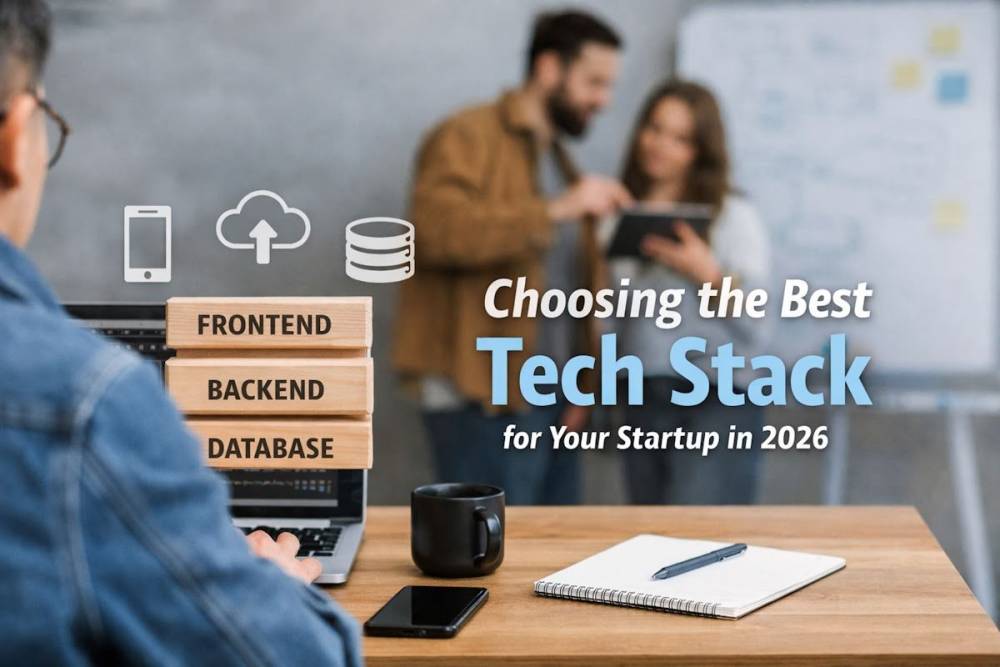
Picking a tech stack sounds like a deeply technical call. It is, sure. But it is also a business decision, a hiring decision, and in a lot of cases, a survival decision.
Startups usually do not fail because they picked the wrong JavaScript framework on day one. They run into trouble because they picked tools that did not fit their product, their team, or their budget. Then the code got messy, releases slowed down, bugs piled up, and every new feature felt harder than the last.
That is why this choice matters so much in 2026. Founders are building in a market where users expect fast apps, smooth onboarding, stable payments, tight security, and mobile-friendly experiences from the start. Investors and early customers are not grading on a curve. They expect things to work.
So how do you choose well without overthinking every little detail?
You keep it grounded. You look at what you are building, who is building it, how quickly you need to ship, and what kind of growth you expect if things go right.
Let’s break it down in plain English.
First, stop asking “What is the best tech stack?”
There is no best stack for every startup. That question sends people in the wrong direction right away.
A better question is this: what stack gives your startup the best chance to build, launch, learn, and grow without creating a mess six months from now?
That shift changes everything.
A social app with real-time messaging has different needs than a B2B dashboard. A healthcare product has different rules than a marketplace. A two-person founding team has different limits than a startup with funding and a full engineering crew.
You do not need the coolest stack. You need one that makes sense for your product and your stage.
Simple beats flashy. Familiar beats trendy. Clear beats clever.
Start with the product, not the tools
Before you compare React, Node.js, Python, Go, Flutter, PostgreSQL, or anything else, get clear on the product itself.
Ask yourself a few basic questions:
-
Is this a web app, a mobile app, or both?
-
Will users expect real-time updates?
-
Are you dealing with payments, private data, or strict compliance needs?
-
Will the product need video, chat, file storage, location tracking, or heavy search?
-
Are you building an MVP to test demand or a core product that already has traction?
A lot of founders skip this part because they want quick answers. Totally fair. But if you skip the product context, every stack discussion turns into random opinions from developers on the internet.
That is not strategy. That is noise.
When your product needs are clear, your stack choices start narrowing on their own.
Think hard about your team
This part gets ignored way too often.
A tech stack is not just code. It is the daily working environment for your developers. It affects hiring, onboarding, testing, maintenance, release cycles, and bug fixing. So the real question is not just “Can this stack work?” It is “Can our team work well with it?”
If your developers already know TypeScript, React, and Node.js, picking an obscure setup just because it looks cool is probably a mistake. You will slow the team down right when speed matters most.
If your co-founder is technical and has spent years shipping products with Python and Django, there is real value in leaning into that comfort zone. Familiar tools let teams move with more confidence. Less second-guessing. Less time lost on setup. Fewer weird surprises.
And if you are planning to hire in the U.S., talent supply matters. A stack with a larger hiring pool can save you a lot of pain later.
This is one reason many startups talk to firms that offer IT consulting services before locking in a stack. A good outside team can help you match product needs with team strengths, hiring plans, and budget limits, instead of chasing whatever is getting hype that month.
In 2026, speed still matters, but so does staying power
A lot of startup advice pushes speed above everything else. Ship fast. Test fast. Break things. Move on.
Sure. Early speed matters. You need to get to market before money or momentum runs out.
Still, speed without structure can hurt you. If your first release is built with shortcuts everywhere, the product may become painful to maintain. What felt fast in month one turns into drag in month eight.
That does not mean you need enterprise-level architecture on day one. Please do not do that. Most startups do not need a giant system split into ten services before they even have paying users.
A cleaner path for many teams is to begin with a simple monolith using tools your developers know well. That gives you a straightforward codebase, faster development, and fewer moving parts. Later, when usage grows and pressure points become real, you can split parts of the system where needed.
In other words, build for the next stage, not for some fantasy version of your company that may never happen.
Choosing your frontend stack
For web products, the frontend is what users touch first. It shapes their first impression fast.
In 2026, JavaScript and TypeScript still sit at the center of most startup frontend work. TypeScript is especially useful because it helps teams catch mistakes earlier and keep code easier to follow as projects grow.
React remains a common choice for startups because it has a huge community, lots of hiring support, and strong flexibility. Next.js is also attractive for startups building web apps that need fast page loads, better SEO, and a cleaner full-stack setup.
Vue can also be a smart pick for teams that want a gentler learning curve and clean structure. It often feels easier for smaller teams that want to move quickly without a lot of extra ceremony.
So what should you choose?
If you want broad hiring access and lots of shared knowledge, React with TypeScript is a safe bet.
If your product depends on content, landing pages, public pages, and app features in one place, Next.js can make life easier.
If your team already likes Vue and can ship quickly with it, that can be the right answer too.
The key is not picking a winner in some online debate. The key is choosing a frontend setup your team can build with confidently week after week.
Choosing your backend stack
Your backend handles business rules, user accounts, billing, permissions, APIs, and the logic that keeps the whole product running.
For startups, a few backend paths keep coming up for good reason.
Node.js with TypeScript
This works well when you want one language across the frontend and backend. That can simplify hiring and make teamwork smoother. It is often a strong fit for SaaS apps, real-time products, dashboards, and fast MVP work.
Python with Django or FastAPI
Python is popular because it is readable and quick to work with. Django is a strong choice for startups that want a lot of built-in structure right away, especially for admin panels, user systems, and database-driven products. FastAPI is often picked for API-heavy products that want a more modern and lightweight feel.
Ruby on Rails
Rails still deserves respect. It helps startups ship web products fast, especially when the team already knows it. It is productive, opinionated in a good way, and battle-tested.
Go
Go is often chosen for backend systems where performance, concurrency, and simpler deployment matter. It can be a strong fit for products dealing with high request loads, infrastructure tools, or services that need tight control over resources.
How do you choose among them?
Match the backend to the product and the people building it. A small SaaS startup can do very well with Node.js, Django, or Rails. A more demanding platform with real-time or high-throughput needs might lean toward Go for certain services later on.
Again, you do not need to get fancy too early.
Also read: 5 Best AI Agent Development Companies to Watch in 2026 (USA)
What about mobile apps?
Not every startup needs a mobile app right away. Some do. Many do not.
If your product can succeed through a web app first, that route may save time and money. It also helps you validate demand before taking on the extra work of iOS and Android development.
But if mobile is core to the experience, like social, health, delivery, travel, or field operations, then mobile cannot be an afterthought.
In that case, many startups weigh cross-platform tools against native development.
Cross-platform
React Native and Flutter are common picks when speed and shared code matter. They let teams build for both iOS and Android with one core codebase. For startups with tight budgets, that can be a very practical move.
Native
Swift for iOS and Kotlin for Android give deeper control over device-specific behavior and may offer a better fit for apps with advanced platform features, demanding performance needs, or highly polished user experiences.
A lot of founders ask, “Should we go cross-platform first?”
Usually, yes, if the budget is tight, the app is still being validated, and the product does not depend on advanced native features. That is often the most sensible route.
Your database choice matters more than people think
Databases are not exciting to most founders. Fair enough. Still, this choice can quietly shape performance, reporting, product flexibility, and future maintenance.
For many startups, PostgreSQL is a solid default. It handles relational data well, supports complex queries, and fits a wide range of product types. User accounts, orders, subscriptions, transactions, reporting, internal tools, marketplaces, CRMs, project platforms—it covers a lot.
MySQL can also work well, especially for teams with existing experience.
MongoDB and other NoSQL options make sense in some cases, especially when data structures change often or when the product deals with less structured data. But founders sometimes pick NoSQL too early because it sounds more modern. Then later they miss the consistency and query power of a relational database.
That stings.
If you are unsure, start by asking how your data relates to itself. If the product has clear relationships between users, teams, projects, payments, permissions, and records, a relational database is often the safer call.
Do not ignore cloud and hosting choices
Your app still needs somewhere to live. And yes, infrastructure choices can get expensive and messy if handled poorly.
For many startups in 2026, cloud platforms like AWS, Google Cloud, and Azure remain common options. They offer flexibility, scale, and a huge range of services. Still, that depth can feel overwhelming for early teams.
Some startups move faster with simpler platforms like Vercel, Render, Railway, or managed hosting tools that cut down setup work for frontend apps, APIs, and databases. That can be a great move for MVPs and early products.
The mistake is assuming you need a huge cloud setup from day one.
You probably do not.
Pick hosting that matches your current needs and your team’s comfort level. Keep deployment simple. Keep monitoring basics but be useful. Keep costs visible. Hidden cloud costs can sneak up on startups fast.
Security and compliance are not “later” problems
A lot of founders treat security like a future concern. That can backfire badly.
Even early-stage products should take basic security seriously. User authentication, password handling, access control, database backups, logging, encryption, and safe API design should be part of the plan from the beginning.
And if you are handling healthcare data, financial records, personal identity details, or anything tied to strict rules, your stack choice has to support those needs from the start. You do not want to rebuild core parts of the product because compliance came up after launch.
This is one place where being cheap can become very expensive.
Not glamorous, I know. Still true.
Watch out for these common startup mistakes
Founders make a few stack mistakes over and over. Here are the big ones.
Picking tools based on hype
Just because a framework is everywhere on social media does not mean it fits your product.
Building for giant scale before you have users
You do not need a highly split-up system with complex infrastructure when you are still testing whether people want the product.
Ignoring hiring realities
A stack that is hard to hire for can slow growth when you need to expand the team.
Letting one developer choose based only on personal taste
Developer input matters a lot, of course. But this is a company decision, not a favorite-tools contest.
Choosing too many tools at once
Every new tool adds setup, maintenance, and learning overhead. Keep the stack lean.
Forgetting long-term ownership
The stack is not just about launch week. Someone has to maintain this code for years, maybe under pressure, maybe during outages, maybe while customers are angry.
That is the real test.
A practical way to make the decision
If you want a simple process, use this one.
Start by writing down:
-
Your product type
-
Your must-have features
-
Your team’s current skills
-
Your expected timeline
-
Your budget
-
Your security or compliance needs
-
Your hiring plan for the next 12 months
Then compare two or three stack options. Not ten. Just two or three.
For each one, ask:
-
Can our current team build with this right now?
-
Can we hire for it without a struggle?
-
Does it support the product we want to build in the next year?
-
Will it keep the codebase manageable as features grow?
-
Are hosting and maintenance costs reasonable?
-
Will this choice create needless friction later?
That exercise alone clears up a lot.
You do not need perfect certainty. You need a strong working definition.
A balanced stack many startups can consider in 2026
There is no universal answer, but here is a practical setup many startups can consider:
- Frontend: React or Next.js with TypeScript
- Backend: Node.js with TypeScript, or Python with Django/FastAPI
- Database: PostgreSQL
- Mobile: React Native if mobile is required early
- Hosting: Vercel for frontend, cloud or managed platform for backend and database
- Auth and payments: Use proven third-party tools instead of building from scratch
Why does this combo appeal to so many teams?
Because it is familiar, widely supported, and easier to hire for. It gives startups a good path to launch without burying them in technical overhead. And that matters a lot when every sprint counts.
Still, your startup may need something else. A fintech app, a health platform, a data-heavy product, or a real-time tool may need a different shape.
That is normal.
The real goal is not "future-proofing."
Founders love the phrase “future-proof.” It sounds smart. It sounds safe.
But in startup life, the future changes too fast for that kind of thinking.
Your goal is not to lock in the perfect stack for the next ten years. Your goal is to choose a stack that helps you launch, learn from users, fix what is broken, and grow without forcing a painful rewrite too soon.
That is it.
Make the next smart choice. Then the next one after that.
Tech stacks are not permanent tattoos. They are working on decisions.
Also check: Latest AI Technology Trends in the USA
Where founders usually get the most value from outside help
A lot of startup teams do not need someone to write every line of code for them. They need help making cleaner decisions before development gets expensive.
That may include:
-
Reviewing product needs before architecture is set
-
Comparing stack options with business goals in mind
-
Estimating trade-offs around cost, hiring, and release speed
-
Spotting future pain points early
-
Cleaning up a messy plan before the build starts
That is where experienced technical partners can save real time and money. Not by overcomplicating things. By helping you avoid preventable mistakes.
And honestly, that is often worth more than a flashy pitch.
One last thing before you lock it in
Do not let stack choice become procrastination dressed up as strategy.
At some point, you need to decide and build.
Research matters. Planning matters. But endless comparison can eat weeks that should have gone into product development and customer feedback.
So ask the right questions. Keep the stack simple. Match it to your team. Match it to your product. Match it to the stage your startup is actually in, not the version you daydream about during pitch prep.
That is how strong early products get built.
And if you are stuck between what looks good on paper and what will actually work in the real world, take a step back and be honest. What can your team ship confidently? What can you maintain without chaos? What will help you learn from users fastest?
Start there.
That answer is usually a lot better than the trendy one.
Make the call, then get moving
Choosing the right tech stack for your startup in 2026 is not about chasing buzz. It is about making smart trade-offs. The right stack helps your team build faster, stay focused, and avoid painful rework later. The wrong one can drain time, money, and momentum before the product even finds its footing.
Keep it practical. Keep it grounded. Pick tools your team can actually use well. And once the choice is made, get the product out there and learn from real users. That is where the real progress starts.