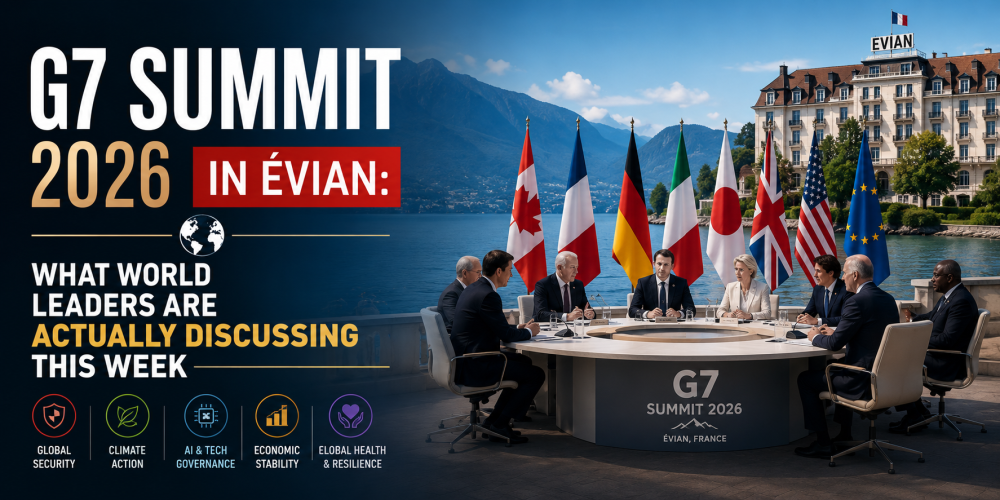
If you've been half-listening to the news this week and caught a glimpse of Lake Geneva, motorcades, and a small army of security personnel, you're not imagining it. The G7 Summit is back in Évian-les-Bains, France—the same lakeside spa town that hosted the G8 back in 2003. It's a strange kind of déjà vu for a place better known for bottled water than world politics.
This year's gathering, running June 15 to 17, lands at a genuinely tense moment. There's a war in Ukraine that's now stretched into its fifth year, a fresh ceasefire-style agreement between the US and Iran that everyone's still trying to figure out, and a growing sense that the global economy is wobbling under imbalances nobody quite wants to own up to. Add in AI—which seems to show up on every major agenda these days—and you've got a summit with more on its plate than most.
So what's actually being discussed? Let's walk through it without the diplomatic fog.
A Quick Refresher: What Even Is the G7?
Before diving into the agenda, it's worth a thirty-second reset. The G7 is an informal club of wealthy democracies—the US, UK, Canada, France, Germany, Italy, and Japan—plus the European Union, which has been a fixture at these meetings since the early 1980s. Its member states have a combined annual GDP of more than $50 trillion, which is just under half the world economy.
There's no headquarters, no permanent staff, no binding legal authority. It's essentially a standing invitation for the leaders of these countries to sit in a room (or several rooms, with breaks for very nice meals) and try to align on the big issues of the moment. Russia was part of this group until 2014, when it was suspended after annexing Crimea from Ukraine.
This year, France holds the presidency, which is why President Macron is hosting and largely setting the tone for what gets discussed. And he's chosen to set that tone in a town that's hosted this exact kind of gathering before—23 years after the 2003 Evian G8 Summit, to be precise.
The Big One: Ukraine, Again
Let's be honest—Ukraine has been on every G7 agenda for years now, and this year is no different. What's notable this time is the framing. G7 leaders are expected to discuss lowering the price cap on Russian oil as part of the broader sanctions push, though that's been a sticking point before because not everyone's on the same page about how aggressive to be.
President Volodymyr Zelensky is making the trip to Évian himself. He's set to arrive for a dedicated session on Ukraine, and the broader goal from the European side and Canada is straightforward: keep reminding the US that pressure on Russia needs to continue, even as attention shifts elsewhere. Macron and the other leaders have been firm that no concessions should be made to Russia at this stage.
Here's the thing about these Ukraine sessions, though—and I say this having watched a few of these summits play out over the years. The headlines tend to focus on big symbolic gestures (a new aid package, a joint statement, a photo of leaders standing together). But the real substance usually happens in the smaller bilateral meetings on the sidelines, where individual countries hash out specifics on weapons systems, financing, or sanctions enforcement. If you're trying to gauge how this summit actually moves the needle on Ukraine, watch for announcements that come out a few days after the cameras leave, not just during the main sessions.
Iran, the Middle East, and a Deal Everyone's Watching Closely
This is arguably the freshest and most unpredictable item on the agenda. The G7 leaders are meeting just after the US and Iran announced a framework agreement aimed at ending their conflict, though the formal signing isn't expected until later in the week.
What does that mean practically? A few things. The agreement isn't due to be signed until Friday, but G7 leaders want details on how quickly the Strait of Hormuz can reopen to shipping traffic, with Trump indicating it could reopen by Friday and that he'd ordered an end to the US blockade on Iranian ports.
If you're wondering why a shipping strait matters so much to a summit about global politics—think of it like this. The Strait of Hormuz is one of the narrowest, busiest oil-shipping corridors on the planet. When it's blocked or restricted, energy prices ripple outward almost immediately, hitting everything from airline ticket prices to the cost of heating a home in Germany. So when G7 leaders say they're "watching the Strait of Hormuz closely," they're really saying "we're watching everyone's energy bills closely."
This part of the agenda isn't just a G7 affair, either. Arab leaders, including Egypt's President Abdel Fattah al-Sisi, are joining the discussions, and Gulf states, including Qatar, the United Arab Emirates, and Saudi Arabia, are also taking part. Macron has also flagged a related priority: looking at ways to diversify energy routes from the region to reduce dependence on any single chokepoint.
Global Economic Imbalances: The Quiet Crisis Nobody Loves Talking About
This one doesn't generate flashy headlines, but it might be the most consequential long-term topic on the table. The basic concern, summarized fairly bluntly by French officials, comes down to a simple (if a little oversimplified) framing: China produces too much, the US consumes too much, and Europeans invest too little.
That's the kind of statement that sounds almost too neat, but there's real substance behind it. There's growing alarm in the West over China's record trade surplus and its movement up the value chain, while Beijing has pushed back hard on claims of unfair subsidies. Macron has reportedly been trying to find some kind of cooperative path forward with China before the EU potentially hardens its trade stance—but here's the catch: China isn't at the table, so no major breakthroughs are expected. French officials seem to be framing it as a partial win just to get everyone to acknowledge the imbalance exists, which, fair enough, is sometimes step one.
If you've ever tried to get a group of friends to agree there's a problem with how bills get split before actually fixing the split—that's roughly the energy here. Acknowledgment first, solutions later (much later, probably).
AI Takes a Seat at the Table—Literally
This is the part of the agenda that probably surprises people the least and interests them the most. France has invited around a dozen senior tech executives, including OpenAI's Sam Altman and Anthropic's Dario Amodei, to discuss AI technologies and the threats and opportunities they present.
It's a notable shift in how these summits operate. A decade ago, the idea of tech CEOs sitting in on a G7 leaders' meeting would've felt out of place. Now it feels almost overdue. AI has gone from "interesting emerging technology" to "thing that's reshaping labor markets, information ecosystems, and national security calculations" in the span of a few years, and government leaders are scrambling to keep pace.
A couple of specific threads worth knowing about:
Child safety online is on the agenda, which makes sense given how much of the AI conversation has shifted toward platforms, chatbots, and content that kids interact with daily. Digital infrastructure protection is also part of the discussion.
Digital taxation, interestingly, is explicitly off the table this time. The taxation of digital giants will not be discussed at this summit—which is a bit of a reversal from previous years, when that topic tended to dominate any conversation involving big tech.
There's also a separate digital ministers' track running alongside the main summit, focused on building a shared roadmap for trustworthy AI and digital services that work for citizens. Whether "trustworthy AI roadmap" translates into anything concrete is, frankly, an open question—these documents have a track record of being more aspirational than operational. But the fact that it's being discussed at all, with the actual people building these systems in the room, is worth paying attention to.
The Expanded Guest List: Who Else Showed Up
One of the more interesting things about modern G7 summits is how much bigger the actual guest list has gotten compared to the founding seven countries. This year's invitees include India, South Korea, Kenya, and Brazil, plus, somewhat unusually, Syria.
That last one is worth a pause. Syria's inclusion reflects just how much the regional picture has shifted, and it's a reminder that these summits increasingly function as informal diplomatic crossroads—a chance for leaders who might not otherwise share a stage to have brief, often consequential conversations on the sidelines.
There's also been some friction around who didn't make the cut. Reports earlier this year indicated South Africa protested its exclusion from the Évian summit, reportedly under pressure from the Trump administration. Whatever the politics behind that decision, it's a useful reminder that the guest list itself is often as politically loaded as anything discussed once everyone's seated.
Critical Minerals, Debt Relief, and the Stuff That Doesn't Make Headlines
Beyond the marquee topics, there's a whole layer of agenda items that rarely get news coverage but matter quite a bit if you're paying attention to global supply chains or development finance.
Critical minerals got their own dedicated session, with an OECD forum focused on mobilizing investment in critical minerals through partnerships, standards, and traceability. If you've followed the conversation around electric vehicle batteries, semiconductor manufacturing, or renewable energy infrastructure, you'll know why this matters—almost everything in the modern green-tech supply chain runs through a fairly small number of mineral sources, and most G7 countries are uncomfortably dependent on countries they don't always see eye-to-eye with.
Debt burdens in developing economies also made the list. G7 leaders are likely to express resolve in addressing the heavy debt loads carried by many emerging market and developing countries, though, as is often the case with these statements, what that resolve actually translates into concrete terms remains unclear.
There's also a methane-focused event running alongside the main summit—an international, multi-stakeholder event focused on methane action—plus sessions on illegal fishing and information integrity, which sounds dry until you realize "information integrity" is largely shorthand for disinformation and foreign interference in elections, a topic that's only gotten more urgent as AI-generated content has become harder to distinguish from the real thing.
Security: Why Évian Feels Like a Fortress This Week
If you're anywhere near the Lake Geneva region this week, you'll notice it immediately—this isn't a normal week for the area. The summit requires exceptional security measures, extending into Switzerland as well, with the cantons of Geneva, Vaud, and Valais all involved in preparations.
Switzerland has even taken the unusual step of temporarily reinstating border controls along its frontier with France from June 10 to 19, specifically to support the cantons hosting security operations for the event. Previous G7 summits have seen significant unrest, so this isn't just precautionary theater—it reflects genuine lessons learned from past gatherings where protests and security incidents became part of the story.
If you've ever lived in a city hosting a major international event—the kind where entire neighborhoods get cordoned off for a few days—you know the feeling. Daily life doesn't stop, but it definitely gets weirder. Extra checkpoints, rerouted traffic, a noticeably different vibe on the streets. Multiply that by an international border, and you get a sense of what the Lake Geneva region is dealing with this week.
What to Actually Expect by Friday
Here's where I'll offer a slightly less polished take than you'll find in most coverage: don't expect dramatic breakthroughs by the time this summit wraps up.
That's not cynicism—it's just how these things tend to work. Sources have framed the summit's priorities around three themes: concrete measures, reconvergence, and responding to whatever crisis dominates the moment. Translation: There will be statements, joint declarations, probably a few headline-grabbing commitments on Ukraine or Iran, and a lot of careful diplomatic language designed to paper over the genuine disagreements that exist between, say, the US and European positions on Russia or between everyone and China on trade.
The AI conversations might end up being the most consequential long-term, simply because the people building these systems were actually in the room. Whether that translates into anything resembling coordinated policy is a different question entirely—but at least the conversation is happening with the right people present, which hasn't always been true of these summits in the past.
Wrapping This Up
Évian in 2026 is hosting a G7 summit that's trying to do a lot at once—shore up support for Ukraine, figure out what an Iran deal actually means in practice, wrestle with economic imbalances that have been building for years, and get ahead of an AI conversation that's moving faster than most governments can keep up with.
Will it solve any of these things outright? Almost certainly not—that's not really what these summits are for, despite how they're sometimes covered. What they can do is set direction, build (or strain) relationships between leaders who'll need to work together on these issues for years to come, and occasionally produce a genuinely useful agreement that wouldn't have happened without everyone being in the same room.
If you want to actually understand where things stand after this week, my advice is simple: skip the closing press conference and wait a few days. The real signals tend to show up in the follow-up actions—new sanctions packages, funding announcements, or quiet shifts in diplomatic posture—not in the joint statement everyone signs before getting back on their planes.