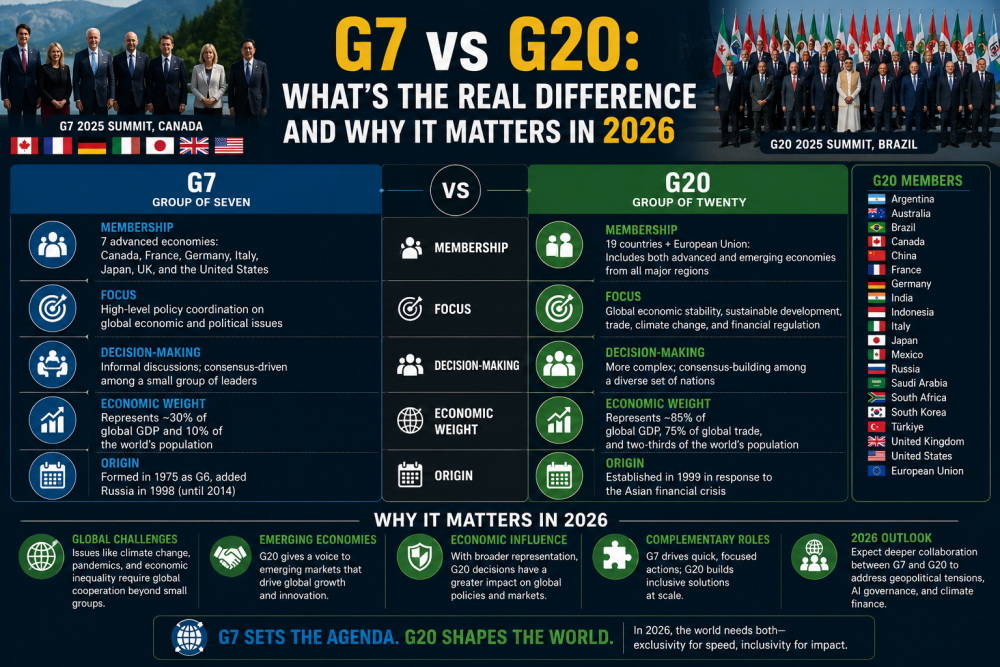
There's a version of international economics coverage where you see these two acronyms constantly—G7 summit here, G20 communiqué there—and if you're honest, they blur together after a while. Both are groups of major economies that hold annual meetings. Both issue statements. Both get the same kind of solemn press photography: world leaders standing in rows, looking purposeful in front of flags.
But they're not the same thing, and the difference between them has become increasingly important as the global economy grows more fractured and multipolar. Understanding which group does what — and why one has effectively superseded the other for economic governance — is genuinely useful context for making sense of global headlines.
The Basic Membership Distinction
Start with the membership, because that tells you everything about the fundamental difference in purpose.
The G7 consists of seven nations: the United States, Canada, the United Kingdom, France, Germany, Italy, and Japan. These were the world's leading industrialized democracies when the group formed in 1975. All are mature market economies. All share broadly similar political values—democratic governance, rule of law, and free markets. That alignment is what makes the G7 capable of acting with relative speed and cohesion, particularly on political and security matters.
The G20 is a significantly larger forum, consisting of 19 countries plus the European Union—and more recently, the African Union as a full member. The members span the entire spectrum of global economic development: the G7 members plus China, India, Brazil, Argentina, Australia, Indonesia, Mexico, Russia, Saudi Arabia, South Africa, South Korea, and Turkey. This brings in roughly 85% of global GDP, 75% of international trade, and two-thirds of the world's population.
Those numbers immediately explain why the G20 matters for economic governance: any coordinated response to a global financial crisis, trade disruption, or debt problem requires the participation of China, India, and Brazil. You can't restructure sovereign debt for developing nations without China in the room. You can't establish global minimum tax rules without getting major emerging economies to sign on. The G7 alone simply doesn't have the coverage to do it.
What Each Group Actually Does
The clearest way to understand the difference is to look at what each group actually spends its time on.
The G7 has become primarily a forum for political alignment among like-minded democracies. It coordinates responses to geopolitical events—additional support for Ukraine, responses to conflicts, sanctions regimes, and defense of what members call the rules-based international order. At the 2026 summit, leaders demonstrated unity on Ukraine support and efforts to address the Iran situation. These are actions that require political consensus rather than economic breadth — and the G7's shared values make that consensus achievable in ways it simply isn't in a larger, more ideologically diverse forum.
The G7 also functions as an agenda-setter: the political commitments made there often get taken to the G20 for broader implementation, particularly on economic matters. Think of it as the policy kitchen where ideas get developed and the G20 as the larger dining table where they get served to the full range of relevant parties.
The G20 handles the economic architecture of the world. Financial regulation, tax cooperation, debt sustainability for developing countries, digital economy governance, global minimum tax standards, climate finance — these are G20 domains. When the 2008 financial crisis hit, world leaders quickly elevated the G20 to its current status because the G7 alone wasn't capable of orchestrating the coordinated response required. At the Pittsburgh Summit in 2009, G20 leaders formally designated their forum as the "premier forum for international economic cooperation," effectively displacing the G7 from the center of global economic governance.
That designation has stuck and arguably deepened. The challenges the global economy faces in 2026—tariff disruptions and trade fragmentation, supply chain security concerns, AI governance, sovereign debt stress in developing nations, and energy transition finance—all require China, India, Brazil, and others to be at the table. The G20 is where that conversation happens.
The GDP Shift That Changed Everything
To understand why the G20 now carries more economic weight than the G7, the data tells a stark story.
In 1994, G7 countries collectively accounted for 67% of global GDP. By 2022, that share had fallen to approximately 44%, and the trajectory has continued. This isn't because G7 economies shrank — it's because emerging economies, particularly in Asia, have grown dramatically. China is now the world's second-largest economy. India has become the fifth largest. Brazil, Indonesia, and South Korea are major economies by any measure.
The G20's share of global GDP, by contrast, has remained relatively stable around 80%, because the growth in emerging markets is captured within the G20 membership. This stability reflects a fundamental reality: if you want a forum that represents where global economic power actually sits, it's the G20, not the G7.
This shift has geopolitical implications beyond just the numbers. The G7's declining share of global GDP means its ability to set economic standards unilaterally has diminished. When the G7 attempts to coordinate things like tariffs, export controls, or sanctions, the effectiveness of those measures depends significantly on whether major non-G7 economies cooperate or circumvent them. China's presence in global supply chains means that G7 export controls on semiconductors, for example, only partially achieve their goals without the cooperation of other technology-importing nations.
The Division of Labour in Practice
The relationship between the two groups is often described as a division of labor, and that framing is useful—though it slightly underplays the tension between them.
The G7 functions best as a rapid-response political mechanism. When Russia invaded Ukraine in 2022, the G7 could quickly coordinate sanctions, financial freezing of Russian assets, and military support packages precisely because all seven members share broadly aligned political values and security interests. The G20 couldn't do the same: Russia is a G20 member, and China and India declined to condemn the invasion. The G7's coherence is its primary advantage.
The G20 functions best as a standard-setting and crisis-response mechanism that requires global buy-in to be effective. The OECD's global minimum corporate tax rate — a 15% floor designed to prevent multinational tax avoidance — was developed within G20 frameworks precisely because getting major non-G7 economies to adopt it was essential to making it work. If only G7 countries had adopted the minimum rate, multinationals would simply have relocated profits to non-participating jurisdictions.
The practical result is a two-speed international cooperation architecture: the G7 for political and security alignment among democracies, and the G20 for the broader economic and regulatory cooperation that requires near-universal participation.
Critics on Both Sides
Neither group escapes legitimate criticism, and in 2026 those criticisms are well-established.
The G7's critics have a fundamental structural point: the group no longer represents the world's most powerful economies by the metrics that matter. It excludes China, India, and Brazil from full membership. This creates a representational problem when the G7 attempts to set norms or standards for the global economy — it's a minority of global GDP attempting to set rules for the majority. The Council on Foreign Relations notes that "due to internal divisions and the rise of alternative institutions such as the G20, some experts have questioned the G7's relevance" as an economic body.
The G20's critics point in a different direction: the forum is structurally difficult to reach consensus within, precisely because of its diversity. Getting 20 major economies with genuinely different interests to agree on meaningful policy is harder than it sounds, and G20 communiqués are often characterized by the diplomatic vagueness needed to produce consensus. The declarations are non-binding. Implementation is uneven. And the presence of both democratic and authoritarian states creates fundamental disagreements about values that sometimes make substantive cooperation impossible.
Both criticisms have merit. The answer, most analysts suggest, isn't to abolish either group but to be clear-eyed about what each does well and what falls outside its reach.
BRICS: The Third Dimension
Any 2026 discussion of G7 versus G20 is incomplete without acknowledging the rise of BRICS—the grouping of Brazil, Russia, India, China, South Africa, and more recently expanded to include Saudi Arabia, the UAE, Egypt, Ethiopia, and others.
BRICS represents something different from both the G7 and G20. Where the G7 is a values-based club of liberal democracies and the G20 is a practical economic cooperation forum, BRICS is increasingly being positioned as an alternative power structure for countries that view the G7-led international order as serving Western interests at the expense of the global South.
The BRICS project has gained momentum with discussions of alternative reserve currencies, development banking through the New Development Bank, and trade settlement outside the US dollar. Whether these ambitions materialize significantly is debated, but the existence of the BRICS forum signals something important: the G20 itself may not fully contain the appetite among major emerging economies for a different kind of international institutional architecture.
This dynamic is part of why G7 leaders have made deliberate efforts to co-opt influential Global South nations—regularly inviting India, Brazil, and South Africa to G7 summits as "guest nations"; building bilateral relationships; and attempting to demonstrate that the G7's values-based framework can coexist with those nations' interests.
Why the Distinction Matters in 2026
The specific context of 2026 makes the G7/G20 distinction more consequential than usual, for several reasons.
Trade fragmentation is accelerating. US tariff policies, reshoring efforts, and supply chain security concerns have produced a more fractured global trade environment. Managing that fragmentation — avoiding a full-scale breakdown of the trading system that has underpinned global growth since World War II — requires the kind of broad cooperation that only the G20 can facilitate.
AI governance is an emerging area where both forums are active but neither has produced binding standards. The G7 issued its Hiroshima AI Process in 2023—a set of principles for responsible AI development among G7 members. But meaningful AI governance for the full global economy requires China and India's participation, making the G20 the relevant forum for any standards that could actually stick globally.
Debt relief for developing nations remains a critical unresolved issue. The G20's Common Framework for debt treatment was designed to address this, but progress has been slow partly because China—as a major bilateral creditor—and Western creditors have struggled to agree on burden-sharing. The G7 can advocate, but the G20 is where any actual deal has to be reached.
The US G20 presidency in 2026 adds additional significance. The United States holds the G20 presidency this year (following South Africa's 2025 presidency), which gives the US significant agenda-setting influence over the forum's priorities. That influence comes at a moment when US foreign economic policy is in a notably different place than it was five years ago.
The Honest Summary
Here's the clearest way to think about it.
The G7 is a club of like-minded democracies that can agree quickly and act in concert on political and security matters but represents a declining share of the global economy and cannot produce binding economic agreements that cover the whole world.
The G20 is a broad economic cooperation forum that covers the whole global economy but often struggles to reach meaningful consensus precisely because of its diversity of interests and values.
Neither is perfect. Neither is going away. And the tension between them — between the speed and coherence of a small, values-aligned group and the representational breadth of a large, diverse one — is one of the defining structural tensions of global economic governance in the 2020s.
When you see a G7 summit make news, it's likely a political or security story. When you see a G20 communiqué, it's likely an economic or regulatory one. That distinction, simple as it sounds, goes a long way toward making sense of international economic coverage.