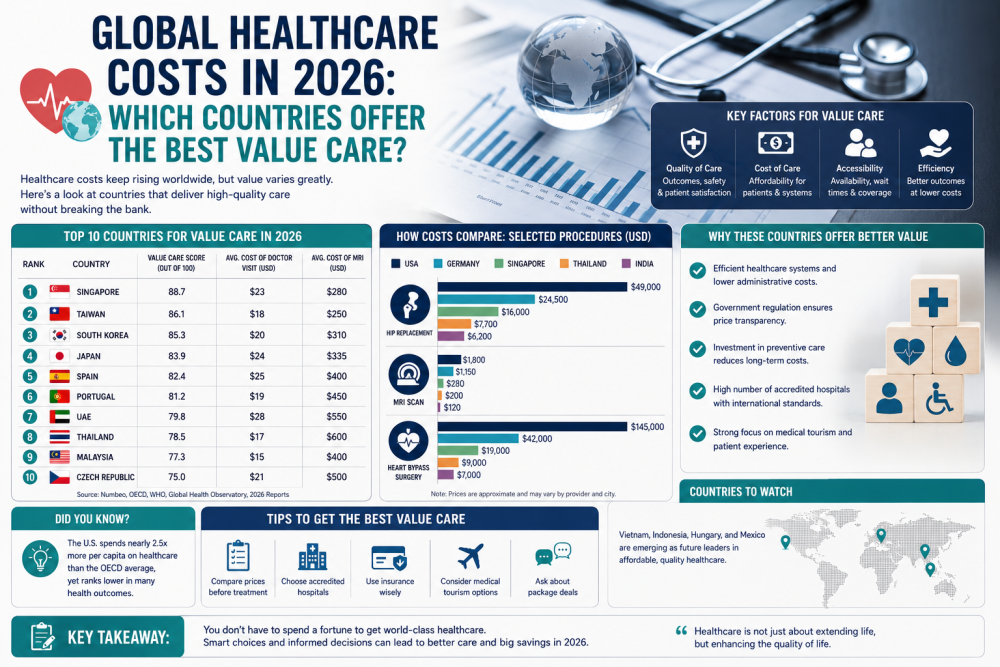
Healthcare is one of those topics where the data consistently confounds the instinct that spending more produces better outcomes. The 2026 edition of this story is no different—and in some ways the gap between what countries spend and what they get for it has become wider and more politically significant.
The numbers are striking. Taiwan ranks first on Numbeo's 2026 Health Care Index, scoring 87 out of 100 on quality measures that include medical infrastructure, staff competency, wait times, and patient experience. Taiwan spends roughly $2,400 per person annually on healthcare. The United States, which spends approximately $13,500 per person — more than any other country on Earth — ranks 40th. That's not a rounding error. It's a structural failure.
But the answer to "Which countries offer the best value care?" isn't simply "countries that spend less." It's more specific: countries that achieve universal or near-universal coverage, strong primary care infrastructure, and efficient administrative systems—regardless of whether they achieve that through tax-funded systems, social insurance models, or well-regulated mixed approaches.
Here's a country-by-country look at what value healthcare actually looks like in 2026.
Taiwan: The Efficiency Benchmark
Taiwan's single-payer national health insurance system covers essentially the entire population. Patients use a smart card to access care at any registered provider—hospitals, clinics, specialists—with minimal administrative friction and predictable low co-payments. Registration, consultation, basic tests, and medication for routine conditions can often be completed within a few hours at a good urban clinic.
The administrative overhead is low because there's one payer, one claims system, and one integrated electronic health record infrastructure. American patients visiting Taiwan for medical care consistently report the experience as faster, less paperwork-intensive, and dramatically cheaper than equivalent care back home.
Taiwan's healthcare quality scores are exceptional across the metrics that matter: cancer survival rates, cardiovascular outcomes, maternal mortality, and preventable death rates all compare favorably with much wealthier countries. The system is not without problems—physician workload is high, rural coverage is uneven, and the system's financial sustainability requires periodic adjustment—but the value-for-money comparison with higher-spending countries is striking.
For context: an MRI in Taiwan costs approximately $100-150. The same scan in the United States averages $1,000-3,000 depending on location and insurance status.
South Korea and Japan: Universal Coverage With Density
South Korea and Japan both sit near the top of global healthcare rankings with systems that share several common features: mandatory social health insurance with broad coverage, dense hospital and specialist networks, extremely low wait times by international standards, and high patient satisfaction.
South Korea operates through the National Health Insurance Service, covering essentially all residents. The country has the highest number of hospital beds per capita of any OECD nation and some of the world's fastest access times to specialist care. South Korea has become a significant destination for medical tourism precisely because both the quality and cost are attractive—international patients can access specialist procedures, cosmetic surgery, and diagnostics at a fraction of US or UK prices while receiving care that matches Western clinical standards.
Japan combines universal mandatory health insurance with a system of registered clinics and hospitals where co-payment rates are modest (typically 30% of fees, with caps that prevent catastrophic out-of-pocket costs). Japan consistently ranks among the world's leaders in life expectancy, cancer survival rates, and chronic disease management. The system produces strong outcomes at per-capita spending approximately 40% of the US level.
Both countries are confronting aging populations that will place increasing strain on their systems over the next decade — a challenge that will require policy adjustments. But in 2026, both deliver reliable, high-quality care at costs that make the US comparison uncomfortable.
Germany: The Social Insurance Model That Works
Germany's healthcare system is one of the world's oldest, tracing its statutory health insurance (GKV) framework back to Bismarck in 1883. Today, the system operates through roughly 97 non-profit "sickness funds" (Krankenkassen) that provide comprehensive coverage to about 90% of the population. The remaining 10% use private insurance.
Prices in the German system are tightly regulated through framework agreements between insurers and medical associations. While total costs are not low by global standards — Germany spends approximately €6,000 per person annually — out-of-pocket costs for covered residents are predictable and capped. You won't go bankrupt from a German hospital stay if you're insured, which is more than can be said for many American patients.
Germany's access to specialist care is reasonably fast, though not as immediate as Japan's or South Korea's—typical specialist wait times are 1-3 weeks for non-urgent conditions. The quality of hospital care, particularly for complex conditions, is world-class. German cancer centers, cardiac surgery units, and orthopedic specialisms attract international patients.
For travelers and expats considering European healthcare, Germany's public system is comprehensive but requires legal residency and contribution to a sickness fund. Visitors are covered for emergency care under EU mutual recognition agreements (for EU citizens) or must rely on travel insurance.
France: The Most Comprehensive European System
France consistently tops or near-tops international healthcare quality rankings. The French system operates on a social insurance basis—called Sécurité Sociale—with the state paying 70-100% of healthcare costs depending on the condition and the patient's situation. Serious illnesses (cancer, diabetes, major surgery) are typically covered at 100% with no patient copayment. Routine care involves modest co-payments that most people recover through supplementary insurance (mutuelle).
French patients have a genuine choice of provider—they can see any GP, specialist, or hospital in the system. Wait times for specialists are moderate, though there's variation by specialty and region. The pharmaceutical system provides access to an extensive formulary at regulated prices, substantially lower than comparable drugs in the US.
France spends approximately €4,300 per person annually on healthcare — roughly a third of the US level — and produces outcomes that are at least comparable and in some measures superior. Life expectancy is higher. Preventable death rates are lower. Infant mortality is lower.
For international visitors, France's healthcare is accessible in emergencies and for EU citizens through the European Health Insurance Card (EHIC). Non-EU visitors should carry comprehensive travel insurance, as tourist healthcare costs without coverage can be significant even if lower than US equivalents.
Thailand: The Value-for-Money Case in Asia
Thailand's healthcare system shouldn't be as good as it is given per capita income levels—which is precisely what makes it interesting.
The country ranks 8th on Numbeo's 2026 Health Care Index despite spending approximately $350-400 per person annually on healthcare—a small fraction of what European countries spend. The reason Thailand achieves this is a combination of a government-funded Universal Coverage Scheme (accessible to all Thai citizens), a strong private hospital sector, and remarkably low costs relative to quality.
Thailand is the world's leading medical tourism destination. Bumrungrad International Hospital in Bangkok and Bangkok Hospital both consistently rank among the world's best private hospitals, offer Joint Commission International accreditation (the US gold standard for hospital accreditation), and provide specialist care at 20-50% of equivalent US costs. Hip replacement at Bumrungrad: approximately $13,000-15,000. Equivalent procedure in the US: $40,000-100,000 depending on insurance.
For international visitors needing medical care — not emergency tourists but people who travel specifically for planned procedures — Thailand combines high clinical quality with prices that make self-pay viable even without insurance. Cardiac surgery, oncology, joint replacement, dental work, and ophthalmology are the most common areas.
The caveats: rural healthcare in Thailand is significantly less developed than urban care. The world-class private hospitals are in Bangkok and a handful of other major cities. For routine day-to-day healthcare as a long-term resident outside major urban areas, the picture is more mixed.
Singapore: Premium Quality, Premium Cost (But Still Not US-Level)
Singapore operates a three-tier system called 3Ms: Medisave (individual savings for healthcare), MediShield Life (catastrophic coverage insurance), and Medifund (safety net for those who can't afford care). The system requires personal financial participation in healthcare costs—it's the least paternalistic of the universal coverage models—but the government also heavily subsidizes public hospital care in ward classes that the majority of Singaporeans use.
Singapore's healthcare quality is exceptional across almost every measure. Surgical outcomes, infection rates, diagnostic accuracy, and clinical standards are world-class. The country consistently attracts medical tourists from Southeast Asia, South Asia, and the Middle East.
Healthcare costs in Singapore are substantially higher than Thailand's or the rest of Southeast Asia's—more comparable to European than Asian pricing for private care—but still well below US levels. The system produces outcomes that compare favorably with any country in the world.
For expatriates living in Singapore, the system works well. For tourists needing urgent care, comprehensive travel insurance is essential, as out-of-pocket costs without coverage are significant.
The United States: The World's Most Expensive, 40th-Best System
The Commonwealth Fund's 2026 international health comparison is characteristically direct: "Americans pay more for health care, get less in return, and remain far more exposed to illness, debt, and insecurity than their peers."
The per-capita spending number — approximately $13,500-14,000 in 2026, up from previous years — is staggering against any international comparison. Germany at $6,000 gets better outcomes. France at $4,300 gets comparable outcomes. Japan, at $5,500, gets better life expectancy. Taiwan at $2,400 ranks first overall.
The structural reasons are well-documented: high administrative costs from a fragmented multi-payer insurance system, limited price regulation on pharmaceuticals and medical devices, expensive labor costs for clinical staff, and a system historically oriented around acute treatment rather than preventative care.
Twenty-nine percent of Americans are skipping needed care because of cost. Medical debt is the leading cause of personal bankruptcy. Thirty million Americans without health insurance (a number that has grown under recent federal policy changes). These are not outcomes that a $13,500 per-person annual spend should produce by any reasonable comparison with peers.
For international visitors to the US: travel insurance with substantial medical coverage is essential. A serious accident or illness requiring hospitalization without insurance produces bills that are routinely catastrophic. An ambulance ride can cost $3,000-5,000. An emergency room visit for a broken arm: $5,000-15,000. A few days of hospitalization for a serious condition: $30,000-100,000 or more.
The UK: Good Value for Residents, Limited for Visitors
The NHS in 2026 is a system making genuine progress from a position of genuine difficulty—as covered in previous analysis. For UK residents, the NHS provides comprehensive healthcare coverage with no point-of-care cost for most services. GP visits are free. Hospital treatment is free. Prescriptions are free for many categories of patients.
For visitors, the picture is more complicated. Emergency treatment is available to all regardless of residency status, and there's no expectation that emergency patients will pay before receiving care. But the NHS charges for non-urgent treatment to people who aren't usually UK residents, and travel insurance for UK visitors is advisable.
The quality of NHS care is high for serious and complex conditions—the UK has excellent cancer centers, cardiac surgery, neurology, and transplant programs. The pressure points are primary care access (GP appointments), routine elective procedures (with the waiting list recovery underway but still at 7.1 million patients), and A&E waiting times. For visitors needing urgent but non-emergency care, walk-in centers are available and typically faster than A&E for minor conditions.
What Makes a High-Value Healthcare System
The 2026 global rankings reinforce a pattern that's been consistent for years: the systems that deliver the best outcomes per dollar spent share several characteristics regardless of which specific funding model they use.
Universal or near-universal coverage. Every top-ranked system covers its population broadly. Countries where large portions of the population lack coverage produce worse average outcomes and higher costs, because uninsured people avoid preventative care and arrive at emergency rooms with advanced conditions that are more expensive to treat.
Strong primary care. Countries where GPs and family physicians are the first point of contact, well-resourced, and accessible prevent problems from escalating to secondary and tertiary care. Healthcare systems where the ER is the primary care option for uninsured patients generate enormous unnecessary costs.
Administrative simplicity. The United States employs more healthcare administrative staff per hospital than any comparable country—not because US hospitals are larger, but because the multi-payer insurance system requires armies of billing specialists, prior authorization managers, and claims processors. Single or limited-payer systems dramatically reduce this overhead.
Price regulation. Every country that achieves better outcomes at lower cost exercises some form of price regulation on drugs, medical devices, and services. The US is unusual in its absence of such regulation.
Preventative care investment. The countries that spend on early detection, vaccination, chronic disease management, and public health reap long-term savings in avoided acute care.
None of these observations are new. The 2026 data confirms the same conclusions that international health comparisons have been producing for decades. What changes year by year is primarily the magnitude of the US spending gap, which has continued to widen.