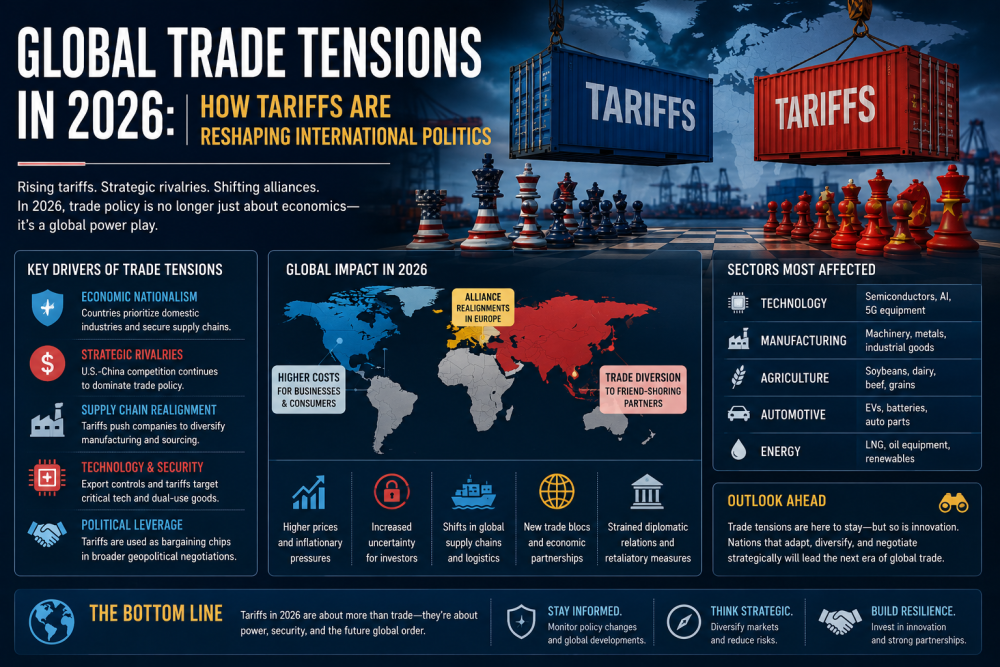
The conversation about tariffs is easy to get wrong in two directions. One error is treating them as purely technical instruments—tax rates on goods, adjusted mechanically, producing predictable economic outcomes. The other error is treating them as purely political theater—chest-thumping that creates noise without fundamentally changing anything.
The reality of 2026 is somewhere more complicated and more consequential than either framing allows. Tariffs have become genuinely geopolitical tools, deployed not just to protect domestic industries or reduce trade deficits but to punish geopolitical rivals, discipline allies, and assert national security interests in ways that previous administrations were reluctant to attempt. That shift — from tariffs as economic instruments to tariffs as geopolitical weapons — is the story of global trade in 2026.
Where the Numbers Stand
The scale of change is significant. By the end of 2025, US tariff rates stood at their highest level since World War II. McKinsey's March 2026 Global Trade Update found that the increases reshaped trade along geopolitical lines, pushing more than $165 billion in trade away from the US-China corridor and deepening a realignment already underway.
Global trade had a record year in 2025—UNCTAD's preliminary data points to a 7% increase to exceed $35 trillion for the first time. But growth is expected to slow in 2026, and the composition of that trade has changed significantly. AI-related trade grew close to 40% against a 6.5% global average in 2025, while energy resources contracted by around 9%. The supply chain of advanced technology and AI infrastructure has become the fastest-growing trade corridor, while the old energy-and-manufactured-goods structure of global commerce is under pressure.
UNCTAD's January 2026 trade update is direct: "Governments are expected to continue using tariffs in 2026 to pursue industrial and strategic objectives. Frequent policy shifts increase uncertainty, discourage investment, and disrupt supply chains."
The US-China Realignment: A Decade in the Making
The shift away from US-China trade is the single most significant structural change in global commerce over the past several years. US imports from China have returned to near 2001 levels—when China entered the World Trade Organization—an extraordinary reversal for a trade relationship that had grown continuously for two decades.
Harvard Business School research by Laura Alfaro suggests that companies were already positioned to adjust to the 2025 tariff levies before they arrived. The "great reallocation" was not entirely the result of policy shock—it was an acceleration of trends that had been building since 2018, when the first major US-China tariffs were imposed during the first Trump administration.
Where has that trade gone? Primarily to Mexico, Vietnam, India, and a set of countries not directly targeted by US tariffs. US imports from Mexico have grown substantially. The reshaping of supply chains toward "friendshoring"—working with countries seen as geopolitically aligned—has been visible in trade data for several years. Tariffs accelerated it rather than initiated it.
Tariffs as Geopolitical Punishment
What distinguishes 2026's trade environment from earlier periods of protectionism is the increasingly explicit use of tariffs for political rather than purely economic purposes. LSE's Public Policy Review documents this shift directly.
In July 2025, the US imposed a 40% tariff on top of the baseline 10% on Brazil to punish the Brazilian government over its prosecution of former president and Trump ally Jair Bolsonaro. In August 2025, the US imposed 50% tariffs on India, partly as punishment for India's decision not to stop purchasing Russian oil. The administration also threatened tariffs against European plans to impose a digital services tax targeting US technology companies.
These actions mark a departure from previous approaches to tariff policy. Rather than being calibrated to specific economic rationales—protecting a domestic industry, addressing a trade deficit—they're being used as diplomatic leverage across a wide range of political disputes. "The tariff threat against Brazil," as the LSE analysis notes, "represents a kind of economic coercion that has few precedents in post-war Western trade policy."
This approach generates real geopolitical disruption. Countries that previously relied on consistent US trade rules are now managing uncertainty about whether any trade relationship with the US is durable. That uncertainty has practical effects — it discourages long-term investment decisions that depend on stable trade conditions, as rational boardrooms will not risk years of profit by breaking ground on new facilities if tariff rates might shift again.
The Supreme Court Challenge and Tariff Volatility
Adding a distinctly American legal dimension to the story: the basis of the Trump administration's tariff authority has faced significant constitutional challenge.
In February 2026, the US Supreme Court ruled that tariffs imposed under the International Emergency Economic Powers Act (IEEPA) were unconstitutional without clear congressional authorization. This was a significant ruling that stripped the administration of the specific authority used for many of the 2025 tariff increases. The administration responded by ending the IEEPA-based tariff program and imposing a temporary 10% global tariff under Section 121 of the Trade Act of 1974.
That 10% global tariff was then ruled unlawful by the US Court of International Trade in May 2026, which directed Customs and Border Protection not to apply those duties. The administration has challenged those rulings and imposed tariffs under alternative authorities.
The result for businesses is genuine whiplash. KPMG's survey data from February 2026 found that half of all business leaders reported "low confidence in executing their investment plans and "strategy"—specifically because the tariff environment changes faster than investment cycles. A factory that takes two to three years to build and requires a stable cost of imported components to be economically viable cannot be planned on the assumption that tariffs might be 10%, 15%, 50%, or zero depending on a court ruling or executive order in any given quarter.
This legal volatility is distinct from but compounds the political volatility. Companies operating in good faith can't plan around a tariff environment that changes not just with political developments but with court rulings that are themselves subject to appeal.
Global Retaliation and Trade Fragmentation
The US tariff program has not gone unanswered. Retaliatory measures have come from multiple directions.
Canada imposed a 25% counter-tariff on select US products. Mexico is expected to announce its own retaliatory measures. China placed tariffs on agricultural exports from the US, with exports to China of soybeans — the largest category — dropping dramatically when similar tariffs were imposed in 2018 and facing similar pressure now. The European Union, under pressure from US digital services tax threats, is navigating how to respond without triggering a full trade war that would hurt European industries more than US ones.
At the multilateral level, UNCTAD notes that the World Trade Organization's 14th ministerial conference is taking place "amid rising unilateral tariffs and geopolitical tensions, putting pressure on multilateral trade rules. " The WTO dispute settlement system—the mechanism designed to adjudicate trade conflicts according to agreed rules—has been effectively paralyzed for years because the US blocked appointments to the Appellate Body (the WTO's final appeal court). Without functional dispute resolution, countries that believe they've been subjected to illegal tariffs have limited recourse beyond retaliation.
ING's trade analysis describes this as global trade entering "a new period of slower growth and greater fragmentation" where "geopolitics continues to prevail over efficiency." This is a real structural shift, not a temporary disruption.
The Middle East Conflict as Supply Chain Shock
Overlaid on the tariff-driven trade fragmentation is the energy supply disruption caused by the US-Iran conflict that began in late February 2026. The closing of the Strait of Hormuz — or even partial restriction of traffic through it — has profound implications for global energy markets that feed into trade costs everywhere.
During the week of May 8, 2026, just 4 oil tankers passed through the Strait of Hormuz, compared to a weekly average of 102 ships. That's not a minor disruption — it's a near-complete choking of one of the world's most critical oil transit routes. The IMF, in its April 2026 assessment, was direct: "The closing of the Strait of Hormuz and serious damage to critical facilities in a region central to global hydrocarbon supply raise the prospect of a major energy crisis should hostilities continue."
For businesses in any sector with significant transportation costs—which is most businesses—elevated energy prices are a compounding cost pressure on top of tariff-driven input cost increases. The combination is particularly difficult for small and medium enterprises that lack the hedging sophistication of large multinationals.
The USMCA Review: Another Uncertainty Factor
The United States-Mexico-Canada Agreement, the trade deal that replaced NAFTA, is due for its required review in July 2026. Official statements from the Trump administration have hinted at the possibility of the deal lapsing altogether or being replaced with separate bilateral agreements.
For businesses with supply chains integrated across the US, Mexico, and Canada — particularly automotive, agriculture, and manufacturing — the USMCA review is a source of significant concern. The deal provides duty-free access for many goods traded between the three countries. If it lapses or is renegotiated to significantly different terms, supply chains built around its provisions face disruption.
Mexico in particular has become a major nearshoring destination for companies diversifying away from China. A deterioration in the US-Mexico trade relationship would complicate one of the primary adaptation strategies that companies have been deploying.
What It Means Practically
The world that businesses are operating in today is genuinely different from the one that existed five years ago, and not just incrementally. Several durable shifts are now visible in the data:
Friendshoring is real. The movement of supply chains toward geopolitically aligned trading partners has structural momentum independent of any specific tariff level. Even if tariff rates changed tomorrow, the factory investment decisions made over the past two to three years have shifted production away from China and toward Vietnam, India, and Mexico in ways that won't quickly reverse.
The dollar's global reserve role is diminishing. The dollar's share of global reserve currencies has fallen from 70% in the early 2000s to around 56% in 2026. Geopolitical tensions — including the use of dollar-denominated financial systems as sanctions tools — have pushed countries to diversify their reserve holdings and seek alternative settlement mechanisms for trade.
AI-related trade is the new growth corridor. Advanced semiconductors, AI infrastructure components, and related goods are the fastest-growing trade category. The geopolitical contest over this supply chain—semiconductor export controls and restrictions on technology transfer—is as significant as any tariff regime.
For governments and businesses trying to navigate this environment, the adaptation required is not just tactical (which suppliers to use, which countries to source from) but also strategic (how to build supply chain resilience that can accommodate policy volatility at a speed that doesn't exist in previous eras of trade policy).