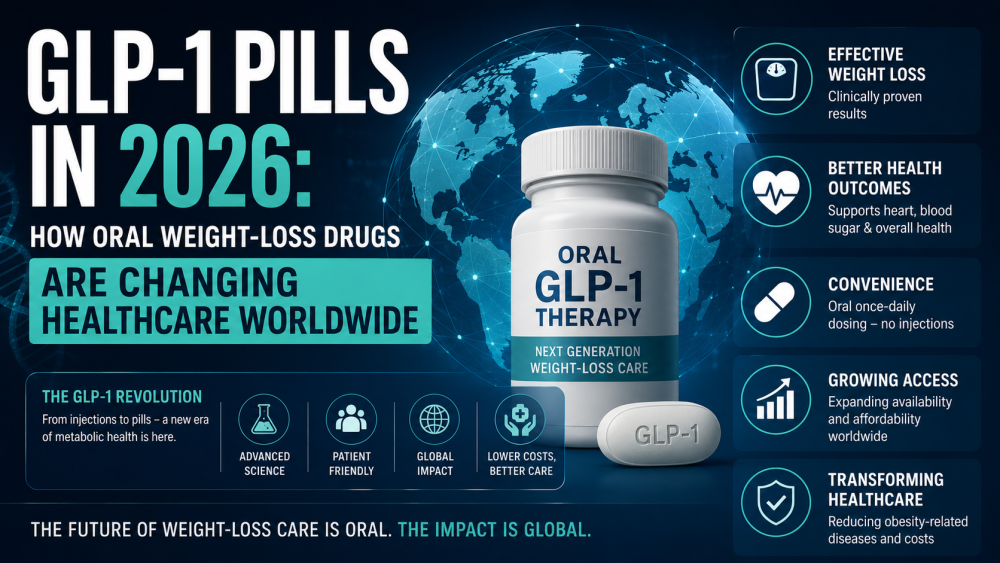
For years, the biggest complaint about GLP-1 weight-loss medications wasn't whether they worked—it was that you had to inject yourself once a week to take them. For millions of people, that was genuinely the dealbreaker. Not just squeamishness either. There were real logistical barriers: needles, refrigeration, the kind of medical-feeling routine that made people feel like patients rather than people trying to manage their weight.
That changed at the end of 2025. On December 22nd, the FDA approved the Wegovy pill—the first oral GLP-1 medication for obesity treatment. Then in April 2026, Eli Lilly's Foundayo (orforglipron) followed. Suddenly, a class of drugs that had already transformed obesity medicine became something you could take with a glass of water and a daily routine rather than a syringe.
The shift sounds incremental. It isn't. It may be one of the more consequential changes in how obesity and metabolic disease get treated—not just in the US, but globally.
A Quick Recap: What GLP-1 Drugs Actually Do
GLP-1 stands for glucagon-like peptide-1, which is a hormone your gut naturally releases after eating. It helps regulate blood sugar, slows how quickly your stomach empties, and—crucially for the weight-loss story—tells your brain you're full. GLP-1 receptor agonists are drugs that mimic this hormone, amplifying signals your body already uses to manage appetite and glucose.
They were originally developed for type 2 diabetes. Ozempic, Rybelsus, Mounjaro—these started as blood sugar medications before researchers and patients noticed a consistent side effect: significant weight loss. That observation kicked off one of the bigger drug development sprints in recent pharmaceutical history.
Injectable versions like Wegovy and Zepbound have been the dominant form. They work well. But they've also come with a long list of access problems—supply shortages, high prices, and that injection barrier—that kept them out of reach for most people who could have benefited.
What's Actually New in 2026
The Wegovy Pill
Novo Nordisk's oral semaglutide—sold under the same Wegovy brand name as its injectable counterpart—launched in January 2026 after FDA approval the month before. It's a once-daily pill, taken with a small amount of water, and it delivers weight loss results broadly comparable to the injectable version for many patients.
The early pricing was notable. Novo Nordisk committed to a $149/month introductory price for the lower doses for self-pay patients, a significant discount compared to injectable Wegovy's pre-deal list price of around $1,350/month. Higher doses run up to $299/month, which is still more affordable than the injectable versions were at their peak.
There's a catch worth knowing: the pill contains SNAC (salcaprozate sodium), an absorption enhancer that helps the peptide survive digestion. This means it needs to be taken on an empty stomach with just a small amount of water—no coffee, no breakfast—and you need to wait at least 30 minutes before eating. For people who wake up and immediately need food or medication, that's a real consideration.
Foundayo (Orforglipron)
Eli Lilly's entry, approved in April 2026, is structurally different. Orforglipron is a small molecule—not a peptide—which means it doesn't need absorption enhancers or food restrictions. You can take it any time of day, with or without food, with any amount of water. That's a meaningful practical advantage over the Wegovy pill for a lot of patients.
Clinical results from the ATTAIN Phase 3 trials showed meaningful weight loss—people with obesity and type 2 diabetes lost an average of roughly 22.9 pounds on the highest dose over about 17 months—and blood sugar improvements consistent with injectable GLP-1 medications. Lilly has been explicit that it's planning global regulatory submissions and has expressed confidence in its ability to scale production worldwide without the supply constraints that plagued earlier injectable rollouts.
Medicare patients may be able to access Foundayo for as little as $50/month through the GLP-1 Bridge Program beginning July 2026, which is a substantial shift in affordability for older Americans.
Why the Pill Format Changes Everything
This isn't just about convenience, though convenience matters.
Think about someone who's been managing type 2 diabetes and obesity for years, living in a rural area where their local pharmacy can't reliably maintain the cold-chain storage that injectable GLP-1s require. Or someone who travels frequently for work and can't consistently keep medications refrigerated. Or, frankly, just someone who hates needles enough that a weekly injection was never going to happen regardless of how well the medication worked.
Pills eliminate the cold-chain problem almost entirely. No refrigeration required, which is a significant barrier to global access—particularly in regions without reliable cold-storage infrastructure. Eli Lilly specifically cited this when discussing orforglipron's global potential. Novo Nordisk's manufacturing expansion has been partly driven by the same logic.
There's also the psychology of it. Several physicians have noted that some patients find a daily pill "more acceptable or approachable" than an injection—not because the efficacy is wildly different, but because it feels less medicalized. That's not a trivial consideration when you're trying to actually reach the roughly 98% of the obese population that still isn't using GLP-1 medications at all.
The Global Picture: Access, Supply, and What's Different This Time
GLP-1 penetration remains remarkably low globally. Even with all the attention these drugs have received over the past few years, only about 7% of diabetes patients and 2% of the obese population worldwide are currently using them. The gap between the drugs' potential impact and their actual reach is enormous.
Oral formulations could meaningfully close that gap—but it won't happen automatically.
Lilly's manufacturing expansion targets the ability to launch orforglipron worldwide without supply constraints, which is a pointed reference to what happened with injectable tirzepatide (Zepbound/Mounjaro), where demand dramatically outpaced production. Both Lilly and Novo Nordisk have been investing heavily in new and expanded manufacturing facilities specifically to prepare for the oral pill market.
Regulatory timelines outside the US will vary. Lilly planned global submissions to regulatory agencies for type 2 diabetes in 2026, with obesity indications following. The European Medicines Agency, the UK's MHRA, and regulatory bodies in major markets like Japan, India, and Brazil each have their own review timelines—so "global availability" will be a phased rollout over the next two to three years rather than a simultaneous global launch.
For developing countries, the pricing question is more significant than the formulation question. At $149–$299/month even at current US introductory pricing, these medications remain expensive by global standards. Compounded versions and eventual generic competition (when patents expire) will matter enormously for whether the oral GLP-1 revolution actually reaches the populations that could benefit most.
Side Effects: The Same, Not Gone
It's worth being direct about this because some of the marketing around oral GLP-1s implies a smoother experience than the evidence actually shows.
The most common side effects of oral GLP-1 medications—nausea, constipation, diarrhea, and vomiting—are broadly similar to the injectable versions. They tend to be mild to moderate, and they usually improve as the body adjusts over the first few weeks. The dose-escalation strategy used with both the Wegovy pill and Foundayo (starting low and gradually increasing) exists specifically to manage this.
There are also rarer but more serious potential risks that carry over from the injectable class: a possible association with thyroid tumors (seen in rodent studies, hence the black-box warning), pancreatitis, and gallbladder issues. These aren't reasons to avoid the medications for appropriate patients, but they're reasons to take them under medical supervision rather than treating them like over-the-counter supplements.
The muscle loss question deserves mention too. GLP-1s help people lose significant amounts of weight, but some of that lost weight is muscle mass—a concern for older adults especially. Adequate protein intake and resistance exercise are generally recommended alongside these medications for this reason.
The Insurance and Cost Maze
Here's where things get complicated in 2026 and where a lot of people are running into frustrating walls.
Insurance coverage for GLP-1 medications has been splitting in two directions. Coverage for type 2 diabetes and cardiovascular risk is generally improving. Coverage specifically for weight loss has been tightening at many commercial plans—some requiring BMIs over 40 to qualify, even though obesity is clinically defined at a BMI of 30 or above. Pennsylvania, for example, eliminated Medicaid GLP-1 coverage for weight loss starting January 2026, and other states may follow.
Medicare coverage is expanding, though gradually. A GLP-1 Bridge Program is expected to make select approved medications available to eligible Medicare Part D beneficiaries for $50/month beginning July 2026—a significant shift for older Americans who previously had limited access.
Direct-to-consumer programs have expanded to fill some of the gap. Both Novo Nordisk and Eli Lilly now offer DTC pathways with home delivery. Telehealth platforms like Ro, Hers, and Noom offer compounded semaglutide versions at $99–$349/month—though it's worth knowing that compounded versions aren't FDA-approved finished products, which carries some quality uncertainty.
The broader picture for employers is tense. In 2024, 44% of employers with 500 or more employees covered weight-loss GLP-1s. Given that these drugs were costing over $1,000/month per patient before recent price negotiations, some employers are pulling back coverage even as utilization grows. The financial math is difficult for plan administrators, which creates a two-tier situation: people with strong coverage get access, and people without it are navigating a patchwork of options.
Beyond Weight Loss: The Expanding Role of GLP-1s
Weight and diabetes are the headline story, but they're not the whole story.
GLP-1 drugs are under active study for an expanding list of conditions. Cardiovascular benefits have been well-established—Wegovy is already FDA-approved for cardiovascular risk reduction. Ongoing research is examining their potential in non-alcoholic fatty liver disease (NAFLD), peripheral artery disease (Ozempic is under FDA review for PAD), heart failure with preserved ejection fraction, kidney disease, and even certain neurodegenerative conditions.
The neurology research is particularly interesting. There are early signals—not yet conclusive—that GLP-1 receptor agonists may have neuroprotective effects relevant to conditions like Alzheimer's and Parkinson's. This is at the investigational stage, but it's the kind of finding that expands how the medical community thinks about what these drugs fundamentally do.
If even a fraction of these additional indications pan out through further trials and FDA approval, the definition of what GLP-1 medications treat will look very different in five years than it does today.
A Realistic Look at What Changes (and What Doesn't)
It's easy to get swept up in the narrative of a category-defining drug class. And in many ways, GLP-1s deserve the attention. The clinical results for weight loss and metabolic health are among the strongest seen for a pharmacological obesity treatment.
But some perspective is useful.
These pills aren't magic, and they're not permanent. Most evidence suggests that stopping GLP-1 therapy—pill or injection—results in weight returning over time, which means many patients are looking at long-term or indefinite use. That has real cost implications that even the most optimistic insurance coverage doesn't fully resolve.
The people who benefit most are those who combine medication with sustainable lifestyle changes: not using the appetite suppressant as an excuse to eat poorly, maintaining physical activity, and getting enough protein. The drugs create a window of easier weight management; what people do with that window determines long-term outcomes.
Competition is also accelerating in ways that should benefit patients. AstraZeneca, Pfizer, Structure Therapeutics, and Viking Therapeutics all have oral GLP-1 candidates in various stages of development. A Goldman Sachs analysis projected the daily oral segment of the GLP-1 market could reach roughly $22 billion by 2030. With that kind of money at stake, the race to bring competing products to market will be fierce—and competitive pressure almost always drives prices down over time.
Where This Leaves Patients and Healthcare Systems
The arrival of oral GLP-1s in 2026 is genuinely significant—not just as a product launch, but as a structural change in how a class of treatments can reach people.
The injection-to-pill shift removes one of the most persistent access barriers. The cold-chain elimination opens doors in global markets that were practically closed before. The competitive dynamic between the Wegovy pill and Foundayo should drive prices lower over the next few years, and the eventual arrival of generics (still years away, but coming) will accelerate that further.
What won't resolve quickly is the coverage fragmentation, the affordability gap in lower-income countries, and the healthcare system capacity to actually manage the influx of patients these drugs could bring into clinics and telehealth platforms.
For individual patients trying to figure out whether to try an oral GLP-1: talk to a doctor who knows your full health picture. The drugs have real benefits and real risks, and neither the breathless enthusiasm nor the skepticism in the media fully captures the nuanced reality. For the right patient—someone with meaningful obesity, ideally with related metabolic risk factors, who understands this is a long-term tool rather than a temporary fix—the 2026 options are genuinely more accessible and more varied than anything that existed even twelve months ago.
That's real progress. It's just also more complicated than the headlines make it sound.