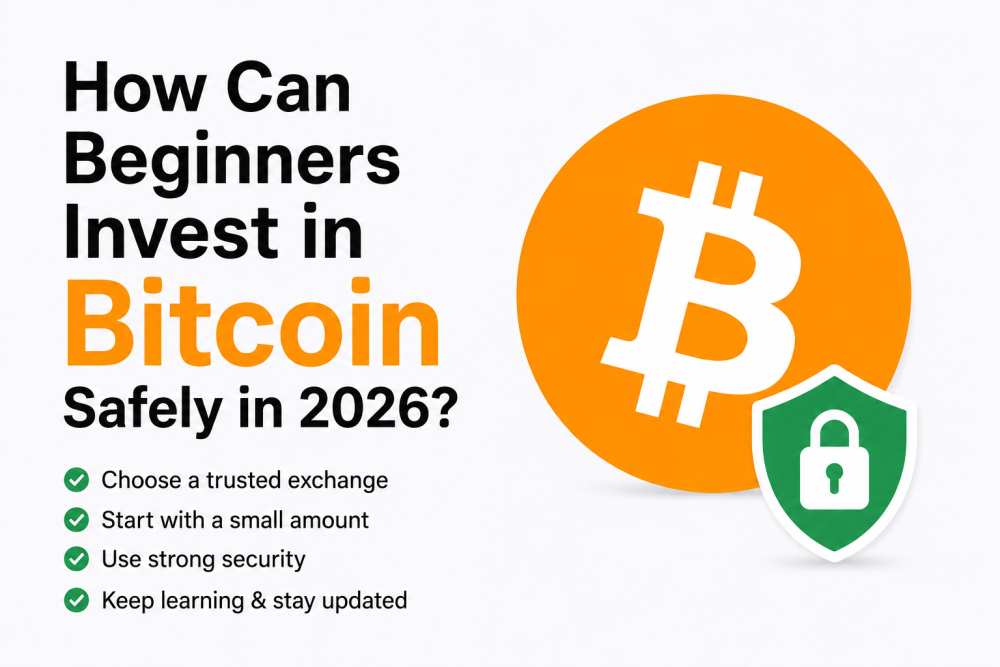
Straight answer up front: the safest way for a complete beginner to invest in Bitcoin in 2026 is either a spot Bitcoin ETF through a regular brokerage account or small regular purchases on a major regulated exchange like Coinbase or Kraken, using money you can genuinely afford to lose. That's the whole strategy for most people. Everything else in this article is detail, guardrails, and the mistakes I'd like you to skip.
And one thing before we go any further, because I'd rather be upfront than clever: I'm not a financial advisor, this isn't personal financial advice, and Bitcoin remains a volatile asset that has dropped 50 percent or more several times in its history and will probably do it again. What I can give you is a clear map of the options, the security habits that actually matter, and the traps that catch new investors over and over. What you do with that map is between you, your budget, and ideally a professional if serious money is involved.
Right. Let's get into it.
First, a Reality Check on "Safe"
There's no such thing as safely investing in Bitcoin the way there is safely putting money in an insured savings account. When people ask about safety here, they're really asking about three separate risks, and it helps to name them.
The first is price risk. Bitcoin's value swings hard. It's been through brutal crashes and spectacular recoveries, and nobody, not the YouTubers, not the bank analysts, not me, knows what it does next. You cannot eliminate this risk. You can only size your investment so a bad outcome stings rather than ruins.
The second is platform risk, the danger that the company holding your Bitcoin fails or freezes withdrawals. Anyone who was around for the FTX collapse in 2022 knows this one isn't theoretical. The industry has cleaned up considerably since, with tighter regulation in the US, Canada, the UK, and the Gulf, but choosing where you buy still matters enormously.
The third is you take a risk. Phishing links, fake apps, "investment managers" sliding into your DMs, forgotten passwords, coins sent to the wrong address. Honestly, in 2026, a careful beginner on a regulated platform is more likely to lose money to a scam or their own mistake than to an exchange collapse. The good news is this risk is almost entirely within your control, and most of this article is about controlling it.
The Easiest Route: Spot Bitcoin ETFs
If you already have a brokerage or investment account, you might not need a crypto exchange at all.
Since early 2024, spot Bitcoin ETFs have traded on regular stock markets in the US, and similar products exist in Canada (which actually had them first) and elsewhere. Funds like BlackRock's IBIT and Fidelity's FBTC hold actual Bitcoin, and you buy shares the same way you'd buy shares of Apple. No wallets, no seed phrases, no new apps, and the whole thing sits inside the regulated brokerage system you already know, often within a tax-advantaged account depending on where you live.
The honest trade-offs: you pay a small annual management fee, usually a quarter of a percent or so. You don't hold actual Bitcoin, so if you're drawn to the self-sovereignty side of crypto, the "be your own bank" philosophy, an ETF will feel like buying a poster of a motorcycle. And you can only trade during market hours while Bitcoin itself trades around the clock, which mostly matters to people it shouldn't matter to.
For a beginner whose goal is simply price exposure with minimum ways to shoot themselves in the foot, the ETF route is hard to argue against. I'd guess it's the right answer for more than half the people reading this.
The Direct Route: Buying on an Exchange
Maybe you want the real thing. Fair enough. Owning actual Bitcoin teaches you how this stuff works in a way an ETF ticker never will.
Stick to the large, regulated, boring platforms. In the US and most of our readers' countries, that shortlist is Coinbase and Kraken, with Gemini as another reasonable name. In the UK, those same platforms operate under FCA registration. In the UAE and the wider Gulf, regulated venues have multiplied under frameworks like Dubai's VARA, and the big international names operate licensed entities there too. The pattern to notice: every platform I just described is registered with a real regulator in your country. That's the filter. If an exchange is offshore, unregistered where you live, and promising bonuses for depositing, close the tab.
Opening an account looks like opening a bank account now, identity verification and all. Some people grumble about that. I see it as a feature; the platforms that don't check who you are attract exactly the people you don't want custody of your money.
A note on fees, because they quietly eat beginners alive. The simple "buy" button on most exchanges charges a convenience premium, sometimes 1.5 percent or more per purchase. Most platforms have an advanced or pro trading view where the same purchase costs a fraction of that. It looks intimidating, it's genuinely a five-minute learning curve, and it can save you hundreds over a year of regular buying.
How Much, and When: The Boring Strategy That Works
Here's where I'll be blunt, because this is where beginners get hurt.
Don't invest money you need. Not rent money, not emergency funds, and not next year's tuition. A common guideline you'll hear from financial planners is keeping speculative assets like Bitcoin to a small single-digit percentage of your overall investments, and while the right number is personal, the principle stands: it should be an amount whose total loss would annoy you, not change your life.
Then, instead of trying to time the market, consider the strategy nearly every experienced investor recommends to newcomers: dollar-cost averaging. You buy a fixed amount on a fixed schedule, say $50 every week, regardless of price. When Bitcoin is expensive, your $50 buys less; when it crashes, your $50 buys more, and over time you average out the terrifying volatility. Every major exchange offers automatic recurring buys precisely for this. Set it, and stop watching the charts.
The psychological benefit is the underrated part. Lump-sum buyers check the price hourly and panic-sell at the bottom; it's practically a rite of passage. Recurring buyers barely notice the crashes, and some even learn to quietly welcome them. Which type do you think tends to still be holding five years later?
Securing What You Buy
If you went the ETF route, skip this section; your broker handles it. If you bought actual Bitcoin, this is the most important part of the article.
Start with the account basics. Use a unique password, and turn on two-factor authentication using an authenticator app, not SMS. Text-message codes can be hijacked through SIM-swap attacks, which remain depressingly common. This one setting change is the highest-value security upgrade available to you, and it takes three minutes.
Then, the custody question. Leaving coins on a regulated exchange is far safer in 2026 than it was in the wild years, and for small amounts, frankly, it's fine, arguably safer than self-custody for someone who's never done it. But once your holdings grow to an amount that would genuinely hurt to lose, the standard advice applies: move them to a hardware wallet, a small physical device from makers like Ledger or Trezor that keeps your keys offline. Buy it directly from the manufacturer, never from a marketplace reseller, and never, under any circumstances, buy one second-hand.
When you set up that wallet, it gives you a recovery phrase, usually 24 words. Write it on paper. Store it somewhere secure, ideally two places. Never photograph it, never type it into a computer, never store it in a notes app or cloud drive, and never give it to anyone. Every "support agent" who asks for your recovery phrase is a thief. All of them. There are no exceptions, and I promise the person this warning would have saved reads it and thinks it doesn't apply to them.
The Scams You Will Definitely Encounter
Not might. Will. Bitcoin's price attention brings out an ecosystem of predators, and beginners are the preferred prey. The current greatest hits:
Romance and "pig butchering" scams, where someone builds a relationship over weeks, then introduces an amazing investment platform. The platform is fake, the dashboard showing your gains is fake, and the withdrawal will never come. This scam took billions from ordinary people last year, and it works on smart people because it attacks trust, not intelligence.
Fake giveaways, usually a hijacked or impersonated celebrity account promising to double any Bitcoin you send. Nobody is doubling your Bitcoin. Sending crypto to receive more crypto back is a scam with a 100 percent hit rate.
Phishing sites, which look like local domains but are one letter off from the real domain, are often bought as ads on search engines. Bookmark your exchange's real site and only ever use the bookmark.
And unsolicited "help," DMs offering trading signals, guaranteed returns, or account recovery services. Legitimate businesses in this industry do not cold-message strangers.
The unifying rule: urgency plus guaranteed profits equals a scam, every single time, no matter how professional the website looks.
Don't Forget the Tax Man
Not thrilling, but skipping this gets people in trouble. In the US, UK, Canada, and most other jurisdictions, selling Bitcoin at a profit is a taxable event, and in many places, so is trading it for another crypto or spending it. Exchanges increasingly report activity to tax authorities directly, so the "they'll never know" era is thoroughly over. Keep records of what you bought and when; use one of the crypto tax tools if your activity gets complicated, and if serious money is involved, pay an accountant who knows the territory. Rules vary a lot by country, so check what applies where you live.
A Sensible First Month, Step by Step
Let me compress all of this into what I'd actually suggest a beginner do. Decide on your route: ETF through your existing broker if you want simplicity or a regulated exchange if you want real coins. Verify your account and turn on app-based two-factor authentication before you deposit a cent. Make your first buy small; embarrassingly small is fine. The first purchase is education, not investment. Set up an automatic recurring buy at an amount you won't miss. Then leave it alone. Check in monthly, not hourly. If your stack grows into real money down the line, that's when you research hardware wallets. And through all of it, tell no stranger on the internet what you own.
That's it. Unglamorous, I know. The people selling courses need it to be complicated. It isn't.
The Bottom Line
Investing in Bitcoin safely in 2026 is less about picking the perfect moment and more about not beating yourself. The infrastructure has never been friendlier to beginners: regulated ETFs inside normal brokerage accounts, licensed exchanges with proper oversight in the US, UK, Canada, and the Gulf, and security tools that are cheap and genuinely effective. The volatility, though, hasn't gone anywhere, and neither have the scammers.
So keep the position small, buy on a schedule instead of a hunch, lock down your accounts, treat every guaranteed return as the lie it is, and think in years rather than weeks. Do those five things and you'll be safer than the vast majority of people who've ever bought Bitcoin, most of whom learned these lessons the expensive way.
FAQs: Investing in Bitcoin as a Beginner
What is the safest way to buy Bitcoin for the first time?
For most beginners, a spot Bitcoin ETF through an established brokerage is the lowest-risk route, since it removes wallets, keys, and crypto-specific scams from the picture entirely. If you want actual coins, a large regulated exchange like Coinbase or Kraken with app-based two-factor authentication enabled is the standard choice.
How much money do I need to start investing in Bitcoin?
Almost nothing. Bitcoin is divisible, so you can buy $10 or $20 worth, and most exchanges and brokers have minimums that low or lower. Starting tiny is actually the smart move; your first purchases are for learning the mechanics, not building wealth.
Is Bitcoin safe to invest in at all?
The honest answer is that it's a high-risk, high-volatility asset, and no framing changes that. It has fallen more than half in value multiple times. Safety in Bitcoin comes from position sizing (money you can afford to lose), platform choice, and personal security habits, not from the asset itself.
Should I keep my Bitcoin on an exchange or in my own wallet?
For small amounts, a major regulated exchange is reasonable in 2026 and simpler than self-custody. Once your holdings reach an amount that would genuinely hurt to lose, moving them to a hardware wallet you bought directly from the manufacturer is the widely recommended step. Whatever you do, never share your recovery phrase with anyone.
What is dollar-cost averaging, and why does everyone recommend it?
It means buying a fixed amount on a fixed schedule, like $50 weekly, regardless of price. It smooths out Bitcoin's wild swings, removes the temptation to time the market, and, maybe most importantly, keeps your emotions out of the process. Every major platform can automate it.
How do I spot a Bitcoin scam?
Guaranteed returns, pressure to act fast, unsolicited investment offers, requests for your recovery phrase, and anyone promising to multiply crypto you send them. Any one of those signals is disqualifying on its own. Legitimate investing is boring and nobody legitimate recruits investors through DMs.
Do I have to pay tax on Bitcoin profits?
In most countries our readers live in, yes. Selling at a profit is typically a taxable event, and in many places trading or spending crypto is too. Exchanges increasingly report to tax authorities, so keep records from day one and check the specific rules where you live.