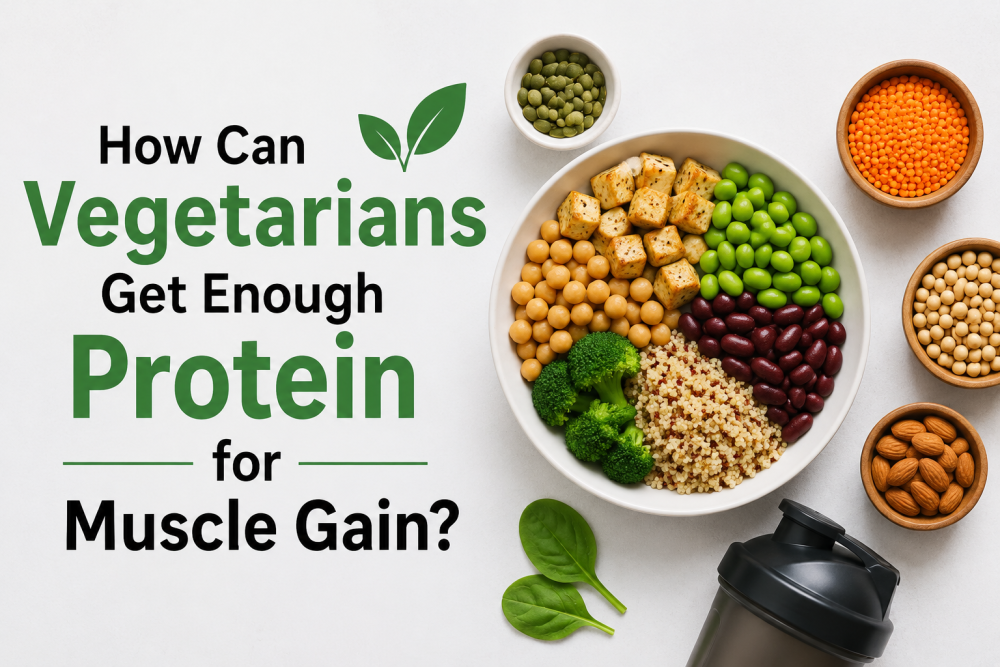
Can vegetarians build muscle? Wrong question, honestly. The gyms already answered it, and so did the research: match the protein totals and the training, and plant-and-dairy lifters grow at the same rate as the steak crowd. Same arithmetic for everyone: 1.6 to 2.2 grams per kilo of body weight, spread through the day, progressive training underneath, and enough total food around it.
The real vegetarian question is logistics. A hundred and twenty-plus grams a day, from a pantry where the protein likes to hide inside carbs and generous portions? That takes engineering. Which is what this article actually is.
Lane note for regular readers: our vegetarian weight-loss meals guide covers eating in a deficit; this is the muscle-gain playbook, surplus context, higher anchors, the density-ranked pantry, and the version of the day built for growing rather than shrinking. The standing line applies as ever: general information, not medical or dietetic advice, and anyone with conditions, or a history of disordered eating, builds their plan with a professional.
The Two Numbers: Protein Target, Calorie Context
Start with the target. Same one our whole health section runs on, 1.6 to 2.2 grams per kilo, upper half for the gain-focused. Do the multiplication for a 70-kilo person, and you get 112 to 154 grams a day, and I'd encourage actually doing it for your own weight, because seeing your number written down is the useful shock. That's not a sprinkle-some-protein-on-lunch number. That's an every-single-meal engineering project.
The context number is the one muscle-gain articles skip: a modest calorie surplus, roughly 200 to 300 above maintenance, because muscle is built from protein and paid for in energy, and lifting hard in a deficit mostly maintains rather than grows (that's the fat-loss configuration our calories guide covers, the same machine, opposite dial). Find maintenance by the methods in that guide, add the modest surplus, and expect slow-gain arithmetic: muscle accrues at a fraction of fat-loss speeds, half a kilo a month is a strong result for most, and the surplus stays modest precisely so the gains are muscle rather than a bulk-and-regret cycle.
And the sentence that outranks both numbers: protein without progressive training is just expensive food. The 2-to-4 weekly strength sessions from our training coverage, loads, or reps climbing over months are what the protein is for; the eating funds the building, it doesn't replace it.
The Complete-Protein Question, Settled Honestly
The old worry, plants lack certain amino acids, so vegetarians must combine foods precisely at every meal, is a myth with a true fossil inside. True: individual plant proteins have weaker amino profiles than animal ones, and leucine, the key growth-trigger amino, runs lower in most plants. Settled: eating a variety of protein sources across a normal day covers the profile automatically, no meal-by-meal combining required, and lacto-ovo vegetarians barely face the question at all, since dairy, eggs, and soy are complete, leucine-rich proteins in their own right.
The practical translation: build most anchors from the strong tier below (dairy, eggs, and soy); let legumes and grains fill around them, and the amino math takes care of itself. Vegans lean harder on soy and variety and do fine; see more in the adjustments section.
The Builder's Pantry, Ranked by Density
The muscle-gain pantry was sorted by protein per portion because at 120-plus grams daily, density is the whole game.
The heavy hitters first. And the heaviest is the one western fitness content keeps ignoring: soy chunks. Fifty grams of protein per 100 grams dry. Fifty! Pennies per serving, sitting in every South Asian grocery, a curry-and-pulao staple that deserves a statue in vegetarian gym culture and instead gets silence. Paneer, as you know from our meals guide, is about 25 grams per 150-gram serving, endlessly useful, with low-fat versions keeping the surplus honest. Tofu and tempeh cover the same ground at 20 to 30 per serving, with tempeh being the denser cousin. Then the dairy-and-egg tier, Greek yogurt or skyr at $15 to $20 a bowl and eggs at $6 or $7 each, so the three-egg anchor lands at $20. And the scoop, whey, or a plant blend, 25-ish grams in ninety seconds. Not a shortcut. A tool, and at these targets, the difference between constantly cooking and being comfortably fed.
The volume tier. Lentils, chickpeas, rajma, and beans bring 15 to 20 grams per thick, generous bowl plus the carbs the surplus wants anyway, dal done thick per the meal guide's rule. High-protein pasta (lentil and chickpea flour) doubles ordinary pasta's protein. Milk adds 8 to 10 per glass and drinks its way to totals painlessly. Nuts and seeds are garnishes, calorie-dense allies of the surplus, and modest protein; count them as energy with benefits.
Structuring the Building Day: Four to Five Anchors
Fat-loss days run three anchors and a snack; building days upgrade the architecture: four to five protein feedings of 25 to 40 grams, spaced through the day, which the muscle-protein research supports as the effective pattern and which, more practically, is the only comfortable way to reach 130 grams without a single heroic meal.
The shape: a breakfast anchor from our breakfast guide's high end (a three-egg scramble or the yogurt bowl plus a scoop stirred in, 30-plus grams). A midday plate with the anchor doubled, the full paneer portion, the whole tofu block's worth, and soy-chunk curry over the rice the surplus welcomes (35-40). The afternoon feeding is the slot that separates building from maintaining: the shake, or milk plus a boiled-egg pair; or the big skyr bowl (25-30). The evening plate, a mirror of midday with the variety rotated (35-40). And the optional fifth, a pre-bed casein-style feeding, paneer or Greek yogurt, the slow-digesting dairy proteins suiting the overnight slot for the upper-target chasers. Every anchor rides with the vegetables, and the carbs, unlike in the deficit version, are teammates: rice, potatoes, oats, and bread fund the training that makes the protein matter.
Vegan Adjustments and the Sample Day
Vegan builders run the same system with three tweaks: aim the target at the upper half of the range (plant proteins' digestibility discount, covered by slightly more total); lean on soy as the backbone, tofu, tempeh, soy chunks, edamame, and soy milk, with a plant protein blend as the convenient closer; and mind B12, which is a supplement conversation for every vegan regardless of muscle goals, flagged here because training raises the stakes on getting the basics right.
So what does a building day actually look like? For a 70-to-80-kilo trainee, ranges are not rules: Breakfast is 30 grams. A lunch plate at 35 to 40. The afternoon feeding, 25 to 30, is the slot most people skip and shouldn't. Dinner mirrors lunch, 35 to 40. The optional pre-bed bowl, 20. Add it up, and you land somewhere between 125 and 160 grams, inside the modest surplus, with swaps flowing freely inside each tier; nobody's married to any specific food here.
How do you know it's working? The signals from our body-composition guide: strength climbing, scale drifting up slowly, and waist roughly holding steady. Off track? Adjusted by the calories guide's two-week logic, it just pointed uphill this time.
The Bottom Line
Vegetarian muscle gain: 1.6 to 2.2 grams per kilo, engineered as four to five daily anchors from the density-ranked pantry: soy chunks, paneer, tofu, Greek yogurt, eggs, and thick legumes, with a shake as the honest convenience, inside a modest 200-to-300 calorie surplus, funding 2 to 4 progressive strength sessions weekly, and the complete-protein worry retired by simple daily variety. Vegans run the same play with a higher aim, a soy backbone, and B12 handled.
The plants-can't-build-muscle era is over; the research closed it, and the gyms are full of the proof. What remains is logistics, and logistics is four anchors, one pantry, and the boring weekly consistency every result in this section is built from. Load the dal thick, load the bar progressively, and let the arithmetic do what it always does.
FAQs: Vegetarian Protein and Muscle
How much protein do vegetarians need to build muscle?
Same range as everyone else, 1.6 to 2.2 grams per kilo daily, upper half if gaining is the goal. For a 70-kilo person that's 112 to 154 grams, and no, being vegetarian doesn't change the number. What it changes is the logistics: hitting that total takes four or five deliberate anchors a day from the dense stuff, dairy, eggs, soy, and thick legumes, rather than hoping it accumulates.
Can you really build muscle on a vegetarian diet?
Yes, and the research is now clear: when protein totals and training match, vegetarian and meat-eating lifters gain muscle at equivalent rates. The requirements are the universal ones: sufficient protein, a modest calorie surplus, and progressive strength training, and lacto-ovo vegetarians have complete, leucine-rich proteins (dairy, eggs, and soy) covering the quality question entirely.
What is the best vegetarian protein source for muscle gain?
Soy chunks, and it isn't close, about 50 grams per 100 grams dry, absurdly cheap, and somehow still the pantry's best-kept secret. Behind them: paneer at 25 per serving, tofu and tempeh at 20 to 30, Greek yogurt, eggs, and the scoop for convenience. Thick dal and bean bowls bring 15 to 20 apiece and carry the carbs, a building phase wanted anyway, teamwork.
Do I need to combine proteins at every meal?
No, that's the fossil version of a real but solved concern: variety across the day covers amino acid profiles automatically, and dairy, eggs, and soy are complete proteins on their own. Build most anchors from those, let legumes and grains orbit them, and the combining happens without a spreadsheet.
Should I eat in a calorie surplus to gain muscle?
A modest one, roughly 200 to 300 calories above maintenance, because muscle is built from protein but paid for in energy, and training hard at maintenance or below mostly preserves rather than grows. Keep the surplus small so gains stay lean; expect slow-gain arithmetic (half a kilo a month is strong); and adjust by the two-week weigh-in logic our calories guide teaches, pointed upward.
Is protein powder necessary for vegetarian muscle gain?
Necessary? No, whole foods can carry the totals, but at 120-plus daily grams, it's the honest convenience that keeps the plan livable: one scoop converts the afternoon gap into a 25-gram anchor in ninety seconds. Whey suits lacto-vegetarians, plant blends cover vegans, and the powder is a tool for the gap between target and plate, never the foundation.