Businesses grew for roughly five thousand years before Google Ads existed, and the mechanisms they used never stopped working. They just stopped being taught, because nobody earns a commission when you get a customer through a referral.
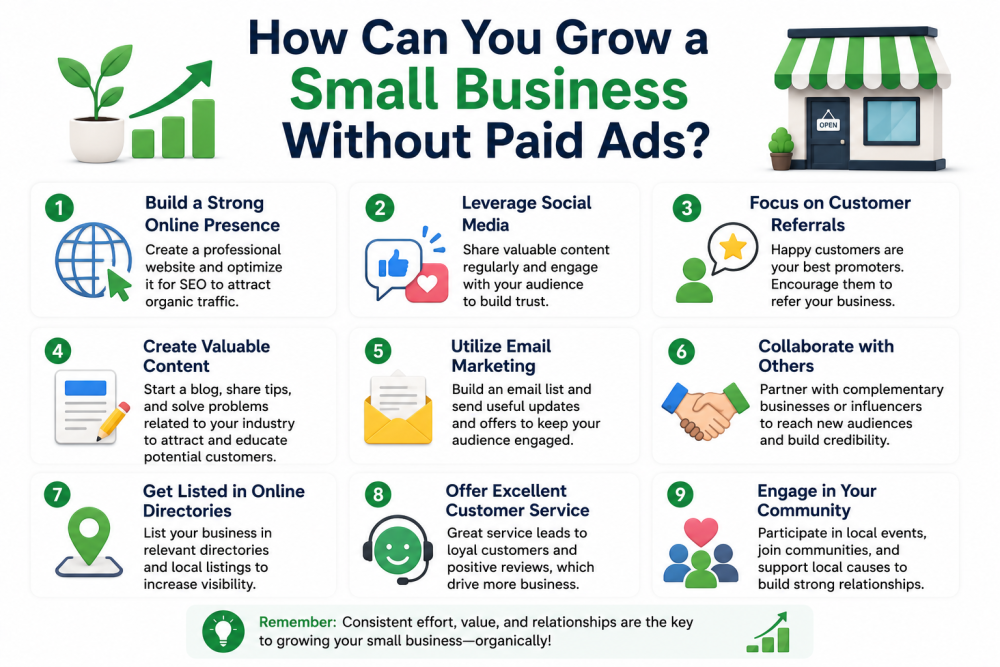
So here's the no-ads growth stack, named up front: being genuinely findable (local SEO and search content), being recommendable (referrals engineered rather than hoped for), owning your audience (email, criminally underrated in 2026), showing up where your customers already gather (organic social and communities, done narrow), and the quiet monster nobody counts as marketing, keeping the customers you already won. None of it costs ad money. All of it costs consistency, which is the honest price this article won't hide from you.
One framing thought before the list, because it changes how you read everything below. Paid ads are renting attention, the moment you stop paying, the traffic stops. Everything in this article is buying attention assets, things that keep working after the effort: a Google profile thick with reviews, an article ranking for a real question, an email list, a referral habit among your customers. Slower to start. Compounding forever. That's the trade.
Get Found: The Search Layer
Start with the least glamorous, highest-return move in all of small business marketing: your Google Business Profile. When someone nearby searches for what you do, that map pack of three businesses is the whole battlefield, and the winners are rarely magic, they're complete profiles, real photos, every field filled, accurate hours, and above all, reviews, steadily accumulated, personally responded to. The mechanism for getting reviews is embarrassingly simple and almost nobody does it: ask, at the moment of happiness, when the customer is thanking you, with a direct link that takes two taps. Make asking a habit, a genuine one, no scripts that bribe or pressure, and watch what thirty honest reviews do to your phone.
Then the broader search layer: content that answers your customers' actual questions. Not "blogging" in the 2015 sense, answering. Every business hears the same fifteen questions on repeat, how much does X cost, how long does Y take, what's the difference between A and B, and each one is a page or article that works your counter 24 hours a day. A plumber's honest "what does a boiler replacement cost" page outranks and out-earns a decade of inspirational posts. Write plainly, answer genuinely, include the numbers competitors hide, and search engines, increasingly AI-powered ones too, will route the askers to you. This compounds for years, and it's the single asset class where a small business can beat big competitors, because big companies are constitutionally incapable of publishing straight answers.
Get Recommended: Referrals as a System
Word of mouth is every small business's biggest channel and almost every small business treats it as weather, something that happens to them. The upgrade is making it a system, and the system has two parts.
Part one, be referable on purpose: the experiences people retell have a peak worth retelling, the unexpected extra, the problem fixed beyond obligation, the follow-up call nobody expected. Engineer one small peak into your standard service and you've built a story customers carry.
Part two, ask, and make it easy. After the happy moment, the direct sentence works: "we grow through recommendations, if you know anyone who needs this, we'd take great care of them." Add a reason to act if it fits your business, a mutual perk, priority booking, a discount both sides share, and keep it human rather than schemey. Businesses that formalize this see referrals go from an occasional gift to a monthly channel, and referred customers, famously, close easier, pay happier, and refer onward.
Adjacent and underused: partnerships with the non-competing businesses that share your customer. The wedding photographer and the florist. The accountant and the business lawyer. The gym and the physio. A standing mutual-referral relationship with three neighbors like these outperforms a lot of marketing, and it costs a coffee to set up.
Own the Audience: Email, Still Undefeated
Social platforms decide who sees your posts. Email arrives. That single difference is why the email list remains, in 2026, decades into its supposed obsolescence, the highest-ROI owned channel a small business has, and why the algorithm-whiplashed businesses of the past few years all learned the same lesson: build on land you own.
The playbook is small and old and works. Give a real reason to join, not "subscribe to our newsletter," which is a request to receive homework, but something worth trading an email for: the honest pricing guide, the checklist, the first-visit perk, the genuinely useful monthly tips. Then show up consistently at a sustainable rhythm, monthly is fine, monthly forever beats weekly for six weeks, with messages that are 80 percent useful or interesting and 20 percent offer. That's the entire art. A list of eight hundred locals who chose to hear from you is worth more than eight thousand drive-by followers, and it's yours through every algorithm change that will ever happen.
Show Up: Organic Social and Communities, Done Narrow
Now the channel everyone starts with, placed deliberately fourth. Organic social works in 2026 under two conditions the gurus mumble past: you go narrow, and you go native.
Narrow means one platform, chosen by where your customers actually are, done properly, rather than four platforms done as chores. For most local and visual businesses that's the short-video-and-stories world; for B2B services it's LinkedIn; for niche products it might be a single subreddit's orbit. Native means making what the platform's residents actually watch, the behind-the-scenes process, the before-and-after, the answered question, the recognizable local moment, not adapted advertisements. Short video deserves its special mention: it's the one organic format platforms still hand free reach to, because they're fighting each other for it, and a phone plus honesty is the entire production budget.
Communities are the quieter half of this channel: the local Facebook groups, the subreddits, the trade forums where your customers ask questions. The rule there is one word, contribute. Answer genuinely, be known as the helpful one, let the profile and occasional natural mention do the selling. It's slow, it builds the kind of reputation ads can't buy, and one truly helpful answer in the right thread has a strange habit of outliving everything else you made that month.
The Hidden Channel: Keeping the Customers You Have
The least sexy section, and the mathematically strongest. Winning a new customer costs many times more than keeping one, every study ever run agrees on the direction, and a small improvement in how many customers return does more for revenue than most acquisition campaigns.
Retention isn't a program, it's a handful of habits. Follow up after the sale like you care, because you do. Remember things, systems help, a simple note field beats a good memory. Fix problems with slightly excessive generosity, the recovered complainer becomes your loudest advocate, this is folklore because it's true. Make rebooking or reordering frictionless, the reminder at the right interval, the standing appointment offered. And stay lightly in touch through that email list between purchases, so the next need arrives with your name already on it.
Every retained customer also feeds the referral system, which feeds the reviews, which feed the search layer. That's the flywheel, and you've maybe noticed by now that all five sections are actually one machine.
The Bottom Line
Growing without paid ads means building the machine instead of renting the traffic: a search presence that answers real questions and wears its reviews proudly, a referral system run on purpose, an email list you own outright, one social channel done natively and narrowly, and a retention habit that quietly compounds under everything. Pick the piece that fits your business's biggest gap, install it as a weekly habit rather than a burst of enthusiasm, add the next piece a month later.
Six months of that and something strange happens: growth stops being a thing you do and becomes a thing your business has. Ads can't buy that. That's rather the point.
FAQs: Growing Without Paid Ads
What is the best way to grow a small business without spending on ads?
For local businesses, a complete Google Business Profile with steadily gathered reviews is the highest-return single move, it decides who wins nearby searches. Beyond that, the strongest stack combines referral habits, an email list you own, content answering customers' real questions, and deliberate retention, chosen in the order that matches your biggest current gap.
How long does organic growth take compared to paid ads?
Ads produce traffic this week and stop the moment you stop paying; organic channels typically take three to six months to show real movement and then compound. Reviews accumulate, content climbs rankings, referral habits normalize, lists grow. The honest framing: paid is renting, organic is building equity, and the timelines differ exactly the way rent and ownership do.
Does social media still work without paying for reach?
Yes, under two conditions: one platform done properly instead of four done thinly, and content native to how people actually use it, process videos, before-and-afters, answered questions, rather than adapted ads. Short video remains the format platforms reward with free reach, and consistency beats production value everywhere.
How do I get more customer referrals?
Make the experience worth retelling, one deliberate moment of unexpected care does it, then ask at the moment of happiness with a plain sentence and an easy way to act. Formalize a small mutual perk if it fits, and build standing referral relationships with non-competing businesses that share your customers. Referrals respond to systems, not hope.
Is email marketing still worth it for small businesses in 2026?
More than ever, precisely because social reach is rented and email is owned. A modest list of genuinely interested customers, emailed consistently at a sustainable rhythm with mostly-useful content, reliably outperforms much larger follower counts, and it survives every algorithm change. The trade for an email address just has to be something actually worth having.
What's the cheapest marketing with the highest return?
Asking. Asking happy customers for a review, asking them for a referral, asking new customers how they found you so you double down on what works, and asking past customers back with a well-timed follow-up. None of it costs anything but the habit, and together those four questions quietly power every channel in this article.