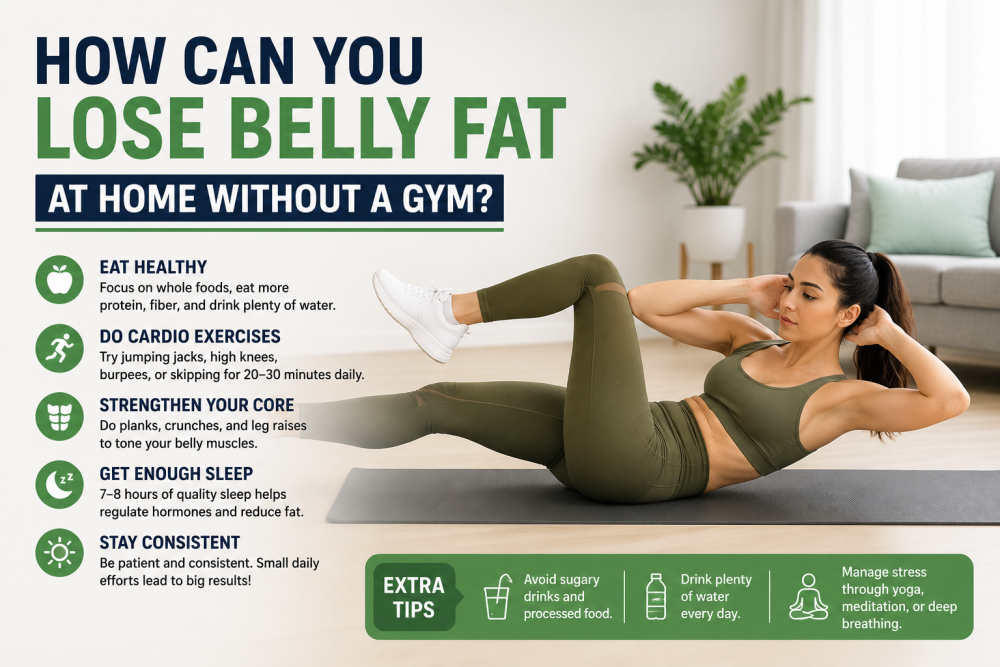
A friend asked me this exact question last month, standing in his kitchen, patting his stomach like it was a misbehaving pet. And I gave him the answer nobody wants, so I'll give it to you too, right at the top.
The gym was never the important part.
You lose belly fat by eating fewer calories than your body burns, over and over, for months, and where you do your exercising, a gym, your bedroom floor, or a park, changes almost nothing about that equation. The people selling home workout programs won't tell you this. Neither will the gyms. Both of them need the location to matter. It doesn't.
What does matter, then? Six things, and I'd rank them in an order that would get me yelled at in most fitness comment sections: your kitchen, walking, sleep, strength work, stress, and dead last, the sweaty jump-around workouts everyone thinks of first. Let me defend that ranking, and along the way we'll bury a couple of myths that have earned a proper funeral.
Standard honesty before we start. Not a doctor here. General information only. Anyone with health conditions, medications in the mix, or a history of trouble around food should run changes past a professional first, and that's real advice, not a legal throat-clear.
The Funeral: Spot Reduction
Crunches don't burn belly fat.
Read that twice if you need to, because the entire "lose your gut in 30 days" industry depends on you never quite believing it. Ab exercises build the muscle underneath. The fat on top? Your body doesn't spend it where you exercised; it pulls from fat stores everywhere according to a genetic pecking order you didn't choose. For most of us the belly is where fat moves in first and moves out last, which feels deeply unfair and is also just how the accounting works.
Weirdly, this is good news. It means you're excused from the thousand-crunch penance. It means the boring lever, total calories, is the only lever, so you can put all your effort there without guilt.
One more thing your doctor cares about even if the mirror doesn't. There are two kinds of belly fat: the soft, pinchable layer and the deeper visceral kind wrapped around your organs, and the deep kind is the health hazard. Happily, it's also the eager one, often shrinking first when you start eating better and moving daily. The inside improves before the outside admits anything happened.
Rule the Kitchen or Lose the War
Can I be blunt? You will not out-walk, out-crunch, or out-burpee a bad diet. A delivery pizza undoes a week of home workouts in the time it takes to watch half an episode of something.
So food first. Always food first. And no, that doesn't mean a spreadsheet and a food scale; it means a few blunt moves that carry most of the weight.
Protein at every meal, before you think about anything else. Eggs, fish, chicken, Greek yogurt, paneer, dal—whatever your kitchen already speaks. Protein is the fullness king; it guards your muscles while the fat comes off, and nearly everyone trying to lose weight eats too little of it. Fix that and watch your snacking half-disappear on its own.
Then vegetables and fruit are doing crowd control on your plate, big volume, few calories, so you finish meals actually full.
And the assassin move: kill the drinkable calories. Colas, juices, the caramel coffee situation, beer. Liquid calories don't register as food to your brain; they just quietly stack hundreds onto the day's total. I've seen people change nothing else, nothing, and start losing.
Keto? Fasting? Fine, if you like them. They work when they work because they trick you into eating less, same as everything, and the diet that works is whichever one you're still following in month four. Speed-wise, aim slow, roughly half a percent to one percent of your body weight per week. Faster mostly means losing muscle and meeting the same fat again next year, now with interest.
Walking. Yes, really. Walking.
If exercise for fat loss were a stock market, walking would be the undervalued blue chip everyone ignores because it isn't exciting.
Forty-five minutes to an hour a day or a step target around eight to ten thousand, whichever framing your brain prefers. Split it into pieces if the day demands. Take calls on it. Walk after dinner like generations of grandparents correctly did.
Why do I rate it above the hard workouts? Three reasons. It burns real calories. It doesn't detonate your appetite the way brutal sessions do, and intense exercise has a sneaky way of getting eaten back at the next meal. And you will actually do it every single day, including bad days, which no HIIT program in history can claim. Consistency isn't one factor among many here. It's the factor.
Keep Your Muscle: Strength Work in the Living Room
While the fat leaves, you want the muscle to stay. That's the difference between finishing this process lean versus finishing it merely slower, and it's also what keeps your metabolism from slowing to a sulk.
Two or three sessions a week, twenty-odd minutes. Squats. Push-ups, and if a full push-up isn't there yet, do them against a wall or from your knees; that's not cheating, that's the correct entry point. Lunges, glute bridges, a plank. Rows, using a backpack stuffed with books, which sounds silly and works fine. Progress by adding reps, adding books, and slowing the movement down.
No equipment needed to start. Adjustable dumbbells would make a nice birthday gift to yourself someday. Someday. Not a prerequisite.
Sleep and Stress, the Levers Everyone Skips
I'll confess I used to scroll straight past this part of every fitness article. Then I actually cleaned up my sleep, and it embarrassed the rest of my routine.
Run short on sleep, and three things happen at once: hunger hormones climb, so the fridge starts winning negotiations. Willpower drains, and food decisions are willpower-expensive. Energy tanks, so the walk doesn't happen. There's decent evidence that people dieting on five or six hours lose noticeably more muscle and less fat than people losing the same weight while sleeping properly. Seven to nine hours. Treat it like part of the program, because it is the program.
Stress plays a supporting villain role. Some of it is hormonal; cortisol has an established association with fat settling around the middle. Most of it is behavioral, stress being the thing that orders the takeaway, pours the second drink, and cancels the workout. You can't fire stress from your life. But notice the elegant trick available: the daily walk lowers stress and burns calories in the same hour. Two birds, one habit.
A Week That Would Actually Work
Enough theory. Here's the whole system in one breath: Walk daily, whenever it fits. Bodyweight strength on Monday, Wednesday, and the weekend, twenty minutes each. Every meal is built on protein, padded with vegetables. Drinkable calories nearly gone. One meal a week that's purely for joy, no ceremony, no "cheat day" branding, just dinner you love. A boring, consistent bedtime. And one measurement ritual, same morning weekly, is a scale plus a tape measure at the belly button, because the tape frequently reports progress during the weeks the scale decides to be moody.
Total cost of that program: zero. Total equipment: shoes, a backpack, and some books.
The Bottom Line
Belly fat surrenders to a modest calorie deficit held for months, and everything else is supporting cast. The kitchen does the heavy lifting. Walking is the daily engine. Strength work protects the muscle you want to keep. Sleep and stress management stop your own biology from working against you. And the belly goes last, nearly always, so the mid-journey stretch where your face and clothes change but your stomach won't budge is not failure; it's the standard sequence.
No gym in the world sells anything better than that list. Hold it for half a year and see.
FAQs: Losing Belly Fat at Home
Can you really lose belly fat without a gym?
Yes. Genuinely, fully, yes. The deficit that drives fat loss is built mostly in the kitchen, and the most effective supporting exercises, walking and bodyweight strength training, require no membership and no machines.
What exercise burns belly fat fastest?
None of them target the belly; that's the myth this whole article keeps swatting. The habit with the highest real-world payoff is the daily walk, because it burns calories without inflating your appetite and it survives contact with real life. Strength training earns second place for protecting muscle, which keeps the weight you lose coming from fat.
How long until I see my belly change?
Figure four to eight weeks for the tape measure to start moving and three to six months for change you'd call obvious, at a sensible pace of half a percent to one percent of body weight per week. The belly is usually the final area to lean out, so measure weekly with a tape and stop interrogating the mirror daily; the mirror lies mid-journey.
Are crunches and planks useless then?
Not useless, just miscast. They build core strength and posture, worthwhile things. What they don't do is remove the fat sitting over the muscles, so keep them if you enjoy them and drop the expectation that they change what you see.
What foods cause belly fat the most?
No single food, but the closest thing to a villain is liquid calories: sugary drinks, juices, sweetened coffees, and alcohol. Hundreds of calories, zero fullness, and cutting them is the highest-impact single change most people can make. After that, it's a totals game, not a banned-foods list.
Does poor sleep really give you belly fat?
It stacks the deck toward it. Short sleep raises hunger hormones, drains the discipline that food choices require, and steals workout energy, and stress works the same territory through cortisol and comfort eating. An earlier bedtime is unglamorous, costs nothing, and helps more than almost any supplement ever sold. Strange advice from a fitness article, and true.