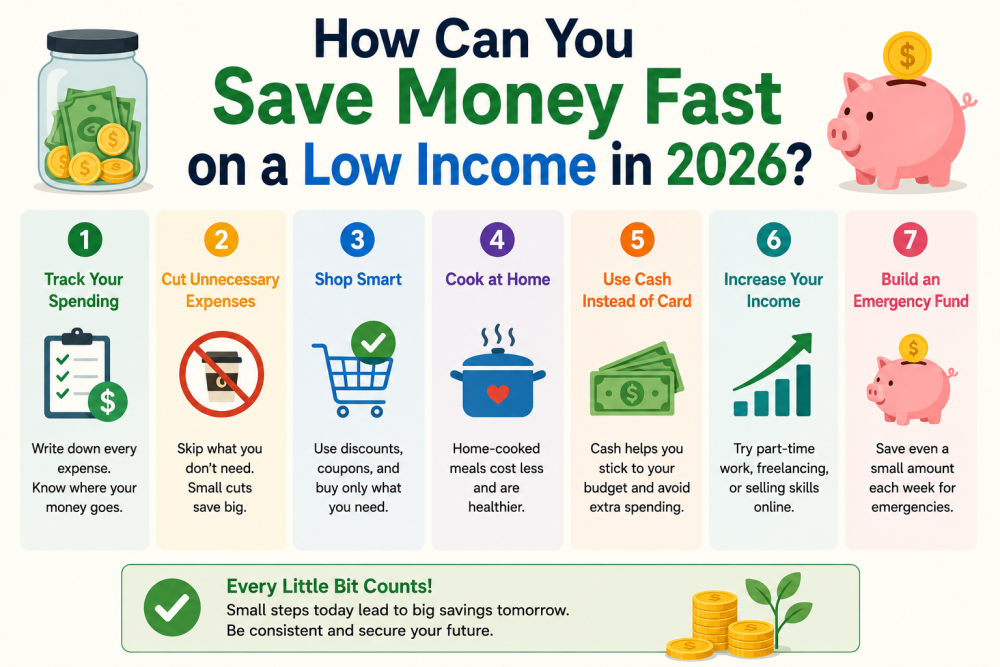
Let's get one thing straight before any tips, because most articles on this topic quietly insult their readers: being low on income is a math problem, not a character flaw. You don't need a lecture about lattes. You need moves that free up real money in weeks, not a decade of deprivation dressed up as wisdom. So that's what this is, the fast levers first, sorted by how much cash they actually free, with the patronizing stuff left out.
One honest framing, though, since "fast" is in the question. On a tight budget, saving fast means two kinds of moves: cutting leaks you've stopped noticing, and pulling cash forward from stuff and skills you already have. Both work in weeks. What doesn't exist is the secret hack, and anyone selling one to low-income audiences specifically is running the oldest hustle there is. Right, the levers.
Week One: The Bill Audit, Where the Fast Money Hides
Sit down with one month of bank and card statements, a highlighter if you're old-school, and hunt three species of leak.
Subscriptions you forgot. Streaming stacked on streaming, the app trial from March, the gym from a more optimistic era. The average household finds real money here, and canceling takes an evening. Rule going forward: one entertainment subscription at a time, rotate monthly if you like, they'll all still be there.
Bills that negotiate. Phone, internet, insurance, in that order of ease. Call, say the phrase "I'm thinking of switching," ask for the retention department, and let silence do some work. This feels awkward exactly once, pays every month after, and in 2026 the comparison sites make the threat credible in ten minutes. Insurance especially, car and home policies quietly creep upward every renewal, and re-shopping them annually is one of the highest-per-hour paid tasks available to a normal person.
And the small automatic bleeds: the account fee your bank charges that a different account doesn't, delivery apps' service-fee stack, the buy-now-pay-later installments that individually felt like nothing. Add them up once. The total does the motivating.
That's week one. For most people it frees somewhere between real and surprising money, monthly, forever, without touching quality of life.
The Big Three, Because the Small Stuff Was Never the Problem
Housing, transport, and food take the majority of a low income, which means they're where meaningful saving lives, and also where glib advice goes to die. So, carefully.
Food is the most movable. Not by suffering, by system: a rough plan before shopping, a list, groceries over delivery apps, more meals from cheap anchors, eggs, lentils, beans, rice, seasonal vegetables, frozen counts, and lunch brought from home most days. The delivery-app line alone shocks people, fees, markups, and tips can double a meal's cost, and cutting that one habit funds a grocery upgrade with change left over. None of this is joyless. A good dal costs pennies and beats sad desk food.
Transport rewards a yearly look: insurance re-shopped (again, yes), whether the second car earns its keep, whether a transit pass beats the parking-and-fuel math for your actual commute. Not everyone has options here, geography is real, but those who do often find the single biggest number on the whole list.
Housing is the heaviest lever and the slowest, so file rather than force it: when a lease renews, negotiating politely with evidence of local listings sometimes works, a housemate transforms the math entirely if your life allows it, and in several countries renters on lower incomes qualify for support they never claimed. Which deserves its own paragraph.
Actually check what you're entitled to. Billions, and that word is literal, in benefits, credits, and assistance go unclaimed every year in the US, UK, and Canada because eligible people assume they don't qualify or find the forms hostile. Tax credits for workers, utility assistance, food support, council tax and housing help in the UK, benefit finders exist online in each country and take twenty minutes. This is your money, already allocated, waiting on paperwork. Pride costs more than the form does.
Pulling Cash Forward: The Fast Side of Fast
Cutting is half. The other half of saving fast is money in weeks from what you already have.
Sell the unused stuff. Every home holds a few hundred dollars of it, the console nobody touches, the bike, the clothes with tags, and Facebook Marketplace, eBay, and Vinted turn it into cash by the weekend. Start with the biggest three items, not a garage-sale marathon.
Then, if hours exist in your week, the smallest viable income move: one shift of tutoring, a few hours of freelancing a skill you already have, pet-sitting, the flexible-gig layer. This is a savings article, not a hustle article, we've written that one separately, but the honest math is that on a genuinely low income, the cutting levers cap out, and even a small second stream changes what's possible. Fifty extra a week out-saves almost any frugality tip in print.
And the windfall rule, install it now before the next one arrives: tax refunds, gift money, the odd bonus, decide today that a fixed slice, half is a good default, goes straight to savings before it can evaporate into the month. Windfalls are where low-income savings actually get built, and the rule only works if it predates the money.
Making It Stick: The Boring Mechanics
Where the saved money goes matters nearly as much as saving it.
Open a separate high-yield savings account, different bank than your spending account is the pro move, friction is a feature, and automate a small transfer the day money arrives. Small meaning genuinely small if it has to be: the automation matters more than the amount, because the habit survives bad months and the amount can grow in good ones. Pay-yourself-first is a cliché for the annoying reason that it works.
Give the account a job, "emergency fund" being job one, because on a tight income the emergency fund isn't a luxury, it's the thing that breaks the borrowing cycle: the car repair that used to become card debt at punishing interest becomes, eventually, just a bad Tuesday. Even a few hundred banked changes the weather.
And the traps, named plainly because they hunt this exact readership: payday loans and their app-shaped descendants, rent-to-own pricing, BNPL stacked across five providers, and "credit building" products with fees that outrun the benefit. The common thread is pulling tomorrow's money into today at brutal cost, the exact opposite of everything above. If the month genuinely doesn't close, the earlier paragraph about unclaimed assistance, and a free conversation with a nonprofit credit counselor, beat every one of those products, every time.
The Bottom Line
Saving fast on a low income runs on four moves, in order: the bill audit that frees monthly money in one evening, the big three, food systems, transport math, housing when the moment allows, plus the benefits check most people skip, cash pulled forward by selling the unused and adding even a thin second income stream, and mechanics that protect the result, automated transfers to a separate account with a job. Weeks, not years, for the first results, and no lattes were lectured about.
None of it is magic and all of it compounds: the audit funds the emergency fund, the fund breaks the borrowing cycle, the freed interest funds the next step. That staircase is how tight budgets actually loosen, one boring, deliberate step at a time, and the first step is available this evening with a highlighter.
FAQs: Saving Money on a Low Income
What's the fastest way to save money on a low income?
The bill audit: one evening with a month of statements, canceling forgotten subscriptions, negotiating phone, internet, and insurance, and killing small automatic fees. It typically frees meaningful monthly money immediately, without lifestyle sacrifice, and every month after is free. Selling a few unused items runs a close second for speed.
How much should I save each month on a low income?
Whatever amount survives automation, and that's a serious answer: a small automatic transfer that happens every payday beats an ambitious target that collapses in week three. Start where it doesn't hurt, even trivially small, aim it at an emergency fund first, and raise it when the bill audit and any extra income create room.
Is it even possible to save money in 2026 with prices this high?
Harder than it should be, genuinely, and still yes for most situations, through the combination this article walks: recovering leaked money (subscriptions, unshopped insurance, delivery fees), the food system, checking unclaimed benefits and credits, and small extra income. When the math truly doesn't close on any of it, the answer is assistance programs and free nonprofit credit counseling, not shame and not payday products.
What expenses should I cut first?
In order of pain-to-payoff: forgotten subscriptions and bank fees (zero pain), unshopped insurance and phone plans (one awkward call each), delivery apps and bought lunches (habit change, big number), then the structural pair, transport and housing, reviewed when natural moments arrive like renewals and lease ends. The famous small stuff, coffee included, sits last for a reason.
Where should I keep the money I save?
In a separate high-yield savings account, ideally at a different bank from your spending account, filled by automatic transfer on payday and labeled with its job, emergency fund first. The separation adds just enough friction to stop casual raids, the interest finally pays something in this rate era, and the automation keeps the habit alive through bad months.
How do I stop dipping into my savings?
Three mechanics beat willpower: a different bank so the money isn't one tap away, a named purpose so spending it feels like breaking something specific, and a small "leaks" buffer in your checking account so normal overruns don't touch the fund. And redefine dipping: using the emergency fund for an actual emergency isn't failure, it's the fund doing precisely the job it was built for.