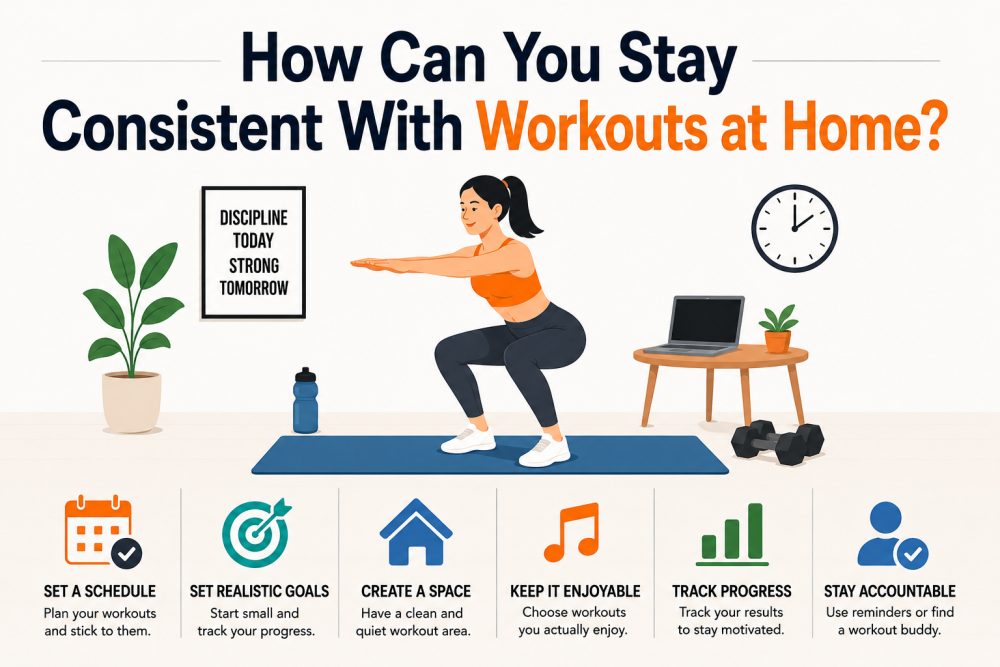
Consistency isn't a personality trait, and the people who have it aren't built differently, they've just designed differently. That's the whole thesis, and it matters because home exercisers keep diagnosing themselves with a discipline problem when what they actually have is a design problem: no fixed time, a workout that takes ten minutes to set up, a program too ambitious to survive a bad Tuesday, and a couch conducting counter-programming from three meters away.
Design problems have design fixes, and this article is the toolkit: the anchoring trick that removes the daily decision, the friction audit, the never-zero rule that saves more fitness journeys than any program ever written, the missed-day protocol, and the honest word about motivation, which is that the people waiting to feel like working out have the sequence backwards. Everything here plugs into the training our belly fat and diet guides prescribe, two to four strength sessions a week plus the daily walk, this is the article about actually still doing that in month four.
Kill the Daily Decision: Anchoring
The biggest consistency leak is invisible: deciding, every day, whether and when to work out. Decisions cost willpower, willpower runs out, and by evening the negotiation always ends the same way. The fix is making it not a decision, and the tool is anchoring: the workout gets welded to a fixed slot or an existing habit, after the morning coffee, right after the work laptop closes, the same three weekday slots forever, so it happens the way brushing teeth happens, by schedule, not by referendum.
Two supporting details make anchors hold. Morning-adjacent slots survive better for most people, not because mornings are magic, but because the day hasn't had time to ambush them yet, the 6pm workout has eight hours of accumulating excuses to defeat, the 7am one has none. And the anchor should be embarrassingly specific: "I work out more" is a wish, "Monday, Wednesday, Saturday, straight after coffee, in the living room" is a system, and systems are the only thing that shows up in week nine.
The Friction Audit: Make Starting Stupidly Easy
Every step between "I should work out" and the first rep is a place to quit, so count them and delete them. Kit lives out and visible, the mat unrolled in its corner, the dumbbells where you'll trip over them, because the mat in the cupboard adds a retrieval step and the cupboard wins more often than anyone admits. The program is written down in advance, tonight's session decided last week, since "what should I do today" is a quitting point wearing a thinking face. Clothes ready if it's a morning anchor. And the workout itself needs no setup: the bodyweight sessions our home training coverage uses, squats, push-ups, lunges, rows with the loaded backpack, planks, start in the time it takes to stand up, which is precisely their superpower over any routine requiring assembly.
Then flip the audit: add friction to the competition. The phone charges in another room during the slot, the couch doesn't get sat on before the session, and the home's great trap, "I'll just check one thing first", gets treated as what it is, the exit ramp. Environment beats intention. Rig the environment.
The Never-Zero Rule: The One That Saves People
Here's the rule that separates the people still training in month six from the people restarting in month six: never zero. On the days the planned session is impossible, tired, slammed, sick of it, the answer isn't skipping, it's shrinking: ten minutes, one round, a single set of everything, even just the daily walk from our belly fat guide. Anything above zero.
The logic is identity, not calories: a ten-minute session burns little and preserves everything, the anchor stays welded, the habit stays unbroken, and you remain, in your own accounting, a person who trains, which is the entire asset. Zeros are what kill fitness journeys, not small sessions, because zeros come in twos and threes and then the restart requires the activation energy of day one all over again. The companion protocol for when a zero happens anyway, and it will: never miss twice. One missed day is life; two is the start of a new identity, so the day after a miss is the most important session of the month, at whatever size it needs to be to happen.
Keep It Boring, Track It Visibly
Program design serves consistency before it serves optimization, which means simple wins: the same handful of movements, two to four sessions a week per the diet guide's prescription, progressed slowly, add a rep, add a book to the backpack, slow the tempo, for months. The internet's program-hopping culture is a consistency killer dressed as enthusiasm, every new routine resets the learning curve and the habit both. Boredom, when it genuinely arrives, is a signal to rotate a variable, swap one exercise, change the rep scheme, not to demolish the system.
And track where you can see it: the calendar with its chain of marked days, the strength log that, bonus, doubles as the fat-versus-muscle instrumentation our body composition guide runs on. Visible streaks recruit a surprisingly powerful ally, the reluctance to break a run you can see, and the log turns invisible progress into a graph during the weeks the mirror says nothing, which, per that same guide, is most weeks. Progress you can see funds discipline you don't have to manufacture.
The Motivation Myth, and the People Fixes
The word nobody needs: motivated. The waiting-to-feel-like-it model has the sequence backwards, action produces motivation far more reliably than motivation produces action, which is why the two-minute start, just begin, just the warm-up, just one set, converts so many "not today" days into full sessions once the body's moving. Start small enough that starting is trivial, and let momentum do the recruiting.
For the socially wired, add people to the design: a workout partner even over video, a standing online class whose schedule does your anchoring for you, a friend who gets the calendar screenshot each week. Accountability isn't weakness, it's outsourced consistency, and it's cheaper than every abandoned gym membership that tried to buy the same thing. And keep the sessions honest to your life stage: the parent training in nap windows and the shift worker anchoring to variable mornings both consist fine, the design just bends to the anchor that actually exists rather than the idealized one.
The Bottom Line
Staying consistent with home workouts is a design job with five parts: an anchor that deletes the daily decision, a friction audit that makes starting instant and quitting inconvenient, the never-zero rule with its never-miss-twice companion, a boring program tracked visibly so streaks and strength do the motivating, and action placed firmly before motivation in the sequence. None of it requires discipline in the movie sense. All of it manufactures the appearance of discipline, which, from the outside and in the results, is indistinguishable from the real thing.
Design it once, run it on schedule, shrink it on the bad days, and let month four arrive to find you, unremarkably, still training, which was the entire goal and is rarer than any PR.
FAQs: Home Workout Consistency
How do I stay motivated to work out at home?
By needing motivation less: anchor sessions to a fixed slot or existing habit so they run on schedule rather than mood, and use the two-minute start, just begin, one warm-up, one set, because action generates motivation far more reliably than the reverse. Visible tracking, a calendar chain, a strength log, then supplies the reward loop that keeps the system fed.
How many days a week should I work out at home to stay consistent?
Two to four strength sessions weekly, the same prescription across our training and diet guides, with the daily walk underneath, and the counterintuitive rule is that fewer, kept, beats more, abandoned: three anchored sessions that survive month four outperform six ambitious ones that die in week three. Start at the low end and earn the additions.
What should I do when I miss a workout?
Apply never-miss-twice: one missed day is ordinary life and requires no penance, but the following day's session becomes the priority, at whatever shrunken size guarantees it happens, ten minutes counts. Streak-breaking isn't the danger; the second consecutive zero is, because that's where the habit's identity starts unwinding.
Is a 10-minute workout at home even worth it?
As a floor, it's the most valuable session type there is: the never-zero day preserves the anchor, the habit, and your identity as someone who trains, which is worth more than the calories of any single session. As a ceiling it's limited, so the system is full sessions by default, ten-minute versions on the days the alternative is nothing.
Why do I always quit home workouts after a few weeks?
Almost always design, not character: no fixed anchor (so daily willpower negotiations), setup friction (kit in cupboards, undecided programs), routines too ambitious to survive a bad week, and program-hopping that resets the habit each time enthusiasm dips. Rebuild with the anchor, the friction audit, a boring repeatable program, and the never-zero rule, and week-three-quitting mostly stops being a pattern.
Do I need equipment to stay consistent at home?
No, and minimal kit actually helps consistency: bodyweight sessions, squats, push-ups, lunges, backpack rows, planks, start instantly with nothing to assemble, which removes the setup friction that kills routines. A pair of adjustable dumbbells is a fine later upgrade for progression; it's never the missing ingredient in week one, and buying gear is not the same habit as using it.