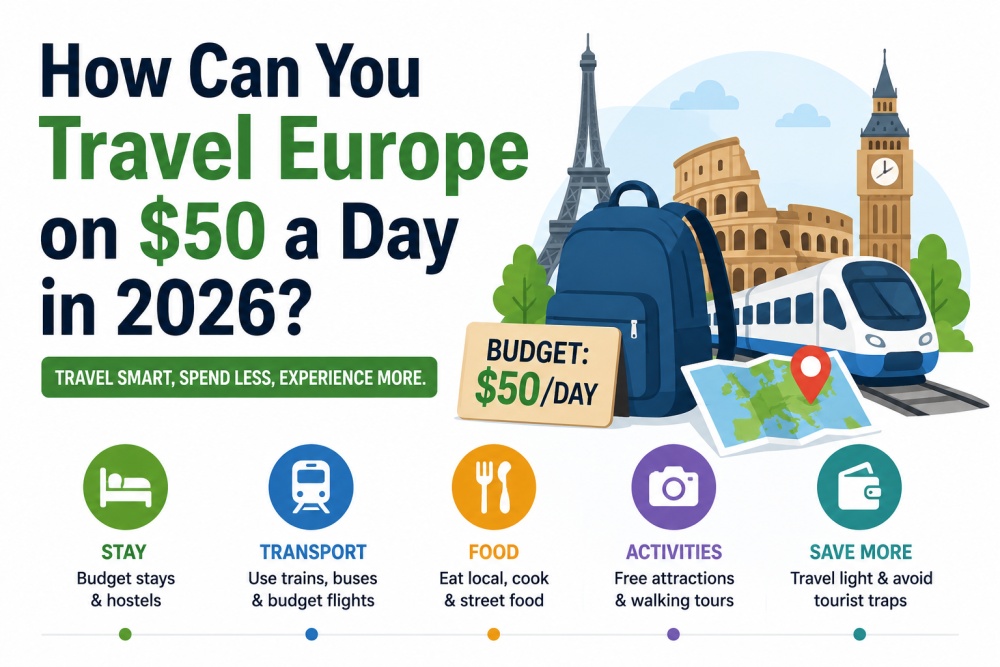
Fifty dollars a day in Europe is completely doable in 2026, comfortably in the east and south, skillfully in the middle, and, honestly, not everywhere, and the difference between travelers who make it work and those who blow through double is almost never luck. It's a budget with line items, a handful of skills applied to each line, and a weekly rhythm that absorbs the expensive days. This article is that system.
Quick scope-setting, because the travel cluster divides the labor: where to go lives in our budget destinations and cheapest cities guides; how to move between places lives in the transport guide; and this piece owns the daily math, what $50, call it 45 euros give or take the exchange rate, buys per line, how each line compresses, and the honest map of where the number glides versus grinds. Solo-traveler assumptions throughout, couples sharing rooms run cheaper per head, and every trick below scales.
The $50 Template, Line by Line
A working day's budget in the $50 zone splits roughly like this: bed, $15 to $20; food, $12 to $15; local transport and amortized intercity travel, $5 to $8; sights and fun, $8 to $10; and a few dollars of buffer, because days without buffers borrow from tomorrow. The split isn't sacred; the skill is knowing which lines flex, but as a default it survives contact with reality across most of the destinations our guides cover.
Two framing rules before the line items. First, the budget is a weekly average, not a daily cage: $350 a week, with cheap days at $35 funding the $70 day trip, beats seven identical joyless $50 days, and the travelers who fail budgets are usually the ones who never built the save-splurge rhythm. Second, big transport is a separate pot: the flight there and any long jumps between regions, per the flights and transport guides, get budgeted as trip costs, while the daily number carries only the local and amortized regional movement; mixing them is how honest budgets look impossible.
The Bed Line: $15-20, the Make-or-Break
Accommodation decides the whole budget, so it gets the most skill. Hostel dorms across Eastern Europe, the Balkans, and the value cities run $10 to $18; the same bed in the famous west runs double, which is the single biggest reason the $50 map tilts east. The compressions: book the first night early and the rest as you go per the solo guide; weekday and longer-stay rates over one-night hops; private hostel rooms split between two people, often beating two dorm beds; and the night-transport double from the transport guide, a sleeper leg that replaces a bed entirely, effectively a $0 accommodation day that funds a splurge elsewhere.
The location rule ranks higher than the price rule, though: the $14 bed forty minutes out costs $6 of transport and an hour of life daily; the central $18 bed wins, by our city guide's math, applied nightly.
The Food Line: $12-15, Eating Well Anyway
The food budget fails when every meal is a restaurant and thrives on the local rhythm: breakfast from the supermarket or included at the hostel ($2-3); the menu-of-the-day lunch, the continent's great bargain; a proper cooked meal at half dinner prices ($6-9 east and south); and dinner alternating between self-catered hostel-kitchen nights ($3-4) and the one-street-back local places ($7-10). That alternation is the whole trick: cook half your dinners and the food line funds itself; eat every meal out and it doubles.
The supporting cast: the water bottle (Europe's taps are fine nearly everywhere); the bakery lunch on travel days; market picnics as an event rather than a compromise (some of the best meals of any trip are bread, cheese, tomatoes, and a view); and the drinks' honesty. Alcohol is the great budget assassin, and the $50 traveler drinks at supermarket and happy-hour prices or budgets bar nights as splurge-day items, knowingly.
Transport, Sights, and Fun: The Flexible Lines
Local transport is compressed through the walking default; these cities were built before cars and reward it, plus single tickets over unexamined day passes, and the amortized regional movement stays cheap on the bus-first stack. The transport guide details $10-15 hops spread across the days between them. Sights compress without shrinking the trip: the free-walking-tour opening move in every city (tip fairly); the free museum days most institutions run (a search per city pays for itself); student and youth discounts wherever they apply; and the standing truth that the best of Europe, old towns, viewpoints, beaches, markets, and the evening promenade are free by default. The paid highlights you actually care about come from the splurge rhythm: one properly done paid experience per city beats five ticket queues, and choosing it deliberately is half the pleasure.
The Honest Map: Where $50 Works
Glides: the Balkans (Sarajevo, Belgrade, Skopje, and Tirana at $35-50 all-in); Romania; Bulgaria; and the value cities of Poland and Hungary, per the cities guide, where $50 buys comfort with change. Works with the skills: Czechia beyond central Prague, the Baltics, Greece's quieter corners, Portugal's north, and much of Spain's and Italy's south; $50 holds if the bed and food skills are actually applied. Grinds or breaks: the famous western capitals, Paris, London, Amsterdam, Zurich territory, and anywhere at peak season, where the bed alone can cost $40; the honest plays there are the day-trip model (sleep cheap outside, visit in), the short-stay model (two skillful days, then east), or simply routing around them this trip, the cluster's standing advice being that the same Europe costs a third as much two borders east.
And the tracking habit that keeps it all real: thirty seconds nightly, one running note of the day's spend, because budgets fail silently and a week of quiet overruns is a lost trip day, the same money truth our finance guides preach while wearing a backpack.
The Bottom Line
Europe on $50 a day in 2026: the template is a $15-20 bed, $12-15 food, $5-8 movement, and $8-10 fun, run as a weekly average with a save-splurge rhythm; the skills are early-booked central hostel beds, the cook-half-your-dinners alternation, menu-of-the-day lunches, walking as default, free tours and museum days, and night transport doubling as accommodation; and the map is read honestly, gliding through the east and south, skillful in the middle, and routed around the famous-capital price traps or day-tripped into them from cheaper beds.
It's not a deprivation budget; that's the part the doubters miss: it's the full trip, old towns, long dinners, and the paid highlight you actually chose, running on a system instead of a wince. Fifty a day, tracked nightly and averaged weekly, Europe stops being a splurge and becomes a habit, which is the most dangerous discovery of all in travel.
FAQs: Europe on $50 a Day
Is $50 a day really enough for Europe in 2026?
Yes, across Eastern Europe, the Balkans, and the value cities, where it buys comfort, and yes, with skills through much of the middle and south. It genuinely isn't enough for the famous western capitals at normal prices, where the honest strategies are day-tripping from cheaper bases, keeping visits short, or routing the trip east, where the same continent costs a third as much.
How should I split a $50 daily travel budget?
The working template: $15-20 for the bed, $12-15 for food, $5-8 for local and amortized regional transport, $8-10 for sights and fun, and a small buffer. Run it as a weekly average rather than a daily cage, $350 a week with cheap days funding splurge days, and keep long flights and big jumps in a separate trip cost pot.
What's the biggest expense to control when traveling cheap in Europe?
The bed is the largest line and the most variable: hostel dorms run $10-18 in the value regions and double in the famous west, which single-handedly draws the $50 map. Book early for the first nights, favor central-but-modest over cheap-but-far, and use night buses or sleeper trains occasionally; a moving bed is a $0 accommodation day.
How do I eat cheap in Europe without eating badly?
The local rhythm: supermarket or hostel breakfasts; the menu-of-the-day lunch as your main cooked meal, half of it at half-dinner prices; and dinners alternating between hostel-kitchen cooking and small local places one street off the tourist drag. Add market picnics as an event and drink at supermarket and happy-hour prices; alcohol at bar prices is the quietest budget killer in travel.
Can couples travel Europe on $50 a day each?
Comfortably below it, usually, a shared private room often costs less than two dorm beds, food scales for cheaper cooking for two, and every per-room cost is halved. Couples applying the same system typically land at $40-45 each, whereas a solo traveler spends $50, which is one of travel's rare economies of scale.
How much should I budget for a month in Europe?
On the $50 system, roughly $1,500 for the daily life of the trip, plus the separate pot: the flights there and back per our cheap-flights guide; one or two budget jumps between regions; insurance (the non-negotiable, per the insurance guide); and a contingency of 10-15 percent. Call it $2,100-2,400 all-in for a well-run month in the value regions, less for couples, and more if the route insists on the famous west.