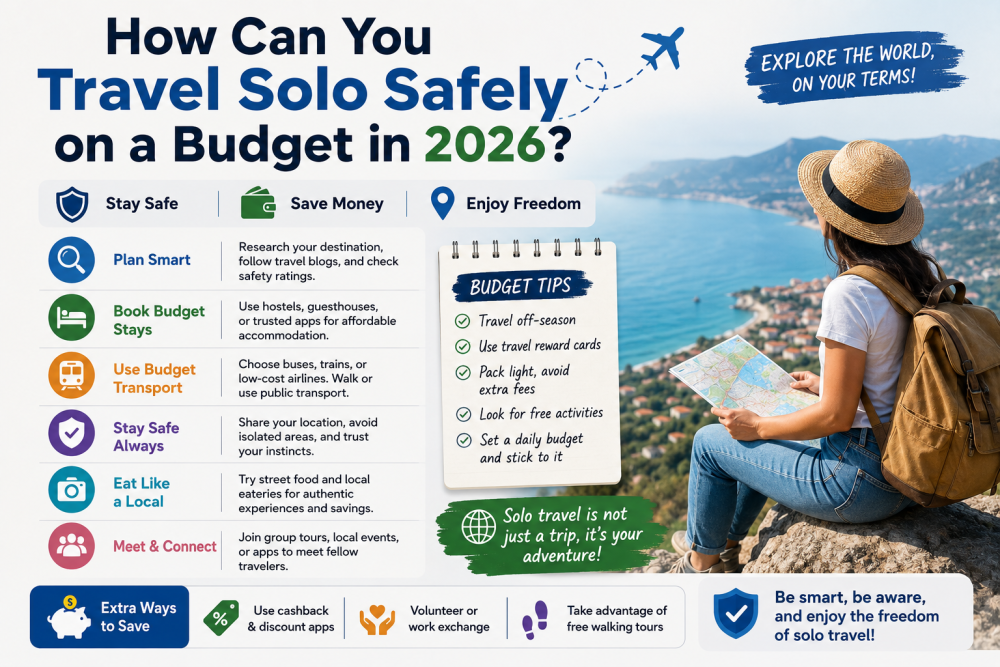
Two reassurances before anything else, because the fear industry gets to solo travelers first. One: traveling alone is dramatically safer than its reputation, millions of people do it every year, most of them uneventfully, and the realistic risks are pickpockets and overcharging, not the movie plots your relatives are imagining. Two: safety and budget are not opponents. Nearly every habit in this article costs nothing, and a few of the safest choices, hostels, daytime buses, eating at busy local places, happen to be the cheapest ones too.
What solo travel actually demands is a system, because you are your own backup. No travel partner to watch the bags, notice the odd vibe, or handle the logistics when you're tired, so the solo traveler builds small routines that do a partner's job. This article is that system: the arrival protocol, the accommodation playbook, the information discipline, the scam field guide, and the honest section for women traveling alone, all tuned for budget-level travel across the destinations our travel guides cover.
Choosing Where: The Easiest Safety Decision
The cheapest safety upgrade is made before booking anything: destination choice, and the good news is that the budget-travel map and the solo-friendly map overlap heavily.
The starter tier, where infrastructure is easy, solo travelers are everywhere, and hassle is low: Vietnam, Georgia, Sri Lanka, and Portugal from our cheapest-countries guide, plus Poland, Albania's main routes, and Greece from the Europe list, all places where a first-time solo traveler slots into a well-worn groove. Japan and Taiwan deserve a mention as the gold standard of solo ease if the budget stretches slightly. The general filter: established backpacker routes exist precisely because they work, and "well-trodden" is a safety feature, not a tourist failure.
What to check per destination, ten minutes' work: your government's travel advisory for the actual current picture, not vibes, entry rules via our visa-free guide, and a skim of recent solo-traveler threads for the local quirks, which neighborhoods, which taxi situation, which scam is fashionable this season. That last one is the real intelligence, and it's free.
The Arrival Protocol: Your First Hour, Scripted
Almost everything that goes wrong for solo travelers clusters in the same window: arrival, tired, disoriented, visibly new. So the protocol, built once, run every time.
Land in daylight when booking allows, night arrivals are where bad decisions get made at premium prices. eSIM installed before takeoff, ride app open before leaving the terminal, Grab, Bolt, Careem, Uber, whichever our destination guides list for the region, because the airport taxi hustle preys specifically on the solo and confused. First two nights booked ahead, always, at a well-reviewed place near the center, wandering with all your luggage looking for a bed is the single most vulnerable state in travel, and it's entirely optional. And the home-contact habit: someone at home has your rough itinerary and accommodation names, with a lazy check-in rhythm agreed, a message every day or two, not a leash, a tripwire.
Total cost of the protocol: essentially zero. Value on the one bad day: everything.
Accommodation: The Hostel Case, and How to Read Reviews
Budget and safety meet at the hostel, and solo travelers should hear the case properly: a good hostel is not the grim dorm of legend, it's a building full of people in your exact situation, staffed by locals who answer questions all day, with lockers, 24-hour reception, and an instant supply of walking companions for the neighborhoods you'd rather not solo at night. The social layer is a safety layer. Loneliness makes people take rides and invitations they shouldn't; a hostel common room is the antidote to both.
The selection skill is reading reviews like a detective, and it's learnable in one paragraph: sort recent, then search the reviews for the words that matter, "safe," "locker," "staff," "location," "solo", and weight recent solo travelers' comments over everything. Location beats amenities every time on a budget: the plain room ten minutes' walk from the center beats the lovely one requiring night transport, because your commute home at 11pm is part of the accommodation. Private rooms in hostels split the difference beautifully when dorm-sharing wears thin, still cheap, still social downstairs, door locks upstairs.
Wherever you stay: use the locker, don't flash the electronics, and let reception be your local oracle, "is this area fine at night?" is a question they answer honestly and constantly.
Information Discipline and the Money Split
Two habits that separate seasoned solo travelers from beginners, both free.
Information discipline: you control what strangers know. The live-location Instagram story tells everyone watching where you are right now, post the beach when you've left the beach. New acquaintances get the vague version, "staying near the old town" not the hostel's name, "meeting friends later" as a standing pleasant fiction, and the general principle that solo doesn't have to advertise itself. None of this is paranoia; it's the same privacy you'd keep in any city at home, applied while carrying everything you own.
The money split: never all of it in one place. Card and some cash on you, backup card and reserve cash separate, locker or hidden in the bag, so the worst pickpocket day costs a wallet, not a trip. A no-foreign-fee card, digital copies of your passport in email and cloud, and the number for freezing your cards saved offline complete the kit. Fifteen minutes of setup, and the most common travel disaster demotes itself to anecdote.
The Scam Field Guide, Solo Edition
Scams target the solo disproportionately, one mark, no witness partner, so know the genres, because they're the same everywhere with local costumes. The taxi theater: broken meters, marathon routes, "your hostel is closed, I know a better one", solved almost entirely by the ride apps. The instant friend: overly helpful strangers steering you somewhere, the friendship bracelet forced onto your wrist, the "art student" with a gallery, all variations of manufactured obligation, and the counter is cheerful, repeated, walking refusal. The distraction plays: spilled sauce, petitions, someone "finding" a ring, all designed to occupy attention while hands work, and the reflex is bag forward, keep moving. And the drink rule, non-negotiable solo: it comes from the bartender to your hand, it stays in your hand or it's finished, no exceptions, no offense meant, none taken.
The unifying instinct, worth training deliberately: manufactured urgency plus a stranger's plan equals exit. Politeness is not a debt you owe anyone who engineered the encounter, and the solo traveler's superpower is that leaving is always allowed, mid-sentence if needed.
For Women Traveling Solo: The Honest Section
Women ask the solo safety question more and get worse answers, either terror or toxic positivity, so, the practical middle. The system above does most of the work, and a few additions carry real weight: research the destination's specific texture for women through recent accounts by women, the variation is real and local knowledge beats general rules. Dress by local norms where that reduces friction, pragmatism, not endorsement. A cheap ring and a mentioned "husband arriving tomorrow" are tools some travelers deploy against persistent attention, use or skip by your own judgment. Trust the gut ruthlessly: the discomfort that has no polite explanation does not require one, change hostels, leave the bar, exit the conversation, and let awkwardness be the cheapest safety expense on the whole trip. And the sisterhood is real infrastructure: women-only dorms exist in most hostels, women's solo-travel communities online hold current, specific intel on nearly every destination, and asking them beats any general article, this one included.
The Bottom Line
Solo budget travel in 2026 runs on a free system: pick the well-trodden destination, script the first hour, eSIM, ride app, pre-booked bed, daylight, home contact, choose hostels for the social-safety double win and read their reviews like a detective, keep information vague and money split, know the scam genres well enough to smile and keep walking, insure the trip, always, it's the one non-negotiable spend, and obey the gut with zero apology.
None of it makes the trip fearful, that's the part the worried relatives miss. The system runs in the background, precisely so the actual traveling, the markets, the mountains, the strangers who become the story, gets your full attention. Solo isn't the risky version of travel. Done like this, it's just the version where you take the credit for all of it.
FAQs: Solo Budget Travel Safety
Is it safe to travel alone on a budget?
Genuinely, yes, for most destinations and most travelers, the realistic risks are pickpocketing, overcharging, and scams rather than anything dramatic, and budget choices like hostels and busy local eateries are often the safer options, not the riskier ones. The difference-maker is a routine: pre-booked arrival nights, ride apps, split money, shared itinerary, and destination research.
What is the safest cheap country for first-time solo travel?
Vietnam, Georgia, Portugal, and Sri Lanka lead the value-plus-ease table, with Poland and mainstream Albania close behind in Europe, all well-trodden solo routes with low hassle and strong budget infrastructure. Japan and Taiwan are the ease gold standard if the budget stretches. Established backpacker routes exist because they work; for a first solo trip, popular is a feature.
Are hostels safe for solo travelers?
Good ones are among the safest budget options precisely because you're not alone in them: lockers, 24-hour staff, and a building full of fellow solo travelers for company in the evenings. Select by recent reviews mentioning safety, staff, and location, use the locker, prefer central locations over nicer-but-remote ones, and consider women-only dorms or hostel private rooms as comfort requires.
How do I stay safe at night traveling alone?
Mostly by arranging the night in advance: central accommodation so the walk home is short, ride apps instead of street taxis after dark, the drink staying in your hand from bartender onward, and company from the hostel for anything adventurous. The unglamorous truth is that most solo night risk is optional and books itself out of your trip when the bed is central and the app is installed.
Should solo travelers share their location?
With one trusted person at home, yes, itinerary, accommodation names, and a relaxed check-in rhythm are the solo traveler's tripwire. With the internet in real time, no: post places after leaving them, keep accommodation details away from new acquaintances, and give strangers the vague version by default. The distinction is chosen contacts versus broadcast, and it costs nothing.
Is travel insurance worth it for budget solo trips?
It's the one non-negotiable spend in the entire budget, precisely because you're solo: nobody's traveling wallet backs you up, and a medical issue abroad without cover is the only routine travel event that genuinely ruins finances rather than days. Policies covering medical care and theft cost a few percent of the trip; skip a few restaurant meals before you ever skip this.