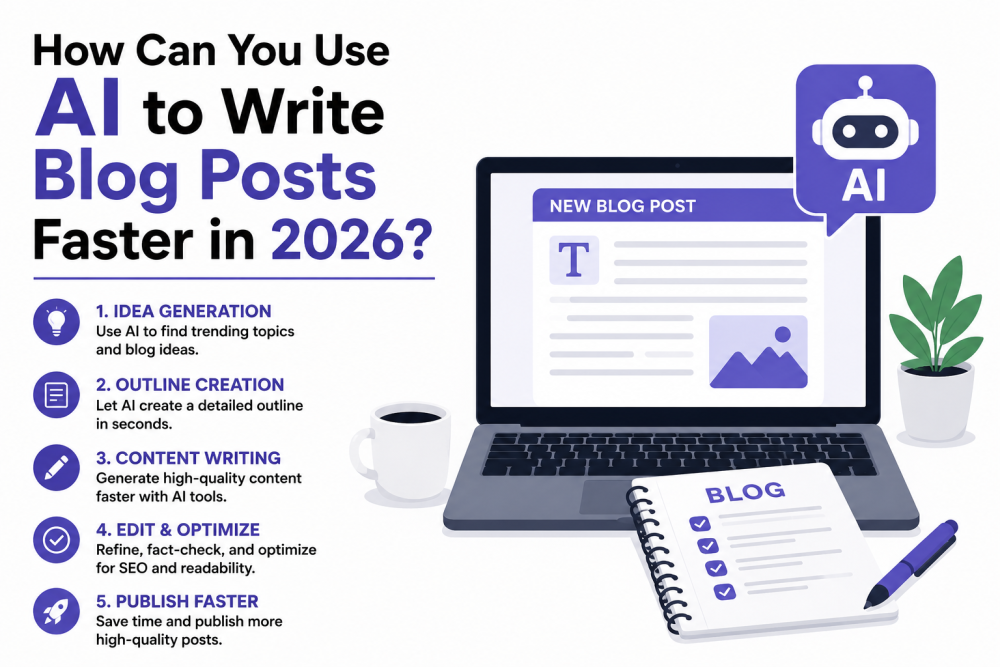
A blog post that used to take me six hours now takes about two. That's the honest math after a couple of years of writing with AI daily, and I'll show you exactly where those four hours come from.
But first, the part most articles on this topic are too polite to say. AI doesn't write good blog posts. AI writes fast first drafts, decent outlines, and endless variations, and a person turns those into good blog posts. The bloggers winning with AI in 2026 aren't the ones who found a magic prompt, they're the ones who figured out which parts of the job to hand over and which parts to keep with a death grip. Get that split wrong in one direction and you're barely faster. Get it wrong in the other direction and you're publishing beige mush that readers bounce off and Google's helpful content systems quietly bury.
So this is a workflow article. Where AI goes in the process, where it absolutely doesn't, the prompting habits that separate usable drafts from junk, and the mistakes I've watched sink real websites. Everything here works with any of the big assistants, ChatGPT, Claude, Gemini, pick your poison, the workflow matters more than the logo.
The Split: What AI Does Well and What It Ruins
Hand these to the machine, gladly. Brainstorming angles and titles, it'll give you twenty in seconds and two will be good, which is the point of twenty. Outlining, it's genuinely excellent at structure. First drafts, the blank page is dead and I don't miss it. Rewriting a clunky paragraph five different ways. Meta titles and descriptions. Summarizing your research notes. FAQ generation from a topic. The mechanical layer of writing, basically.
Keep these for yourself, always. The opinions, because AI has none worth reading and hedges like a politician. The experiences, the "I tried this and here's what broke" material that makes readers trust you, the machine can only fake it and readers smell fake. The facts, checked by you, because models still confidently invent statistics, studies, and quotes, less than they used to, but "less" is doing dangerous work in that sentence. And the final voice pass, the read-aloud edit where you make the thing sound like a person, specifically you.
That's the entire philosophy. Now the assembly line.
The Workflow, Step by Step
Here's the actual process, timed loosely against a 1,500-to-2,000-word post.
Research first, and do it yourself, twenty to thirty minutes. Read the top-ranking posts on your keyword, note what they cover, note what they all miss, that gap is your angle. Skim Reddit or forums for how real people phrase the problem. Paste your messy notes into the AI at the end and ask it to organize them. What you don't do is ask the AI to "research" from its own memory for anything factual or current, that's how invented statistics end up in your post wearing confident little citation costumes.
Then brief it like a freelancer, ten minutes, and this step is where most people fail. A prompt like "write a blog post about email marketing" produces the same oatmeal for everyone who types it. A brief that works looks more like: here's the audience, here's the angle, here's my outline or ask it to propose one, here's a 300-word sample of my writing to match, keep sentences varied, no bullet-point spam, US spelling, 1,800 words. The quality of what comes back tracks the quality of the brief almost embarrassingly closely. Garbage in has never been more literal.
Draft, five minutes of generating, then the real work. Read the draft as raw material, not product. Sections in the wrong order? Move them. A generic paragraph where your experience should be? Delete it and write three sentences from your actual life. Every fact, number, and name gets checked against a real source before it survives. This edit pass is 60 to 90 minutes and it is the job. The draft saved you from typing, not from thinking.
Finish with the humanity pass, fifteen minutes. Read it out loud, genuinely out loud, and everywhere you stumble or cringe, that's AI residue, rewrite it in the words you'd say across a table. Add one detail no model could know. Then the trimmings: meta title, description, FAQs, internal links, and yes, use the AI for those, it's good at trimmings.
Total: roughly two hours for a post that used to eat an afternoon. The four saved hours came out of typing and staring, not out of quality. That's the trade you're allowed to make.
Prompting Habits That Actually Move the Needle
A few habits worth stealing, learned through a lot of mediocre drafts.
Feed it your voice. A few hundred words of your best previous writing, pasted in with "match this style," improves output more than any clever instruction I've found. The models are excellent mimics with nothing to mimic by default.
Ask for ranges, not answers. Ten titles, five intros, three ways to explain the concept. Picking beats accepting, and the second-best option often sparks the version you actually write.
Iterate in the chat instead of settling. "Make paragraph three more specific." "Cut this by a third." "That example is generic, give me one about restaurants." Treat it like an infinitely patient junior writer on a call, because that's functionally what it is.
And keep a standing instruction against the AI-isms. Every model has tics, the "in today's fast-paced digital landscape" openers, the "whether you're X or Y" constructions, the conclusion that begins "In conclusion." Tell it to skip them, then delete the ones that sneak through anyway. They always sneak through somewhere.
The Mistakes That Sink Sites
I've watched each of these happen to real websites, so consider this section a graveyard tour.
Publishing raw output. The one unforgivable sin. Unedited AI text is recognizable to readers within a paragraph, and readers who feel a site is machine-written don't come back, which shows up in engagement signals, which shows up in rankings. The publish button is earned by the edit pass.
Mass generation. The 200-posts-in-a-weekend strategy had a moment, and then Google's updates specifically flattened sites doing it, some lost everything overnight. Scaled content with nothing added is precisely what the helpful content system exists to catch. Ten posts with real editing beat two hundred without, and it isn't close.
Trusting the facts. Models hallucinate less than they did, and still do it smoothly enough that fake statistics read exactly like real ones. Every number gets a source or gets cut. No exceptions, especially in health, finance, and anything else where being wrong hurts people.
And skipping your own experience. Google's guidance says the quiet part out loud now, the E in E-E-A-T stands for experience, and it's the one ingredient no model possesses. A single paragraph of genuinely yours, what you tested, what surprised you, what you'd skip next time, does more for a post than any optimization pass.
For what it's worth, Google has been consistent on the method question: it evaluates whether content is helpful and reliable, not whether a human or machine typed it. The risk was never "AI content." The risk is unhelpful content, which AI merely lets you produce at terrifying speed.
The Bottom Line
Using AI to write blog posts faster in 2026 comes down to an assembly line with a human at both ends. You bring the research, the angle, and the brief. The machine bulldozes the blank page and handles the mechanical layers, outlines, drafts, variations, trimmings. Then you take it back for the parts that were never its to do: the facts, the opinions, the lived experience, the voice. Two hours instead of six, with the quality living or dying on that final human pass, same as it always did.
The tools will keep improving. The split won't change. Machines for speed, you for the reasons anyone reads a blog written by a person in the first place.
FAQs: Writing Blog Posts With AI
Can AI really write a whole blog post by itself?
It can generate one, and you shouldn't publish it. Raw AI drafts are generic by nature, occasionally wrong with total confidence, and recognizable to readers. Treat the AI draft as raw material that saves you the typing, then spend your time editing, fact-checking, and adding what only you know.
Will Google penalize my blog for using AI?
Google has said repeatedly that it rewards helpful, reliable content regardless of how it's produced. What its updates have hit hard is mass-produced content with nothing added, AI or otherwise. Use AI for speed, add genuine experience and editing, and the method isn't the risk.
Which AI tool is best for blog writing in 2026?
The workflow matters far more than the tool. ChatGPT, Claude, and Gemini all produce strong drafts when briefed well, and all produce oatmeal when briefed lazily. Pick whichever you already use, feed it samples of your writing, and invest your energy in better briefs rather than tool-hopping.
How much time does AI actually save per post?
For a typical 1,500-to-2,000-word post, expect the total to drop from five or six hours to roughly two: the drafting and outlining time nearly vanishes, while research, fact-checking, and the final edit stay human and stay long. Anyone promising ten publishable posts a day is describing volume, not blogging.
How do I make AI writing sound like me?
Paste in 300 to 500 words of your own best writing with the instruction to match its style, then finish every post with a read-aloud pass where you rewrite anything you'd never say. The sample does more than any descriptive instruction like "write casually," and the read-aloud catches what the sample missed.
What should I never let AI do in my blog workflow?
Three things. Never let it supply facts, statistics, or quotes without you verifying them against real sources. Never let it fake first-hand experience, readers and search engines both punish it. And never let it publish, the final pass belongs to a human, every time.