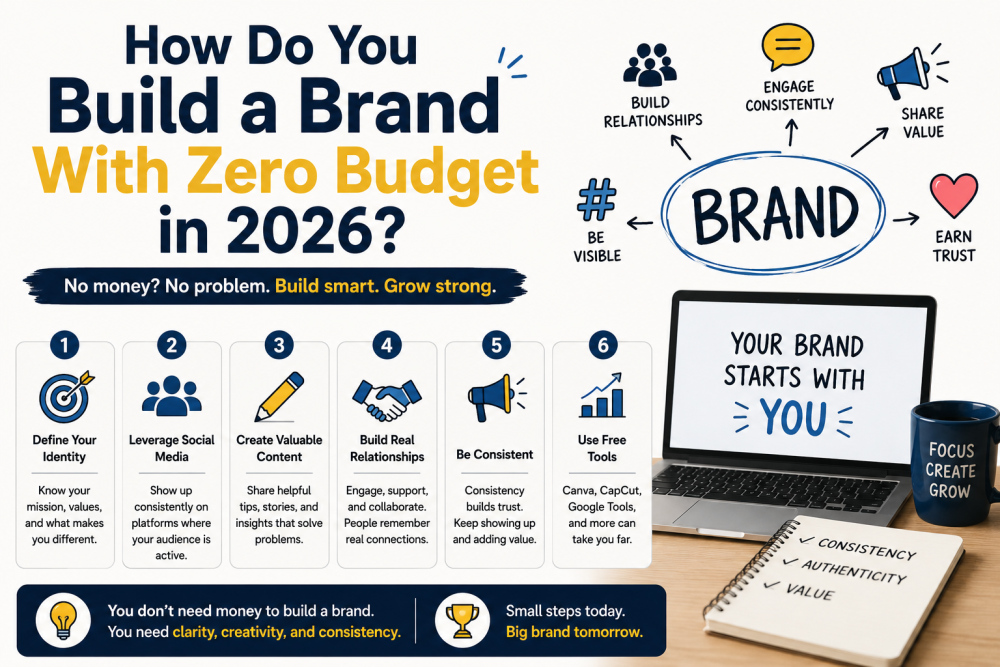
A brand is what people say about you when you're not in the room. That's the whole definition, and notice what it costs: nothing. Reputation has no invoice, which means the core of branding was always free, and the expensive parts, the agency logo, the campaign, the billboard, were only ever amplifiers for businesses that had the core or camouflage for ones that didn't.
So zero-budget branding isn't a compromise version of the real thing. It is the real thing, minus the amplifiers, and this article is the build: the decisions that create a brand before any design exists, the free identity kit that makes you look deliberate, the one-channel presence that beats scattered noise, the proof assets that do your talking, and the only ingredient that genuinely can't be bought, which, spoiler, is showing up the same way for a long time.
The Brand Before the Logo: Three Decisions
Every strong brand, from the global giants to the pressure-washing guy whose van you recognize, rests on decisions, not design, and the decisions are free. Make these three before touching a single template.
Who, exactly. Not "small businesses," not "people who want to be fit", the narrower audience whose specific problem you solve. Our pricing and business guides bang this drum for revenue reasons; here's the brand reason: a brand is a memory, and memories need hooks, and "the bookkeeper for restaurant owners" hooks where "bookkeeping services" slides straight off the mind. Narrow isn't a limit on your business. It's the handle people carry you by.
What you're the answer to, in one sentence a customer would actually say. Not a mission statement, those are incense, pleasant and weightless, a sentence: "they turn your messy receipts into clean books by Friday." "She makes wedding cakes that taste as good as they look." If a happy customer wouldn't say it to a friend, it's not positioning, it's poetry, start over.
And how you sound. Voice is the most underused free branding asset in existence: formal or familiar, funny or steady, blunt or gentle, pick deliberately, write it down in three adjectives, and then, the actual work, sound that way everywhere, the Instagram caption, the invoice email, the way you answer the phone. Customers can't always articulate why one business feels trustworthy and another feels random. Voice consistency is usually the why.
The Free Identity Kit
Now, and only now, the visual layer, and 2026's free tools make this almost embarrassingly easy, the gap between "no budget" and "looks deliberate" has never been thinner.
The kit is five choices made once: a name you can say aloud without explaining the spelling, two colors, not five, two, one font family, a simple logo, and Canva's free tier plus an hour of restraint produces something clean, text-based logos age better than clip-art concepts anyway, and a profile photo or product shot standard, same style, decent light, every platform. Save it all in one place, apply it everywhere, never freelance from it on a whim.
Here's the secret the design industry won't lead with: at zero budget, consistency IS the design skill. A modest look applied identically across your Google profile, socials, invoices, and packaging reads as professional; a brilliant logo surrounded by visual chaos reads as amateur. Customers aren't grading your kerning. They're pattern-matching for "does this business have its act together," and repetition is the pattern.
Skip, at this stage: paid logo contests, trademark filings (that's a later milestone, when there's something worth defending, and worth checking your country's rules on), brand "strategy" packages sold to businesses with no customers yet. The order is customers first, polish later, always.
One Channel, Done Like You Mean It
Distribution is where zero-budget brands live or die, and the rule comes straight from our growing-without-ads playbook: one channel, chosen by where your people actually are, done natively and relentlessly, beats four channels done as chores.
The brand layer on top of that rule: whatever the channel, your job is to become a recognizable repeated thing. The barber whose transformation videos always open the same way. The bookkeeper whose weekly tip always lands Tuesday morning. The candle maker whose behind-the-scenes has a signature shot. Formats are brand assets, repetition builds them, and the algorithm era quietly rewards them too, since recognizable formats train audiences to stop scrolling.
And for service businesses especially, consider the founder-face option honestly: personal brands travel faster than logo brands at zero budget, people trust faces, follow people, and refer humans, and "the person who X" is the strongest small-business brand format there is. It costs comfort, not money, being visible is a tax some owners genuinely don't want to pay, and the logo-brand route works too, just slower. Choose knowingly.
Proof: The Brand Assets Customers Build For You
The strongest zero-budget brand material isn't produced, it's collected, and most businesses collect almost none of it.
Reviews first, the compounding asset: asked for at the moment of happiness, with a direct link, every time, as a habit, the full mechanism is in our organic growth guide, and thirty honest reviews are a brand identity all by themselves, one no competitor can copy. Then the show-your-work layer: before-and-afters, a simple portfolio, the two-paragraph case story, "came to us with X, here's what happened", which converts better than any adjective you could write about yourself. And the words customers actually use, in reviews and messages, are your positioning research, when three people independently say "so fast," fast just became a brand pillar, put it in the bio.
The meta-point: at zero budget, your customers are the marketing department. The businesses that understand this engineer small remarkable moments worth retelling, then make retelling easy, and their brand builds itself in other people's mouths, which was always where brands lived anyway.
The Ingredient Money Can't Buy
Here's the honest heart of it, and the reason zero-budget brands beat funded ones more often than the funding industry likes to discuss: brands are built by consistency over time, and consistency over time cannot be purchased, only performed.
Show up the same, sound the same, deliver the same, weekly, for a year, and something happens that no launch budget replicates: you become expected. The Tuesday tip gets awaited. The style gets recognized in a feed before the name loads. The referral happens with your positioning sentence attached, word for word, because you said it enough times that they memorized it for you. That's a brand, the real kind, and its entire cost was discipline.
The corollary is the honest warning: the zero-budget brand's biggest risk isn't looking cheap, the free tools solved that, it's quitting in month three, when the consistency hasn't compounded yet and the room is still quiet. Every brand you admire had that silent stretch. The ones you've heard of are simply the ones that kept talking through it.
The Bottom Line
Building a brand with zero budget in 2026: make the three free decisions, the narrow who, the sentence you're the answer to, the voice, then ship the modest, ruthlessly consistent identity kit the free tools now make easy. Pick one channel and become a recognizable repeated thing on it, face-forward if you can bear it. Collect proof like it's revenue, reviews, before-and-afters, the customers' own words, because it is. And then the part that was never for sale: the same show-up, week after week, through the quiet months, until expected becomes recognized becomes referred.
The budget was never the barrier. The consistency was, is, and remains the whole price, and it's payable only in the one currency every competitor has exactly the same amount of.
FAQs: Building a Brand With No Money
Can you really build a brand with no money at all?
Yes, because a brand is reputation plus recognition, and both are built by decisions and consistency rather than spending: narrow positioning, a repeated voice and look (free on Canva-class tools), one channel done natively, and collected proof like reviews and before-and-afters. Money amplifies a brand; it has never been what creates one.
What should I create first when branding with zero budget?
The three free decisions before any design: exactly who you serve, the one plain sentence you're the answer to, and how you sound. Then the minimal kit, name, two colors, one font, simple text-based logo, applied identically everywhere. Businesses that start with the logo and skip the decisions end up with decoration, not a brand.
Do I need a professional logo to look credible?
Not at the start. A clean, simple, text-based logo from free tools, applied with total consistency across every touchpoint, reads as more professional than an expensive logo surrounded by visual chaos. Consistency is what customers pattern-match for credibility; upgrade the design later, when revenue makes it a rounding error.
Is a personal brand better than a business brand for beginners?
At zero budget, usually faster: people trust faces, follow humans, and refer "the person who X" more readily than a logo they just met. The trade is personal visibility, which not every owner wants, and the business-brand route works too, just more slowly. Service businesses benefit most from the founder-forward approach; product businesses can go either way.
How long does it take to build a recognizable brand?
Expect the compounding to feel invisible for roughly the first three to six months, that's the quiet stretch where most people quit, with real recognition, being expected, recognized in feeds, referred with your own positioning sentence, typically arriving somewhere in the six-to-eighteen-month range of weekly consistency. The timeline is paid in showing up, and there's no express lane, funded or otherwise.
What branding expenses are worth paying for later?
In rough order, once revenue exists: a proper domain and email on it (cheap and worth it early), a designer's pass on the identity you've already proven, trademark protection when there's genuinely something to defend, checked against your country's process, and photography, real images of real work outperform stock forever. Everything sold to you before customers exist, brand strategy packages, logo contests, follower services, belongs on the skip list.