Cheap flights aren't found. They're permitted, by flexibility, and that one reframe is worth more than every booking hack ever posted.
Here's what I mean. Airline prices move constantly, driven by demand for that specific plane on that specific day, and the person hunting "cheap flights to Rome, August 14th to 21st, from my home airport" has locked every variable and left the price nowhere to bend. The person who can flex any one of those variables, the dates, the destination, the airport, hands the market room to hand them a deal. Flexibility is the discount. Everything else in this article is technique for spending whichever flexibility you've actually got.
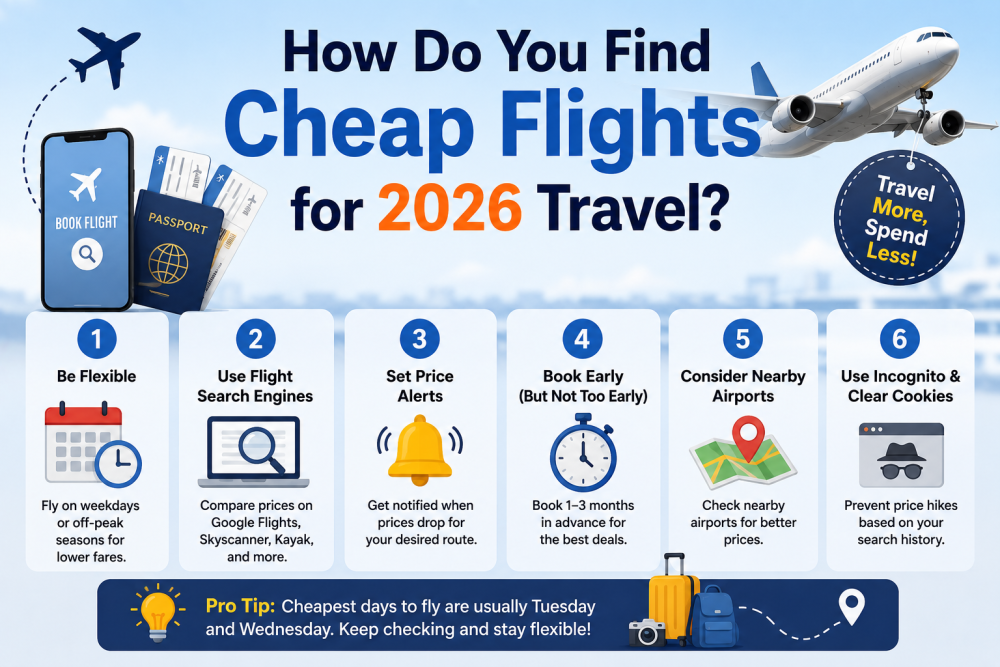
And since flight advice is the internet's most myth-infested genre, we'll be clearing some famous rubbish along the way, including the incognito-browsing legend and the sacred Tuesday booking window. Neither survives contact with how pricing actually works. Right, the levers, biggest first.
Level One: Flexible Dates, the Heavyweight
Same route, seven days apart, the fare can double or halve. Nothing else in travel moves money like dates do.
The tools make this lever effortless now: Google Flights and Skyscanner both show calendar and grid views where a whole month's prices sit side by side, greens and reds doing the thinking. The patterns you'll see repeat everywhere: midweek departures, Tuesday, Wednesday, undercut Fridays and Sundays, since you're bidding against weekenders and business traffic on the popular days. Shoulder weeks, the edges just outside school holidays and festivals, price kindly. And the same beach in early June costs a fraction of its mid-August self, a trick our budget Europe guide leans on heavily.
Practical version: never search a single date pair. Search the month, let the grid show you where your trip is cheap, and if your calendar can slide even two days, slide it. That's frequently a three-digit saving for a two-day shuffle.
Level Two: Flexible Destination, the Adventure Discount
Flip the search. Instead of "flights to Lisbon," ask "where's cheap from here in September?" Google Flights' Explore map and Skyscanner's Everywhere search answer exactly that question, your airport, your dates, the whole world ranked by price, and it's the single most underused feature in travel.
This is how the savviest budget travelers actually operate, and it's the standing rule across our travel guides: let the fare pick from your shortlist. Keep five places you'd genuinely love, watch what's cheap, and the flight sale decides. The trip to the place with the $280 fare beats the identical trip to the place with the $850 fare, and the beach doesn't know the difference.
Half-flexible counts too: "Greece" instead of "Santorini" opens every Greek airport, "Southeast Asia" instead of "Bali" opens a continent of entry points with cheap regional hops between them.
Level Three: Airports and Routing
The unglamorous lever with real money in it. Check the alternative airports on both ends, the bigger hub two hours from home often beats the local airport by more than the train ticket between them, and the same is true on arrival, into Milan, train to Florence, that genre. Run the total honestly, transfers and time included, sometimes the local airport wins after all, but never assume without looking.
Two routing tricks worth knowing, one with a warning attached. Open-jaw itineraries, fly into one city, home from another, often cost the same as a return and delete the backtracking from a multi-city trip, book them with the "multi-city" option everyone ignores. And self-transfer routing, two separate cheap tickets glued together, does produce real savings, with a real risk: separate tickets means no protection if the first flight delays and you miss the second, so it's for the experienced, with long buffers, hand luggage only, and eyes open. A missed connection on separate tickets is a brand-new full-price ticket, which can vaporize a year of clever savings in one afternoon.
The Tools and the Timing, Honestly
The toolkit is short: Google Flights for the calendar grids, Explore map, and its genuinely useful price tracking, Skyscanner for Everywhere searches and coverage of budget carriers Google sometimes misses, and price alerts on both, set them for your routes and let the tools do the watching. Booking itself is usually best done directly with the airline once a fare is found, same price most of the time, and infinitely less misery when anything changes, third-party ticket agents are where refund requests go to develop character.
Now the timing truths, minus the folklore. There is no magic booking day, the Tuesday-at-midnight legend is a fossil from an era of manual fare updates, prices now move continuously and the studies keep finding day-of-booking differences of roughly nothing. Incognito mode isn't saving you money either, the browsing-history price-hike story has been tested repeatedly and doesn't hold, prices differ because inventory moves, not because the airline saw you looking.
What does hold: fares generally rise as the plane fills, sharply in the final two or three weeks, so last-minute is the one reliably expensive strategy. The sensible windows run about one to three months out for domestic and short-haul, and roughly two to six months out for international, longer for peak season, with the alert-based version beating any fixed rule: set the alert early, learn what normal costs for your route, and strike when the price dips below it. Knowing a route's normal is the actual skill, everything else is decoration.
Budget Airlines: The True-Cost Math
The $40 fare is real and it is also a quiz. Budget carriers price the seat alone, then sell back everything else, the cabin bag, the checked bag, the seat selection, the airport check-in, boarding order, breathing room, and the fair comparison is always final price versus final price, extras included. A "cheap" fare plus two bags regularly loses to the full-service fare that included them, and the budget terminal being 90 minutes further from town has erased many a saving before takeoff.
None of which makes budget airlines bad, they're brilliant for the hand-luggage traveler who plays the game as designed: pack light, check in online, print or download the pass, decline everything at checkout, and the $40 fare stays $40. The airlines profit from people who don't read the rules. Read the rules, be the exception, and Europe and Asia's low-cost networks become the budget traveler's best friend, our cheapest-countries guide is essentially built on top of them.
The Bottom Line
Finding cheap flights in 2026 is a flexibility auction: dates flex hardest, destination flexes biggest, airports flex quietest, and the tools, Google Flights' grids and Explore, Skyscanner's Everywhere, price alerts on both, convert whichever flexibility you have into money. Book direct once the alert fires below the route's normal price, ignore the Tuesday and incognito folklore, respect the true-cost math on budget carriers, and treat self-transfer cleverness with the caution it demands.
And if you keep just one habit from all of this: stop searching single dates for single cities. Search months and maps, let the market show you its soft spots, and take the trip the price is offering. The traveler who bends is the traveler who flies twice as often on the same budget, which was the point all along.
FAQs: Finding Cheap Flights
What is the best website to find cheap flights in 2026?
Google Flights and Skyscanner between them cover the job: Google for the date grids, Explore map, and price tracking, Skyscanner for Everywhere searches and budget carriers Google occasionally misses. Use them to find the fare, then book directly with the airline, same price usually, far less pain when plans change.
What day is cheapest to book flights?
None, genuinely, the Tuesday legend describes an airline industry that stopped existing years ago, and studies keep finding no meaningful day-of-booking effect. Flying midweek is reliably cheaper than flying Friday or Sunday, though, people confuse the two rules, and only one of them is real.
How far in advance should I book flights for 2026?
Rough windows: one to three months for domestic and short-haul, two to six for international, earlier for peak seasons and school holidays. The better method is alert-based: set a price alert well ahead, learn the route's normal price, and book when a fare dips under it. The last two to three weeks before departure are the one reliably expensive zone.
Does searching in incognito mode make flights cheaper?
No, this one's been tested to death and doesn't hold up. Prices change between your searches because seat inventory and demand move constantly, not because the airline saw your browsing history. Spend the energy on real levers, flexible dates, alternative airports, price alerts, instead.
Are budget airlines actually cheaper?
For the traveler who plays by their rules, yes, hand luggage only, online check-in, decline every add-on, and the headline fare stays real. Compare final price against final price though: bags and extras routinely push a budget fare past a full-service one, and out-of-town budget terminals cost time and transfer money. The fare is cheap; the quiz is optional.
Is it cheaper to book two separate flights instead of one ticket?
Sometimes meaningfully, and it carries the one risk that can erase a year of savings: on separate tickets, a delayed first flight and missed second one is entirely your problem, no rebooking protection. If you self-transfer, use long buffers, travel hand-luggage only, and accept the gamble knowingly, or pay the little extra for a single protected ticket and sleep on the plane instead of in the terminal.