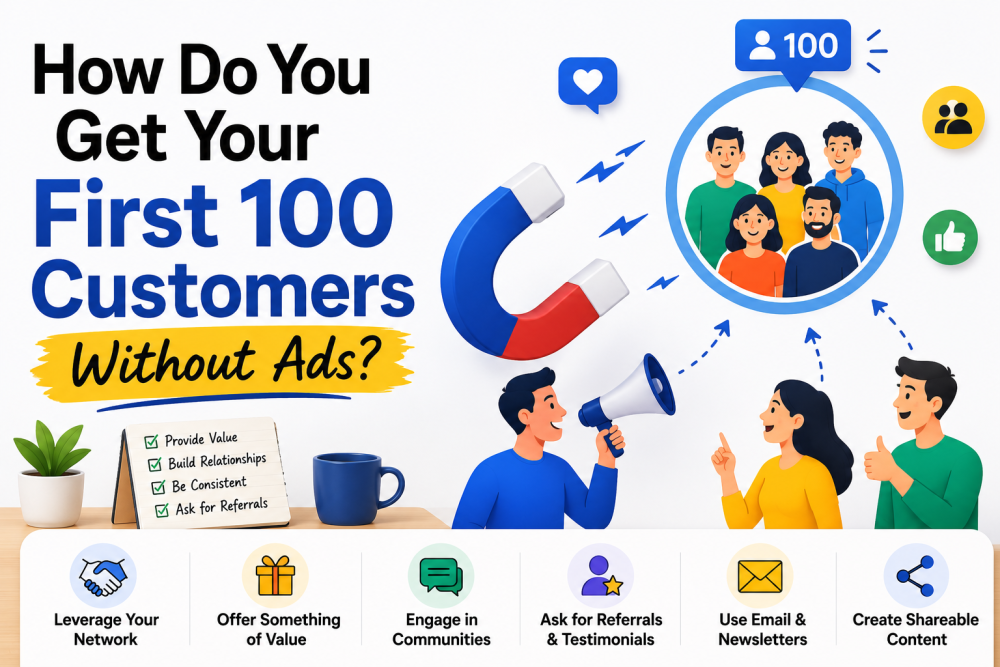
The first 100 customers don't come from marketing. They come from behavior that looks nothing like marketing, individual conversations, plain asks, favors called in, communities contributed to, and this is the part new founders resist hardest, because it feels small, slow, and unscalable. It is all three. That's why it works: the things that don't scale are precisely the things your adless competitors won't do, and by customer 100 they'll have handed you the data that builds the scalable machine.
So here's the playbook as a staircase, because customers 1-10, 10-40, and 40-100 come from genuinely different moves, plus the actual asking scripts, the founding-customer offer done right, and the one-question habit that turns your first hundred into the map for your next thousand. This is the launch-sequence companion to our growing-without-paid-ads guide, that one builds the ongoing channels, this one gets you to the point where you have something to grow.
Customers 1-10: The Warm Start
The first ten come from people who already know you exist, and there is no dignity-preserving alternative, the founders who skip this step to "launch properly" launch to silence, and silence is much worse for dignity.
The move is the plain ask, sent individually, never broadcast: a short personal message to the contacts, former colleagues, community members, and friendly acquaintances who either need what you've built or know someone who does. The script that works, adapted to your voice: "I've started [the specific thing]. I'm looking for my first few customers, and I thought of you because [the genuine reason]. Would this be useful to you, or is there someone you'd point me to?" Two sentences of context, one honest ask, one referral escape-hatch, and no apology anywhere in it, per our pricing guide's whole thesis, you're offering something of value, not requesting charity.
Pair it with a founding-customer offer, discounted with a reason and a boundary, exactly as the pricing article prescribes: "founding rate for my first ten customers, in exchange for honest feedback and, if you're happy, a review." That structure gets you paid three times, the revenue, the product feedback that fixes what you couldn't see, and the testimonials that unlock every later stage. What it's not: free. Free customers aren't customers, they're an audience, and their feedback is worth what they paid.
Customers 10-40: Referrals Engineered, Communities Entered
Ten happy customers is an engine if you install the crank. The referral machinery from our organic growth guide starts now, not later: the ask at the moment of happiness ("we grow through recommendations, who else should I be talking to?"), the small mutual perk where it fits, and the standing habit of over-delivering something small and memorable, the peak worth retelling. At this scale, every single customer asking one other person is literal doubling, no channel required.
Communities are the second move, entered on the contribute-first rule: the local Facebook groups, subreddits, trade forums, and WhatsApp networks where your customers already gather. The math of community acquisition is patience-shaped, weeks of genuinely helpful answers before the first customer arrives from it, and the compounding is real, one thorough answer in the right thread keeps producing customers for months. The violation that gets founders ejected and reputations set on fire: showing up selling. Answer questions, be uncommonly helpful, let the profile and the occasional natural mention do the work, and when someone asks "who does this?", be the name three people type.
For local businesses, this stage also means the Google Business Profile machinery, complete profile, reviews requested from every happy founding customer, since, per the growth guide, the map pack is where nearby customers actually decide, and ten early reviews is a visible head start most new competitors never bother with.
Customers 40-100: Follow the Data You've Been Collecting
Somewhere in the first forty, a pattern emerges, if you've been running the one-question habit this playbook considers sacred: ask every single customer "how did you find us?", and write it down. By customer forty, the answers are a map, most businesses discover that two sources produced almost everything, and the 40-to-100 move is embarrassingly simple: do dramatically more of those two things and quietly stop the rest.
If the map says referrals, formalize the program properly. If it says one community, deepen there, more presence, maybe the useful free resource that community keeps needing. If it says people searching and finding the Google profile, pour into reviews and the question-answering content our growth guide details, every "how much does X cost" article is a 24-hour salesperson. If it says the weekly market stall or the LinkedIn posts, more stalls, more posts. The founders who stall between 40 and 100 are almost always doing the opposite: abandoning what demonstrably worked to try the channel some podcast praised, which is how a working engine gets traded for a hobby.
This is also the stage to systematize what the first ten taught: the onboarding that used to be improvised, the FAQ built from real questions, the testimonials arranged on the site, because customers 40 through 100 arrive with less hand-holding, and the machinery has to catch them.
What Not to Do, From the Graveyard
The four launch-killers, named plainly. Building in secret: months of polishing before anyone sees it, then a launch to silence, the antidote is selling from week one, embarrassingly early, because the feedback of a real customer beats a quarter of solo perfectionism. Broadcasting instead of asking: the announcement post is not customer acquisition, individual messages are, and one hundred personal asks outperform ten thousand impressions of a launch graphic. Buying the shortcuts: purchased followers, engagement pods, and "guaranteed leads" services produce numbers that spend like confetti. And waiting for the confidence: the founders at customer 100 were not less scared at customer zero, they asked scared, which turns out to be the entire difference.
And the honest timeline, so nobody quits on schedule: the first ten usually come in days to a few weeks of real asking, the first forty across a couple of months of referrals-plus-community, and the run to 100 over a quarter or two as the doubled-down channel compounds, faster for local services in thin markets, slower for products building trust from nothing. Slow weeks are part of the arithmetic, not evidence against it.
The Bottom Line
The first 100 customers without ads: a warm start of individual plain asks with a founding-customer offer that trades a bounded discount for feedback and reviews, referral machinery and contribute-first community presence installed by customer ten, the "how did you find us" question asked religiously, and the 40-to-100 stretch spent doubling down on whatever the answers reveal while the systemization catches up. Small, unscalable, personal, and deliberately so, the scalable machine comes next, built on this stage's data, and our growing-without-ads guide is its manual.
One hundred conversations, give or take, stand between a new business and its first hundred customers. That's not a marketing problem. That's a doing-it problem, and it starts with the first message, sent today, to someone you already know.
FAQs: Getting Your First Customers
How do I get my very first customer with no audience and no ads?
Through a direct, individual ask to your existing network: a short personal message to the people who might need what you offer or know someone who does, with a founding-customer rate attached. It feels small and it's the documented starting point of most bootstrapped businesses, the first customer is almost never a stranger, and the broadcast announcement almost never produces them.
Should I offer my product free to early customers?
Discounted with a reason, not free: a founding rate in exchange for honest feedback and a review gets you revenue, product intelligence, and testimonials at once, while free "customers" give unreliable feedback and set an anchor at zero. The discount needs a boundary, first ten customers, launch month, so it ends cleanly, per the never-discount-naked rule.
How long does it take to get 100 customers without advertising?
Honest ranges: the first ten in days to weeks of genuine individual asking, forty within a couple of months as referrals and community presence compound, and the full hundred across one or two quarters, faster for local services in underserved markets, slower for trust-heavy products. The pace is set less by the market than by the volume of actual asks and answers happening weekly.
What should I say when asking someone to become a customer?
Plain language, individually sent: what you've started, why you thought of them specifically, one honest ask, and a referral escape-hatch, "would this be useful to you, or is there someone you'd point me to?", with no apology in it. The referral option matters: people who don't need you often know someone who does, and the ask that offers both paths converts twice.
How do I find customers in online communities without spamming?
Contribute first, sell approximately never: weeks of genuinely helpful answers in the groups and forums where your customers gather, a complete profile that says what you do, and mentions of your business only where naturally relevant or explicitly asked. It's slower than posting promotions and it's the version that works, one thorough answer in the right thread produces customers for months, while promotional posting produces bans.
What's the most important habit for early customer growth?
Asking every single customer "how did you find us?" and recording the answer. By customer forty the responses form a map, usually two sources producing nearly everything, and the entire path from 40 to 100 is doubling down on what the map shows while dropping what it doesn't. Businesses that skip the question end up guessing, and guessing is how working engines get abandoned for fashionable ones.