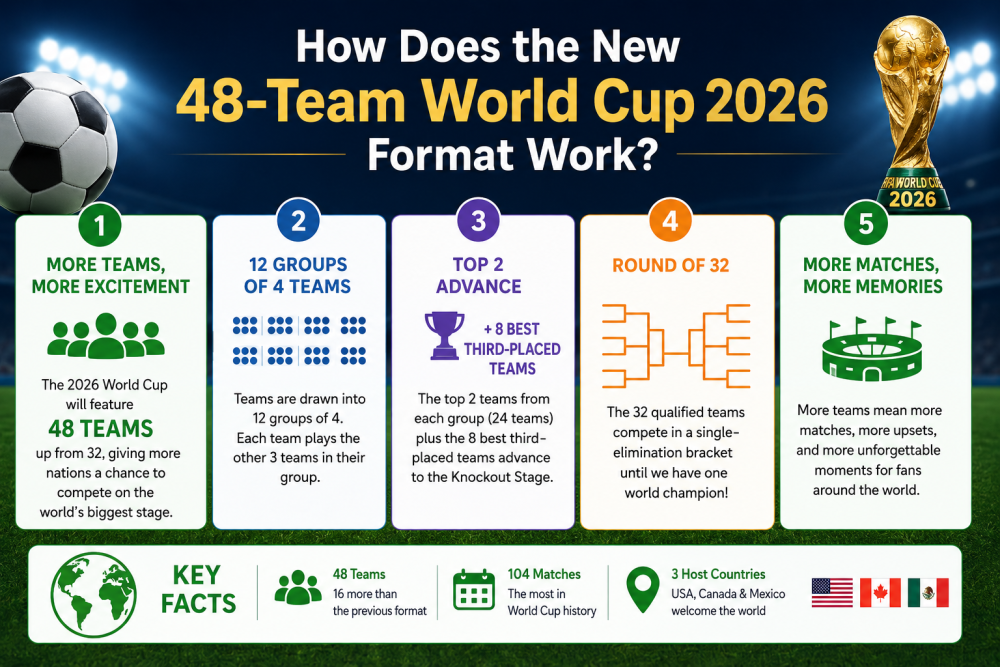
Forty-eight teams. Twelve groups. A brand-new knockout round nobody's brain has fully accepted yet. And 104 matches, which is 40 more than every World Cup you grew up with.
That's the 2026 format in one breath, and if you've found yourself squinting at the bracket this summer wondering how a third-place team is still alive, or why there's suddenly a "Round of 32" between the groups and the round of 16 you remember, this is the explainer. The whole machine, piece by piece, plus, since the tournament is deep into its knockout rounds as I write, some honest notes on how the new format has actually behaved in the wild. Short version: better than the skeptics predicted, with one genuinely weird wrinkle.
The Old Way, for Contrast
For nearly three decades, 1998 through 2022, the World Cup was a fixed shape: 32 teams, eight groups of four, top two advance, straight into a round of 16, then quarters, semis, final. Sixty-four matches. The winner played seven. Everyone could draw the bracket from memory, and half the planet did every four years.
2026 tore that up, mostly because FIFA wanted more countries at the party, and, let's not be naive, more matches to sell. The expansion from 32 to 48 is a 50 percent bigger field, and every piece of the format below exists to make that number work.
The Group Stage: Twelve Groups, and the Third-Place Twist
The 48 teams were drawn into twelve groups of four, labeled A through L. Within a group, nothing changed from the classic version: each team plays the other three once, three points for a win, one for a draw.
The changes are in who gets out. The top two from each group advance, that's 24 teams. But 24 doesn't make a clean knockout bracket, so here's the twist that decides everything: the eight best third-placed teams across all twelve groups advance too. Twenty-four plus eight, 32 teams, and now the bracket math works.
How do you rank third-place teams from different groups against each other? A league table of the twelve of them: points first, then goal difference, then goals scored, then disciplinary record, and drawing of lots as the theoretical last resort. Which produced this summer's most modern spectacle, teams and fans doing spreadsheet math across six simultaneous groups on the final matchday, calculating whether four points would survive the cut, whether a late goal in a match 2,000 miles away just changed everything. It did, more than once.
The practical consequence, and this is the format's biggest personality change: it's now genuinely hard to be eliminated in two games. Lose your opener, draw your second, and you're probably still alive going into matchday three. The old format's cruel early exits, giants dead after two bad afternoons, mostly can't happen anymore. Whether that's mercy or mush depends on your taste; more on that at the end.
The Knockout: Five Rounds Instead of Four
Thirty-two survivors means the knockout stage grew a whole new floor: the Round of 32, sixteen matches over six days, a round that has never existed at a World Cup before this one. Then the familiar staircase: round of 16, quarter-finals, semi-finals, the third-place match, and the final.
Knockout rules are unchanged, level after 90 minutes means 30 minutes of extra time, then penalties. What changed is the length of the road: the 2026 champion will have played eight matches, one more than every winner since 1974, across 39 days, the longest World Cup ever staged. That extra match is quietly the format's biggest sporting consequence, squad depth and rotation stopped being luxuries and became the whole strategy, and the managers who treated the group stage as a rotation opportunity are, not coincidentally, the ones still involved in July.
The bracket also comes pre-drawn, every group position maps to a specific slot, so from the moment groups finished, every team could see its theoretical road to the final at MetLife on July 19. No reseeding, no draws between rounds, just a long corridor with the doors marked.
The Numbers, Side by Side
The whole expansion in one comparison. Teams: 32 became 48. Groups: eight of four became twelve of four. Advancing: 16 became 32, meaning two-thirds of the field now reaches the knockouts, up from half. Total matches: 64 became 104. Matches to win it: seven became eight. Duration: about a month became 39 days. And host cities: one country's worth became sixteen cities across three nations, but that's a geography story we've told elsewhere on the site.
One more number worth knowing because it explains the qualifying you watched: the 48 slots were shared out with Europe holding 16, Africa 9, Asia 8, South America 6, North and Central America 6 including the three hosts, Oceania finally guaranteed 1, and the last 2 decided by an inter-confederation playoff. The expansion's whole point lives in those numbers, several nations played their first World Cup this summer because of them, and at least one of them, as anyone watching the knockouts knows, declined to treat qualification as the achievement.
So Has It Actually Worked?
The honest mid-tournament audit, having watched the thing run.
What worked: the final group matchdays were genuinely electric, the third-place race kept almost every team mathematically alive late, which meant almost no dead rubbers, the exact opposite of what critics predicted. The newcomers weren't cannon fodder as feared, and the Round of 32 produced real drama rather than processional mismatches, including upsets that rearranged the entire tournament. The knockout rounds since have been as ruthless as ever, ask the three host nations, all eliminated in the round of 16, or Brazil, sent home by a nation playing its first knockout football in a generation.
The weird wrinkle: the third-place safety net changes group-stage psychology. A team that's lost its opener can rationally play for a draw and a narrow win, aiming for the eight-team cut line rather than swinging for second place, and a few groups had a distinctly chess-like final round because of it. Purists hate this. Neutrals watching six spreadsheets update in real time seemed, judging by the noise, to be having the time of their lives.
The unresolved question: eight matches over 39 days in a North American summer is a serious physical ask, and whether the final is contested by the two best teams or the two deepest squads is exactly what the next two weeks will answer.
The Bottom Line
The 2026 format in a paragraph: 48 teams in twelve groups of four, the top two from each group plus the eight best third-placed teams advancing to a brand-new Round of 32, then the familiar knockout staircase stretched one round longer, 104 matches across 39 days, and a champion who'll have won eight games to lift the trophy on July 19.
It's bigger, longer, more forgiving early and exactly as merciless late, and on the evidence of this summer, the doomsayers were mostly wrong, the expanded World Cup produced more football, more countries, more late-group chaos, and knockout rounds that spared nobody, hosts included. The bracket takes one extra squint to read. The tournament underneath it is recognizably, gloriously the same animal, just with more teeth.
FAQs: The 48-Team World Cup Format
How many teams qualify from each group in the 2026 World Cup?
The top two from each of the twelve groups advance automatically, 24 teams, joined by the eight best third-placed teams across all groups, ranked against each other by points, goal difference, and goals scored. That makes 32 teams in the knockout rounds, two-thirds of the entire field.
What is the Round of 32?
The brand-new knockout round created by the expansion: 16 matches over six days, slotting between the group stage and the traditional round of 16. It exists purely because 32 qualifiers need one extra round to whittle down, and it's the first new World Cup round introduced since the tournament settled its modern shape.
How many matches are in the 2026 World Cup?
104, up from 64 in every edition from 1998 to 2022: 72 group matches, then 16, 8, 4, and 2 through the knockout rounds, plus the third-place match and the final. The champion plays eight matches, one more than winners of the previous era.
How are the best third-placed teams decided?
All twelve third-placed teams are ranked in a single table: points first, then goal difference, then goals scored, then disciplinary record, with drawing of lots as the never-yet-needed final tiebreaker. The top eight advance, which is why final group matchdays involved so much cross-group mathematics this summer.
Why did FIFA expand the World Cup to 48 teams?
Officially, to globalize the game, and the slot allocation backs that up: Africa jumped from 5 to 9 places, Asia from 4-and-a-half to 8, and Oceania got its first guaranteed spot. Unofficially, 40 extra matches mean substantially more broadcast and ticket revenue. Both things are true at once, and this summer's debutant nations and expanded drama are the counterargument to purist objections.
Is the 48-team format permanent?
The 2026 edition is the template going forward, and nothing FIFA has signaled suggests shrinking back; if anything, discussions in recent years have floated further expansion. Formats do get tuned between editions, the 2026 twelve-group structure itself replaced an earlier three-team-group plan that was scrapped, so details may evolve, but the 48-team era is here to stay.