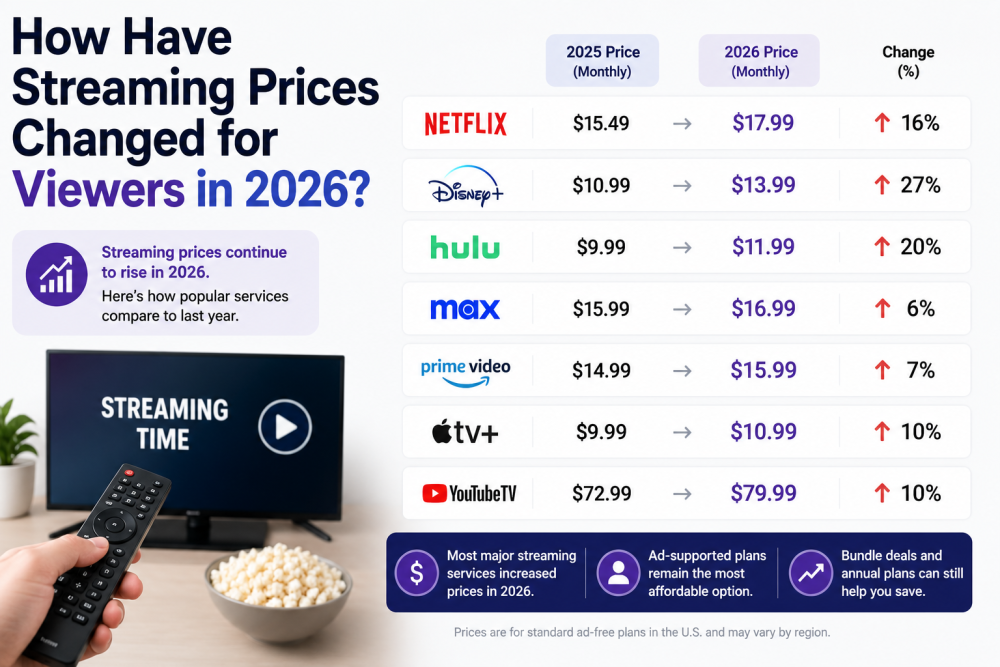
Remember when streaming was the cheap rebellion? One subscription, ten dollars, no contract, and cable was the bloated villain of the story. That era is fully, officially over, and 2026 is the year nobody bothers pretending otherwise: the major services have hiked prices on a near-annual rhythm for years now, ad-free tiers of the big platforms have drifted into territory that would have sounded like satire in 2019, and a household subscribing to everything, the way people once casually did, is paying cable money for the privilege, minus the single bill.
This article is the state of streaming prices in 2026, told honestly: the four structural shifts that changed what you're actually buying, the direction and rough shape of today's pricing (with the standing caveat that exact figures move quarterly, and any specific number ages fast, always check the service's current page before judging), and, most usefully, the viewer strategies that beat the whole system, because the system, it turns out, is very beatable.
Shift One: The Hike Era Became Routine
The pattern hardly needs proving anymore because everyone's inbox has the receipts: across recent years, the big services normalized a price increase roughly every year or so, each announced with the same press-release vocabulary about investing in content, each a few dollars, each compounding. The cumulative effect is the story, subscribers who signed up in the cheap era and never touched their plan have watched some subscriptions roughly double over the years, a few dollars at a time, in the grand tradition of the frog and the saucepan.
The strategic meaning for viewers: the price you signed at is a courtship, not a marriage, the same rising-floor rule our AI tools coverage flags, and the annual "is this still worth it" review moved from optional to mandatory. Auto-renewal is where the hike era collects its winnings.
Shift Two: The Ad Tier Became the Real Product
The biggest structural change of the era, and the one worth genuinely understanding: the cheap tier with advertisements stopped being the budget option and became the product the industry actually wants to sell you. The economics explain everything, services earn ad revenue on top of your subscription on those tiers, which is why ad-supported plans have stayed conspicuously affordable, often around a third to half the ad-free price, while ad-free tiers absorbed hike after hike, and why several services have nudged, repriced, or outright migrated users toward ads.
The viewer math, honestly: the ad-free premium of the big services now prices like a small luxury, and the household question worth actually asking is which services earn it. Plenty of viewers land on a split verdict, ads tolerable on the casual-watching service, intolerable on the prestige-drama one, and the split answer is precisely the one the single-tier era never let you give. The ad tier isn't the compromise anymore. For most services, it's the honest price of the product, and the ad-free tier is the upsell.
Shift Three: The Sharing Crackdown and the Return of the Bundle
Two more moves completed the era. Password sharing, once winked at as free marketing, was systematically shut down across the industry after the crackdowns proved they added subscribers rather than losing them, the "extra member" fee is now a standard product, and the borrowed-login economy that quietly subsidized millions of households is largely history, which functioned as a stealth price rise for everyone who'd been sharing.
And then, the funniest development in media: the bundle came back. Services that spent a decade unbundling cable began bundling each other, platform duos and trios at a discount, telecom packages with streaming stapled in, because churn, viewers hopping in and out, became the industry's terror and discounts-for-commitment its answer. The bundles are genuinely decent value when, and only when, you'd pay for the components anyway; assembled from habit, they're just cable being reinvented by the people who killed it, minus the irony.
What Viewers Actually Pay Now
The shape of it, painted in ranges rather than exact figures because exact figures don't survive the quarter: ad-supported tiers of the major services cluster in the single digits to low teens, ad-free tiers of the big platforms have drifted into the mid-teens to mid-twenties, premium 4K plans sit at the top of that, and live-TV streaming packages, the full cable replacements, crossed into genuine cable pricing long ago. A stacked household running four or five ad-free services plus a live package is comfortably past what the old cable bill was, which is the sentence this whole era builds to.
Check any specific service's current page before quoting or budgeting, prices move quarterly and vary by country, and the direction of travel needs no forecast: it has been up, annually, for years, and nothing in the industry's economics suggests the escalator stops.
The Strategies That Beat the System
Now the part the services would rather you skip, and the reason viewers hold more power than the hike era suggests.
Rotation remains undefeated, the strategy our web series guide is built on: subscribe to one or two services, binge their best, cancel or pause, move on next month. Streaming has no contracts, originals never leave their home platform, and a rotating viewer sees everything worth seeing across a year for roughly half of a stacked setup's cost. The services know it, hence the bundles and annual-plan discounts, all of which are churn-prevention wearing a gift bow.
The supporting moves: the annual audit, one evening, list every subscription against what you actually watched, the low-income savings playbook applied to entertainment, and the answer usually cancels one or two on the spot. The ad-tier experiment, one month on the cheap tier of your most casual service, most people discover their tolerance is higher than their principles claimed. The pause button, which most services now offer and almost nobody uses, built for exactly the months between the shows you care about. Cancel-then-return pricing, services routinely court lapsed subscribers with win-back offers that loyal payers never see, loyalty being, in streaming as in insurance, quietly penalized. And the free layer, the ad-supported free services and the library apps, which have grown genuinely good while everyone was watching the paid tiers argue.
The Bottom Line
Streaming prices in 2026, the honest summary: the hike era is routine, the ad tier is the real product and the ad-free price is the upsell, password sharing is dead as a subsidy, the bundle has been reinvented by its murderers, and a fully stacked household now pays cable money with extra steps. None of it is going backward.
And yet the viewer wins this era easily, because everything that made streaming cheap once still exists, it just moved from the price tag to the behavior: rotate instead of stack, audit annually, test the ad tier, pause between shows, let the win-back offers chase you. The industry built an escalator and hoped you'd stand still on it. Don't stand still. That was always the whole trick.
FAQs: Streaming Prices in 2026
Why do streaming prices keep going up?
Because the industry's economics changed: the growth-at-any-cost era ended, investors demanded profit, content costs stayed enormous, and services discovered that modest annual hikes lose fewer subscribers than they gain in revenue. Ad tiers sharpened the incentive further, since migrating price-sensitive viewers to advertising earns money twice. The direction is structural, not temporary.
Is streaming more expensive than cable now?
A fully stacked setup, several ad-free services plus a live-TV streaming package, comfortably reaches and often passes old cable bills, which is the era's defining irony. The honest difference is that streaming's cost is optional in a way cable's never was: no contracts, instant cancellation, and rotation strategies that deliver the good content for a fraction of the stacked price.
Are ad-supported streaming tiers worth it?
For most viewers, on at least some services, yes, they've stayed conspicuously affordable, often a third to half the ad-free price, because services earn advertising revenue on top, and ad loads on streaming remain lighter than old cable television. The practical approach is the one-month experiment per service: many people find ads tolerable on casual-viewing platforms and reserve ad-free spending for the one or two services where it genuinely matters to them.
What's the cheapest way to watch everything in 2026?
Rotation: one or two subscriptions at a time, binge the best of each, cancel or pause, and move on monthly or quarterly. Originals stay on their home platforms indefinitely, so nothing is missed, only delayed, and a year of rotating typically costs around half of a stacked setup while covering the same shows. Add the genuinely improved free ad-supported services underneath and the floor drops further.
Are streaming bundles a good deal?
Only when you'd genuinely pay for each component anyway, in which case the discount is real money, and the telecom-package versions can be genuinely strong. Assembled out of habit or fear of missing out, bundles are simply the cable model reborn: a big monthly number defended by content you don't watch. Audit what you actually use first; bundle second, if at all.
Do streaming services offer deals if you cancel?
Routinely, and it's one of the era's worst-kept secrets: lapsed subscribers receive win-back offers, discounted months, upgraded tiers, that loyal continuous payers are never shown. Combined with free pause features, this makes cancel-and-return not just acceptable but quietly rewarded behavior, and it's half the reason the rotation strategy outperforms loyalty so consistently.