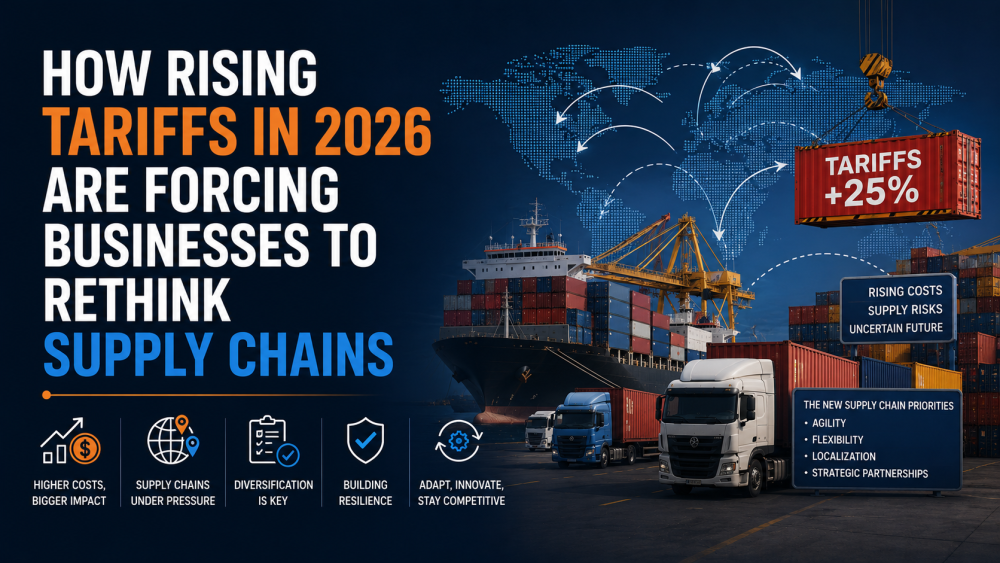
Picture a mid-sized furniture company—let's call them Hazel & Craft. For years, their playbook was simple: source raw materials and finished components from Chinese manufacturers, ship them over, slap on a competitive price, and grow steadily. It worked. Then, almost overnight, that model started bleeding money.
By early 2026, the combined weight of Section 301 tariffs, a new Section 122 surcharge, and fresh investigations under US trade law had pushed effective import duties on many Chinese goods past the 40–50% mark. Steel? Over 65% in stacked tariffs before you even get to base customs duties. Solar equipment? Exceeding 75%. For a company like Hazel & Craft, the math changed completely. A product that cost $100 to source now effectively costs $145 or more to land in the US. Margins evaporated. They had a choice: absorb the loss, pass it to customers, or fundamentally rethink where and how they make their products.
Most businesses in 2026 are living some version of that story.
How We Got Here
To understand why supply chains are under such pressure right now, it helps to trace how the tariff environment actually evolved—because it didn't happen in a straight line.
The trade tensions between the US and China date back to the Section 301 tariffs introduced in 2018–2019 under the Trump administration's first term. Those initial tariffs targeted hundreds of billions of dollars in Chinese goods across electronics, machinery, and consumer products. They were disruptive, but many businesses adjusted—either absorbing costs, passing them to consumers, or beginning tentative moves to diversify away from China.
What happened in 2025 was different in scale and speed. A new wave of executive orders introduced broad tariffs under a legal mechanism called IEEPA—the International Emergency Economic Powers Act—that applied sweeping duties across a huge range of countries and product categories. Some of those tariffs were subsequently ruled unlawful by the Supreme Court in early 2026, but they've been replaced with a combination of Section 122 surcharges, expanded Section 301 investigations, and Section 232 national security tariffs. The practical effect is a tariff environment that's arguably more complex and burdensome than anything businesses have navigated in a generation.
The numbers tell the story clearly. According to the Tax Foundation, Trump-era tariffs now represent the largest US tax increase as a percentage of GDP since 1993—amounting to an average household cost increase of around $1,500 in 2026. And the reach keeps expanding. In March 2026, the US Trade Representative launched new Section 301 investigations targeting excess manufacturing capacity in sixteen countries, including not just China but Vietnam, India, Mexico, Indonesia, Thailand, Cambodia, and others that had previously been seen as "safe" alternatives. For businesses that had spent the last two years building their China+1 strategies, that was a genuinely unsettling development.
The impact on companies has been immediate and measurable. A 2026 survey of 514 supply chain leaders found that 86% said trade policy changes had already impacted their operations. Fifty-one percent had raised consumer prices to offset tariff costs. Twenty-four percent had shifted sourcing away from directly affected countries. This isn't a few edge cases—it's the mainstream experience of doing business in global trade right now.
The "Wait and See" Era Is Over
One of the more telling shifts in the past year isn't about geography or trade policy—it's about mindset.
As recently as 2024 and early 2025, a lot of businesses, particularly small and mid-sized ones, were taking what you might charitably call a cautious approach. In practice, that meant watching the news, attending webinars about tariff risk, and hoping things would settle down before they had to make any real decisions. Supply chain software firm Netstock surveyed businesses for its 2026 Tariff Impact Report and found that 97% of respondents are now deploying at least one active mitigation strategy—a dramatic shift from the prior year's largely reactive posture.
That number is striking. Ninety-seven percent. A year ago it was largely "wait and see." Now companies are moving, sometimes urgently, on supplier diversification, inventory strategy changes, extended planning horizons, and technology investments. The era of hoping tariffs would blow over is finished.
What changed? Partly it was the sheer persistence of the volatility. A company can sit out one tariff cycle. It's harder to sit out three consecutive years of escalating trade uncertainty while watching margins compress quarter by quarter. But there was also a realization, painful for many executives, that the old geopolitical and trade consensus isn't coming back any time soon. The bilateral frictions between the US and China are structural, not cyclical.
There's also something worth noting about what "active mitigation" actually looks like in practice. For some businesses it means genuine supply chain transformation—shifting factories, qualifying new suppliers, and building regional hubs. For others it means incremental hedging: adding a secondary supplier in Vietnam while maintaining the China relationship or moving one product line to Mexico while leaving others in place. The smart companies understand that not every product has the same tariff exposure or the same realistic alternative.
Where Businesses Are Moving—And the Real Trade-Offs
The obvious first question any business with Chinese supply chain exposure asks is, "Where else can we go?" The answer, in 2026, is genuinely complicated.
Vietnam: Still the Favorite, But Under Pressure
Vietnam has been the clearest beneficiary of supply chain diversification away from China over the past several years. Vietnamese exports to the US grew from $49 billion in 2018 to over $130 billion by 2025—driven by strong gains in electronics, footwear, apparel, furniture, and machinery. Apple has moved significant iPhone assembly there. Foxconn and Samsung have collectively invested over $20 billion in Vietnamese manufacturing facilities since 2023.
The appeal is real. Vietnam offers lower labor costs than China, a growing manufacturing workforce, improving (though still developing) infrastructure, and—until recently—no Section 301 tariffs. A US deal in mid-2025 set a 20% baseline tariff on Vietnamese imports, far better than the 40–46% rates that had been floated and better than many alternatives.
But there are complications. The new US Section 301 investigations launched in 2026 include Vietnam in their scope. Anti-circumvention investigations are also targeting electronics and solar panels assembled in Vietnam using Chinese components—a real risk for businesses that simply shifted the last step of production without genuinely relocating their supply chain. US Customs enforcement is sharpening. The DOJ has signaled that 2026 is "the year of enforcement" after 2025 was "the year of tariff policy."
The practical message for businesses: Vietnam remains one of the better options for electronics, apparel, and footwear, but compliance rigor matters enormously. You can't route Chinese goods through Vietnam with minor assembly and expect the tariff problem to disappear. The supply chain transformation needs to be real.
Mexico: Proximity Pays, But Watch the Rules
Mexico has become genuinely important in the new trade order, particularly for businesses that value proximity to the US market. Under the USMCA—the trade agreement covering the US, Mexico, and Canada—qualifying goods move tariff-free or at significantly reduced rates. Mexico's logistics advantages are concrete: shipping times are 70% shorter than Asia's, and there's a two-day ground shipment window versus thirty days by sea. For sectors where inventory velocity and responsiveness matter, that's not a trivial difference.
The manufacturing sectors that have moved most aggressively to Mexico include automotive parts and assemblies, electronics, medical devices, and aerospace components. Mexico's maquiladora sector—manufacturing zones with over one million workers—has deep experience in precision manufacturing, and nearshoring FDI surged to approximately $35 billion in 2025, a 50% increase.
The catch, and it's a meaningful one, is that Mexico is now also under Section 301 scrutiny. The new 2026 investigation covers Mexican automotive parts and processed foods, among other categories. Mexico itself raised tariffs significantly in late 2025—by around 35% on auto parts, textiles, and steel from non-USMCA partners, including China—which complicates the strategy of Chinese manufacturers trying to route goods through Mexico to the US.
One real-world example illustrates the trade-offs well: a US auto parts importer moved wiring harness production from China to Mexico. They bypassed a 25% China tariff and cut landed costs by 12%. But lead times ballooned 40% during the ramp-up phase due to labor shortages and quality issues. The Mexico move made long-term sense; the short-term disruption was real and expensive. This is the pattern most businesses encounter. The math on tariffs often favors moving. The operational reality of actually moving is harder than the spreadsheet suggests.
India: Longer Game, Real Potential
India is frequently mentioned as the third major beneficiary of supply chain diversification. It has genuine strengths: a massive engineering talent pool; government incentive programs (the Production Linked Incentive scheme allocating $25 billion to drive $100 billion in electronics manufacturing by 2026); and Apple's commitment to produce 25% of iPhones in India, targeting 60% of US-bound supply by 2026.
But India's infrastructure limitations are real. Power reliability, logistics networks, and the regulatory environment remain more challenging than Vietnam or Mexico. The gap between India's potential and its present-day manufacturing execution capacity is still meaningful for most businesses. India is a medium-to-long-term play for most sectors—significant enough to invest in exploring, but probably too early to bet entirely on.
What This Costs—and Who's Bearing It
There's a human dimension to all this that gets lost in the geopolitical framing. Tariffs are taxes. At the end of the chain, someone pays them.
The Tax Foundation's analysis is blunt: these tariffs are being passed on to American consumers in the form of higher prices. The average household is absorbing roughly $1,500 more in annual costs. For consumers buying electronics, appliances, or clothing, the impact is already visible at retail. iPhone prices in the US are expected to spike 25–40% if tariff costs on Chinese components aren't offset by production shifts to Vietnam and India.
For businesses, the cost shows up in several places at once. There's the direct tariff expense on imported goods. Then there's the cost of actually restructuring—qualifying new suppliers takes time and money, often more than companies expect. The apparel brand case mentioned in supply chain research is instructive: a $3.2 million revenue company faced $280,000 in annual additional costs when Vietnam tariffs jumped to 46% (before the subsequent deal), and their supply chain restructuring cost $320,000 in consulting, legal, and qualification expenses over eleven months. That's not nothing. For a small business, that kind of transition is existential-level planning, not a routine operational adjustment.
Seventy-two percent of trade professionals now identify US tariff volatility as the most impactful regulatory change they face—up from 41% just a year earlier. The Thomson Reuters 2026 Global Trade Report puts it plainly: these disruptions have shifted from routine supply chain concerns about optimization to broader questions of systemic resilience.
The Technology Shift Nobody's Talking About Enough
One consequence of sustained tariff pressure that deserves more attention is how it's accelerating technology adoption inside trade and procurement functions.
In 2024, about 6% of trade professionals reported their departments were exploring AI or blockchain tools for trade management. By 2026, that number has jumped to 40%—a nearly sevenfold increase. Only 2% of trade professionals now describe their department as being in the early stages of technology adoption, down from 40% previously. That's a dramatic shift in a short time.
What's driving it? Manual processes simply can't keep pace with the complexity. Tariff codes change. Exclusion lists update. Classification rules shift. Anti-dumping determinations come in. In a stable trade environment, a skilled team can manage this manually. In 2026's environment, it's becoming genuinely impossible to do well without real-time data systems, AI-assisted classification tools, and supply chain visibility platforms that can flag exposure before it materializes as a landed-cost surprise.
Companies that are managing well tend to have a few things in common. They've built cross-functional "trade risk councils" that bring together Finance, Operations, Procurement, Compliance, and IT rather than treating customs and trade compliance as a siloed function. They use tariff modeling tools to run scenario analysis before committing to sourcing changes—factoring in not just the direct tariff cost but logistics shifts, quality ramp-up time, and compliance burden. And they're treating trade intelligence as an ongoing capability rather than a one-time project.
The businesses that moved early on this—companies that started diversifying suppliers and building data visibility in 2023 and 2024—are meaningfully better positioned today than those who waited.
Strategies That Are Actually Working
So what do you do if you're a business trying to navigate this environment practically? A few approaches stand out from what companies in the field are actually executing.
Phased diversification, not wholesale migration. Most experienced supply chain leaders will tell you that abruptly abandoning a Chinese supply relationship for a new Vietnamese or Mexican one is operationally reckless. The realistic approach is phasing: start by shifting 20–30% of volume to an alternative supplier, validate quality and compliance, build the relationship, and scale gradually. This takes longer but avoids the quality and lead-time blowups that come from moving too fast.
Take origin compliance seriously. The US customs enforcement environment is significantly tighter in 2026. "If 2025 was the year of tariff policy, 2026 is the year of enforcement," as Sourcing Journal put it. Routing goods through a third country without genuine, substantial transformation of the product doesn't change origin. CBP investigations are increasing. The risks of getting this wrong—back duties, penalties, and reputational damage—are high enough that cutting corners isn't worth it.
Know your tariff codes cold. Some products in the same category face very different tariff treatments depending on exact classification. Working with a licensed customs broker or trade attorney to audit your HS codes (the international product classification system) can reveal meaningful savings through legitimate reclassification. Duty drawback programs—which allow refunds on duties paid for goods that are later exported—are also underutilized by many businesses.
Build supplier redundancy into your contracts, not as a plan B. The businesses that managed 2025's volatility best weren't scrambling to find new suppliers when tariffs hit. They already had secondary suppliers qualified, relationships in place, and contracts that gave them flexibility to shift volume. That redundancy has a cost in normal times. It proved its value in turbulent ones.
Don't ignore the USMCA, but watch the 2026 review. The USMCA is up for formal review in July 2026, and the outcomes could meaningfully change which goods qualify for preferential treatment and under what conditions. Companies building Mexico-anchored strategies should monitor this closely and build scenario contingencies.
The Bigger Picture: Is Globalization Really Reversing?
It's tempting to read the current moment as the end of globalization—the great unraveling of the interconnected world economy that was built over the past forty years. But the evidence on the ground is more nuanced than that.
The DHL Global Connectedness Report 2026 expects only a modest slowdown in goods trade—not a reversal of globalization, but what they describe as a "mutation toward greater regionalization and regulatory complexity." That's a more accurate framing. Trade isn't stopping; it's reconfiguring. Supply chains are getting shorter in some dimensions, more regionally concentrated in others, and more expensive almost everywhere.
China remains the largest source of US imports despite years of tariffs and diversification pressure—approximately $430 billion in goods entered the US from China in 2025. No single country has come close to replacing that capacity. Vietnam, India, and Mexico are gaining share in specific sectors, but the structural dependency on Chinese manufacturing is deep, and dismantling it takes years, not quarters.
What's genuinely changing is the risk calculus. Businesses that ran single-source, optimized-for-cost supply chains are recognizing that resilience has a value they weren't previously pricing in. A supply chain that saves $10 per unit in normal conditions but breaks down under tariff pressure isn't actually as cheap as it looked. The companies building through this moment are pricing in optionality, redundancy, and geographic diversification as real assets—not inefficiencies to be stripped out.
A New Normal That Requires a New Mindset
There's no clean ending to this story yet. The tariff environment is still evolving, the Section 301 investigations launched in 2026 could reshape sourcing economics again, and the USMCA review adds another variable. Anyone claiming to know exactly how this resolves is probably oversimplifying.
What's clearer is the operating posture that's working for businesses navigating the uncertainty. They're not trying to optimize for one trade scenario. They're building supply chains that can adapt—with diversified supplier relationships, genuine compliance programs, real-time trade data, and cross-functional teams that treat trade strategy as a business priority rather than a back-office function.
One trade professional surveyed in the Thomson Reuters 2026 report summed it up in a way that stuck with me: "The financial burden caused by tariffs led our company to reorganize our supply chain and production footprint in order to reduce tariff exposure and preserve profitability. "That's not a complaint—it's a description of a business that decided to treat disruption as a forcing function.
The companies that are struggling are the ones still waiting for things to normalize. The ones moving forward have accepted that this volatile, complex, higher-cost trade environment is, for now, the normal they're operating in. The question isn't when the old world comes back. It's what kind of supply chain you're building for the world that's actually here.
For Hazel & Craft, it meant an eleven-month restructuring, a new manufacturing relationship in Southeast Asia, and an uncomfortable conversation with their retail partners about pricing. It was messy and expensive. But they came out the other side with a supply chain that's meaningfully less exposed to any single policy decision by any single government. That's not an accident. That's what adaptation looks like right now.