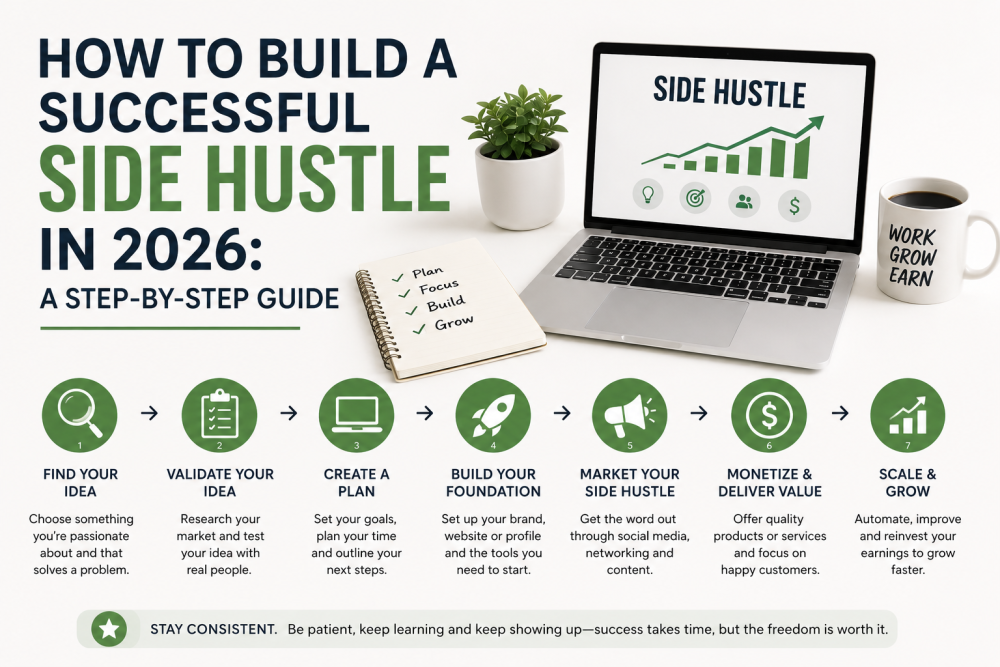
Most side hustle guides start with a list of fifty ideas and a general encouragement to "start today." This isn't quite that. This guide is structured around the specific decisions that determine whether a side hustle actually produces income—the sequence, the timing, the honest trade-offs between different types of hustle, and what the realistic earnings look like.
Because here's the thing about side hustles in 2026: the opportunity is genuinely larger than it's ever been. AI tools have cut the production time for almost every type of knowledge work in half. Platforms for selling, finding clients, and distributing content have matured to the point where barriers to entry are near zero. The ecosystem for turning a skill into income while keeping a full-time job has never been better structured.
But the failure rate of side hustles — defined as starting something, putting in effort, and abandoning it within three to six months — is still very high. The reasons are consistent: wrong idea for the person's actual schedule, unrealistic earnings expectations, trying to do too many things at once, or quitting before the effort compounds into results.
This guide is designed to help you avoid those specific traps.
Step One: Be Honest About Your Goals Before You Choose an Idea
This sounds obvious, but it's the step most people skip. Side hustles are not interchangeable. A hustle that's excellent for generating $500 in month two might take eighteen months to reach meaningful scale. A hustle that generates $2,000 in month four might require ten to fifteen hours a week that you genuinely don't have.
Start by identifying what you actually need this for:
Fast cash. You need money this month or next. Service-based hustles using skills you already have are the fastest path—freelance writing, design, virtual assistant work, tutoring, and bookkeeping. You can get a first client this week through direct outreach or platforms like Upwork, Fiverr, or Contra. The limitation is that your time is the product; the income doesn't scale beyond your hours.
Supplemental income. You want $300–800 per month that consistently adds to what you earn. Same service-based path, but with focus on building two or three recurring clients rather than chasing one-off work. Monthly retainer relationships are more stable than project work.
Long-term scale. You want something that grows beyond your time — income that doesn't stop when you stop working. Digital products, courses, newsletters, or a content channel. These take 6–18 months to produce meaningful income but have no ceiling. They're also the ones most people abandon before the work compounds.
Career pivot. You want to test something that could become your full-time work. In this case, income is a secondary metric early on. Building a portfolio, reputation, and client base in the target field matters more than whether the first few months are profitable.
Know which category you're in before choosing an idea. The category determines the criteria.
Step Two: Match the Idea to Your Life, Not Your Aspirations
The most common mistake is choosing a hustle that looks exciting rather than one that fits your real constraints.
If you work 9–5 in an office, work most evenings with family, and have weekends partially committed, you have perhaps 5–8 hours per week for a hustle. That's real. A hustle requiring 15 focused hours per week will not be sustained—not because you're lazy, but because the math doesn't work.
The right question is, given your actual available hours and your existing skills, what can you offer that people will pay for?
Available skills assessment: Write down every skill you use at work and everything you're competent at outside of work. Include things that feel ordinary to you but might not be ordinary to others—Excel modeling, copywriting, accounting, project management, graphic design, teaching, carpentry, social media, photography, customer service, and speaking another language. These are all monetizable.
Demand check: Is there existing demand for this? Spend thirty minutes on Upwork, Fiverr, or LinkedIn searching for people hiring in the area you're considering. If you find active job postings and profiles of people earning in this space, demand exists.
The Ideas That Are Actually Working in 2026
Not every idea is equal right now. Based on the current market, here are the categories with genuine momentum:
AI-Assisted Content Services
This is the most significant shift in side hustle economics in 2026. A freelance writer or marketer who has integrated AI tools into their workflow can produce three to four times the output of the same person working without them—meaning they can charge flat project rates for work that's completed significantly faster, improving their effective hourly rate substantially.
The opportunity: small businesses need ongoing social posts, blog content, email newsletters, and website copy but rarely have dedicated marketing staff. Retainer relationships for this work typically run $500–1,500 per month per client. With two or three clients, that's meaningful supplemental income that requires perhaps 8–12 hours per week.
The key: use AI as a production accelerator, not a replacement for judgment. Clients pay for your editorial eye, strategy, and quality control—not for outputs a chatbot could produce without you. The combination of your expertise and AI's production speed is the actual product.
Freelance Services in High-Demand Professional Skills
Bookkeeping, virtual assistance, data analysis, graphic design, video editing, web development, copywriting, legal document review, financial modeling, HR consulting—people hire for these constantly. Platforms like Upwork, Contra, and Toptal have different price points and client quality levels. Reaching out directly to small businesses in your area or sector typically generates better rates than platform work after you have a small portfolio.
Realistic earnings: $25–100+ per hour depending on the skill and specialization. The first two months involve building a portfolio and accepting lower rates to establish a track record. From month three onwards, rates improve with demonstrated results.
AI Workflow Consulting for Small Businesses
Relatively new in 2026 but genuinely in demand: small business owners know they should be using AI tools and have no idea where to start. If you've developed practical expertise with automation tools, AI workflows, or prompt engineering, packaging that knowledge into consulting is becoming a viable income stream.
The pitch is simple: "I'll show you how to use AI tools to save 5–10 hours of repetitive work per week, set it up for you, and train your team." That's worth $500–2,000 to a small business as a one-off engagement, with follow-on work for ongoing optimization.
Niche Content (Newsletter, Podcast, YouTube Channel)
The important word is niche. Building an audience around "personal finance" in 2026 is brutal — the competition is enormous and established. Building one around "personal finance for emergency-room physicians in their first five years of practice" is genuinely doable, because the audience is specific, has real money questions, and has few dedicated resources.
Substack, Beehiiv, and similar platforms allow you to publish a niche newsletter, build a subscriber base, and convert to paid subscriptions once you have a real following. Earnings per paid subscriber run $5–10 per month; 500 paid subscribers at $8/month equals $4,000/month. The realistic timeline to reach 500 paid subscribers with consistent quality publication: 12–18 months.
Etsy and Print-on-Demand
Etsy works for solo creators when it's approached as building a niche brand rather than uploading random products. The categories that consistently perform in 2026 are personalized gifts, digital downloads (Canva templates, printable planners, SVG files), handmade goods in specific aesthetics, and niche vintage.
Print-on-demand (Printful, Printify integrated with Etsy or Shopify) lets you design apparel, mugs, and accessories while a third party handles production and shipping. The margin per item is thinner than handmade goods, but the time investment per sale is lower. People who treat it like building a focused mini-brand—specific aesthetic, specific audience—do far better than those who treat it as passive income.
Step Three: Launch Small, Validate First
Before building a website, designing a logo, or setting up a limited company, get one paying customer. One. That's all validation requires.
For service businesses: write three sentences describing what you offer and who it's for, post it in one relevant place (LinkedIn, a Facebook group, your personal network), and directly message five people who might need it or know someone who does. Do the work. Get paid. Repeat before optimizing.
For product or content businesses: produce five pieces of content, five listings, or five products before worrying about marketing. The feedback from the first five tells you what to do with the next fifty.
The trap is spending the first three weeks on branding and zero time on the actual offer. Logos don't generate income. First customers do.
Step Four: Commit to 90 Days of Consistency
The gap between side hustles that quietly die and those that grow into real income streams is almost always time and consistency, not initial quality. Most people quit just before the momentum would have started to compound.
The Everygirl's 2026 side hustle analysis puts it directly: "Pick one. Commit for 90 days. Evaluate after consistency—not after three random attempts."
What 90 days looks like practically: the same number of hours each week, documented with at least a note on what was done, whether it produced results, and what to adjust. At the 90-day mark, you have enough data to make a genuine assessment—not "this is hard so I should stop" but "I've tried X approach Y times, and here's what the response has been."
Many service-based side hustles are generating first income by week three. The compounding income, stable clients, and confidence in pricing typically emerge between month two and month four. Quitting at month one and a half is almost always premature.
Step Five: Use AI to Work Smarter, Not More
This is the biggest operational shift for side hustlers in 2026. The data is striking: 94% of gig workers report using AI tools to support their work, and search interest in AI side hustles rose roughly 28% year-over-year.
The practical applications:
For writers and content creators: AI drafts the first versions; you edit, improve, and add your voice and expertise. Production time per piece can drop to a third of what it was without AI assistance.
For virtual assistants: AI tools handle email drafting, scheduling, research compilation, and data organization—meaning you can manage more client workload per hour.
For designers: AI image generation tools help with concept visualization, logo variations, and social media graphics. You apply judgment and refinement; AI handles the initial generation.
For consultants: AI helps with research synthesis, proposal drafts, and analysis summaries — reducing the time spent on administrative work and increasing the proportion spent on high-value thinking.
The caveat: clients still pay for human judgment, expertise, and quality control. Disclosing AI use where appropriate is both ethically correct and practically smart — clients who understand what they're paying for are less likely to dispute rates or feel misled.
Step Six: Manage the Money From Day One
Only 28% of side hustlers currently save their side hustle earnings, according to Bankrate 2025 data. The rest spend them, which is understandable but misses the financial point of having supplemental income.
From the first payment:
-
Set aside 20–30% immediately for taxes. In most countries, self-employment income is taxed differently from employment income and often requires self-assessment or quarterly estimated payments. Not setting money aside leads to a painful surprise at tax time.
-
Track every income item and every business expense. Business expenses (equipment, software, courses, professional memberships) are typically tax-deductible. Proper records reduce your tax liability significantly.
-
Open a separate bank account for the hustle. Mixing business and personal money creates accounting confusion and makes tax filing significantly harder.
The highest-leverage financial move with side hustle income is to route it directly to savings or investment before it disappears into everyday spending. Automating this — a percentage transferred on receipt — removes the willpower problem entirely. The first financial goal for most side hustlers should be an emergency fund if one doesn't already exist. After that, debt reduction, then investment.
The Honest Timeline
Most side hustle guides imply that income starts quickly. Some does. Here's the realistic picture by type:
Service hustle (freelancing, consulting): First income possible in week 1–3 with active outreach. Stable monthly income of $500–2,000 typically requires 2–4 months of client building.
Digital products (Etsy, Gumroad, and templates): First sales are possible in weeks 2–4 after listing. Meaningful monthly income ($500+) typically requires 6–12 months of building a catalogue and optimising listings.
Content/audience building (newsletter, YouTube, podcast): First income (ads, sponsorships, paid subscribers) typically requires 6–12 months of consistent output and audience growth.
App or SaaS product: First income after product is built (4–12 weeks with AI coding tools). Meaningful MRR typically requires 6–18 months of user acquisition work.
The implication: if you need income within two months, start with a service. If you're building for year two and beyond, a product or content channel makes more sense. Both paths are valid. Very few people successfully pursue both simultaneously.
Final Thought
The side hustle landscape in 2026 is genuinely favorable—AI tools, mature platforms, and a growing market of small businesses that need skills and services provide more opportunity than most people realize. The constraint is not the opportunity. It's the focus and the consistency to show up repeatedly for long enough that the compound effect of good work produces results.
Start with the skill you already have, make one offer to one person who might pay for it, and do that this week. Everything else—the branding, the scaling, the optimization—comes after the first payment. The first payment is the only gate that matters.