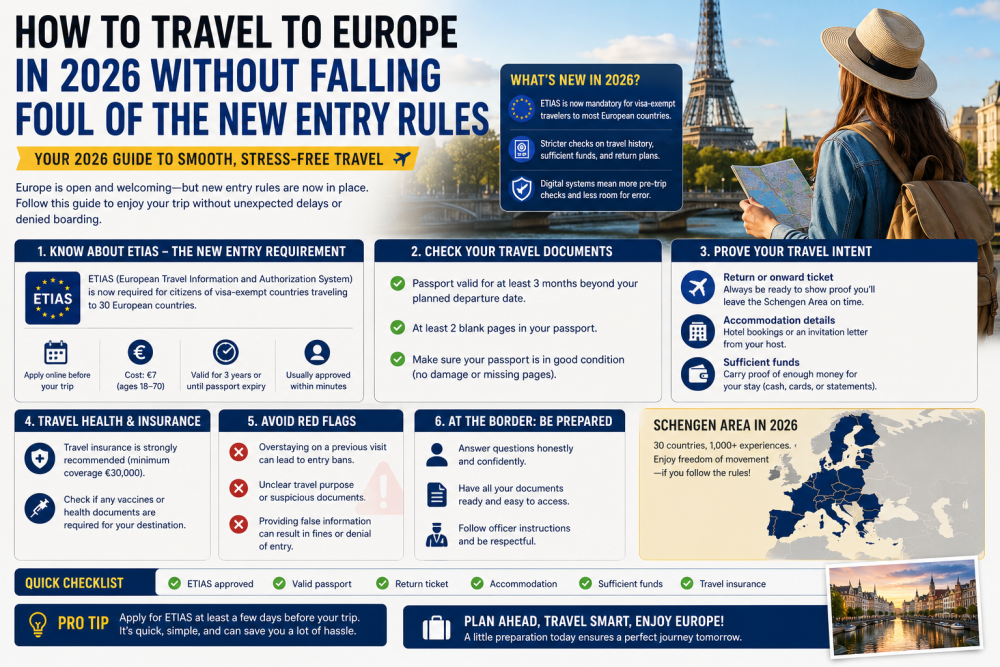
If the last time you traveled to Europe was a few years ago and you're planning a return trip, there are things you need to know that weren't true then. Not a lot has changed from the visitor's perspective in terms of what the trip looks and feels like, but the administrative infrastructure around entering the Schengen Area has fundamentally changed in 2026, and getting it wrong isn't a minor inconvenience. It can mean a missed flight, a refused entry, or an unexpected restriction on future travel.
This guide lays out exactly what has changed, who it affects, what you need to do, and the specific traps that are already catching unprepared travelers.
The Two Systems You Need to Know About
There are two separate things happening simultaneously, and they get muddled together in most news coverage. Keeping them distinct in your mind is the most important thing this guide can do.
EES (Entry/Exit System) — Live since April 10, 2026. Already happening at borders now. ETIAS (European Travel Information and Authorisation System) — Not yet launched. Expected Q4 2026.
They do different things. EES records your border crossing digitally — it's the border infrastructure change. ETIAS is a pre-travel authorization you'll need to complete online before you fly—it's a screening process. One is something that happens to you at the airport. The other is something you do in advance at home.
Let's take them in order.
EES: The Digital Border System That's Already Running
The Entry/Exit System replaced the old passport stamp on April 10, 2026. When you cross a Schengen border—arriving at an airport, a port, or a land crossing—instead of an ink stamp in your passport, a digital record is now created. That record captures:
-
Your passport details
-
A facial image (biometric photo taken at the border)
-
Fingerprints (typically all four fingers)
-
The exact date and time of your entry and exit
This data is logged automatically across all 29 Schengen member states. So if you spend three weeks in Spain, fly to Italy for two weeks, take a train to France for ten days, and then fly home—all of that movement is recorded and linked to your passport.
What you need for EES: The main practical requirement is a biometric (electronic) passport—the type with a small rectangle-and-circle symbol on the cover indicating a microchip. Most passports issued in the last 10-15 years in the US, UK, Canada, Australia, and most developed countries are biometric. If yours isn't, check: some older passports are still technically valid but don't have the chip.
With a biometric passport, you can use the self-service kiosks increasingly available at major airports, which collect your biometrics and process your entry automatically. Without a biometric passport, you're directed to manual screening lanes, which take longer.
Who is affected: Non-EU nationals entering the Schengen Area for short stays. That means Americans, British, Canadians, Australians, Japanese, and nationals of roughly 60 countries that currently travel to the Schengen Area without a visa. EU citizens and Schengen nationals are not affected — the system doesn't apply to them.
The 90-Day Rule Just Got Very Real
Here's where EES changes things most practically for frequent travelers to Europe. The Schengen 90-in-180-day rule has always existed. You're allowed a maximum of 90 days in the Schengen Area within any 180-day rolling window. But until April 10, 2026, enforcement relied on passport stamps—which were inconsistent, sometimes missed, sometimes illegible, and which some travelers exploited or accidentally exceeded without consequence.
EES knows exactly when you entered and when you left. To the day. The system tracks cumulative time across all Schengen countries simultaneously. If you spent 85 days in the Schengen Area in the last six months, the border officer's screen shows 85 days.
This matters for:
-
Digital nomads who spend extended periods in European cities
-
Frequent business travellers who make multiple short trips
-
Retirees and second-home owners who spend substantial time in European properties
-
Anyone who has historically been relaxed about tracking their 90-day limit
The practical advice: start tracking your Schengen days now, before you arrive, not after. The Schengen calculator tools available online (search "Schengen calculator") allow you to input your travel history and see where you stand against the 90-day limit. Use one.
The Queue Problem: Allow Extra Time
EES is new. Border staff are adjusting. Self-service kiosks are still being deployed at different speeds across different airports and border crossings. The result is that queues at Schengen entry points are, in many places, longer than they were before April 10.
Reports from major hubs—Amsterdam Schiphol, Paris CDG, Frankfurt, Madrid Barajas, and Rome Fiumicino—have confirmed that processing times have increased, sometimes significantly. The biometric capture process (scanning your passport, taking your fingerprints, capturing your face) takes longer than a stamp, and when 200 people are queuing for it sequentially, the cumulative delay is meaningful.
The practical implication for your trip:
-
If you have a connecting flight at a Schengen airport, the connection time you previously used may no longer be sufficient. A 90-minute transit that worked in 2024 may not work in 2026. The standard recommendation has moved to 2 hours minimum for international arrivals at major European hubs.
-
If you're arriving on a leisure trip with no onward connection, the queue is merely an inconvenience. But building extra time into your first day's plans is sensible.
-
Peak travel times — Saturday mornings, early summer, bank holiday weekends — will be the worst. Midweek and off-peak flights typically experience shorter queues.
ETIAS: Coming Later This Year — Here's What You Need to Know
ETIAS is not yet operational. If you're traveling to Europe before Q4 2026, you do not need an ETIAS. The expected launch window is the last quarter of 2026, but this date has shifted multiple times since the system was first proposed.
When it does launch, ETIAS will require nationals of visa-exempt countries—the same roughly 60 countries affected by EES—to obtain a pre-travel authorization before visiting the Schengen Area.
How it works:
-
Apply online at the official EU website: travel-europe. europa.eu/etias
-
Pay the €20 application fee (under-18s and over-70s are exempt from the fee but still need the authorisation)
-
Provide passport details, personal information, and answers to background and health questions
-
In most cases, receive a decision within minutes; allow up to 72 hours ideally, or up to 30 days in complex cases
-
Once approved, the ETIAS is valid for three years or until your passport expires—whichever comes first—covering unlimited trips to the Schengen Area during that period
Key things to understand:
The ETIAS is linked to your specific passport. If you renew your passport, you need a new ETIAS. The authorization covers multiple trips and is not a visa—it's a pre-screening that allows you to board a flight to Europe. You can still be refused entry at the border even with a valid ETIAS; border officers retain the final discretion.
There is currently a significant problem with scam websites. Search "apply for ETIAS," and the results contain numerous unofficial third-party sites that claim to offer ETIAS applications, sometimes for fees of €50-100. These are entirely worthless because ETIAS doesn't yet exist. Even after ETIAS launches, the only legitimate application point is the official EU website. Any other site is at best irrelevant and at worst fraudulent.
The UK's ETA: Separate System, Already Required
This is often confused with ETIAS but is a completely different thing. The United Kingdom, which is not in the Schengen Area, has its own Electronic Travel Authorization (UK ETA) that has been required for most visitors since February 25, 2026.
If you're visiting the UK—a separate trip, a different country—you need an ETA that costs £16 and is valid for two years and multiple entries. Apply through the official UK government website (gov.uk/etaus). Without it, you'll be denied boarding.
UK citizens visiting Europe are subject to EES and will be subject to ETIAS when it launches. UK citizens visiting the UK are subject to neither; they're going home. Clear enough in principle, sometimes confused in practice when people plan trips combining both the UK and continental Europe.
Countries Currently in the Schengen Area
For clarity, the 29 Schengen members as of 2026 are Austria, Belgium, Croatia, Czechia, Denmark, Estonia, Finland, France, Germany, Greece, Hungary, Iceland, Italy, Latvia, Liechtenstein, Lithuania, Luxembourg, Malta, Netherlands, Norway, Poland, Portugal, Romania, Slovakia, Slovenia, Spain, Sweden, and Switzerland.
Notably not in Schengen: Ireland and Cyprus (EU members but not Schengen), the UK (Brexit), and several Balkan countries. If you're visiting Ireland, the rules above don't apply. If your European trip combines Schengen and non-Schengen countries, only the time spent in Schengen countries counts against your 90-day limit.
The Practical Pre-Trip Checklist
If you're traveling now (before ETIAS launches):
☐ Confirm your passport has the biometric symbol (rectangle-and-circle on the cover) ☐ Confirm your passport is valid for at least three months beyond your planned departure from the Schengen Area ☐ Calculate your 90-day Schengen days used in the past 180 days (use an online Schengen calculator) ☐ Build extra time into any airport connections at Schengen entry points ☐ If visiting the UK separately, apply for the UK ETA in advance at gov.uk
When ETIAS launches (Q4 2026 or beyond):
☐ Apply only at travel-europe.com. europa.eu/etias — no other site ☐ Apply at least 72 hours before travel; ideally weeks before ☐ Note the passport your ETIAS is linked to; if you renew your passport, reapply ☐ Keep your ETIAS confirmation—you may need to show it when boarding
Other 2026 Changes Worth Knowing About
Beyond the entry systems, a few practical costs have increased that affect the Europe travel experience:
Entrance fees have risen at major monuments. The Louvre in Paris now costs €32 for non-EU visitors, up from €22. Versailles is €35. The Vatican Museums now cap daily visitors more strictly. Booking in advance online is no longer optional at most major European attractions — it's mandatory to guarantee entry and avoid long same-day queues.
Tourist taxes are higher. Several European cities have raised their tourist accommodation taxes significantly in 2026. Barcelona charges €5 per night. Venice continues its day-tripper entry fee for peak periods. Amsterdam has raised its overnight tax. These are small individually but add up on extended trips.
Some temporary internal Schengen border checks. Several Schengen countries — Germany, Austria, France, Slovenia, and others — are maintaining temporary internal border controls for security reasons. If you're travelling between countries within the Schengen Area, you might encounter passport checks at some crossing points. This is unusual compared to how Schengen normally works, but it's been normalized in 2026 and reflects ongoing European security concerns.
The Short Version
Travel to Europe in 2026 is absolutely fine. The new systems are not designed to stop tourism—they're designed to modernize how border management works. Most travelers will find EES is a few extra minutes at the airport. ETIAS, when it launches, will be a 10-minute online form you complete once and don't think about again for three years.
What you do need to avoid is the combination of the following:
-
Turning up with an old non-biometric passport
-
Having exceeded or being close to your 90-day Schengen limit
-
Assuming ETIAS is already running and applying through a third-party site (it's not, and they're scams)
-
Not allowing extra time at the airport for EES processing
Get those four things right and Europe in 2026 is exactly as wonderful as it always has been — probably more so, since the summer sunshine, the food, the history, and the general quality of a European trip haven't been changed by any entry system in history.