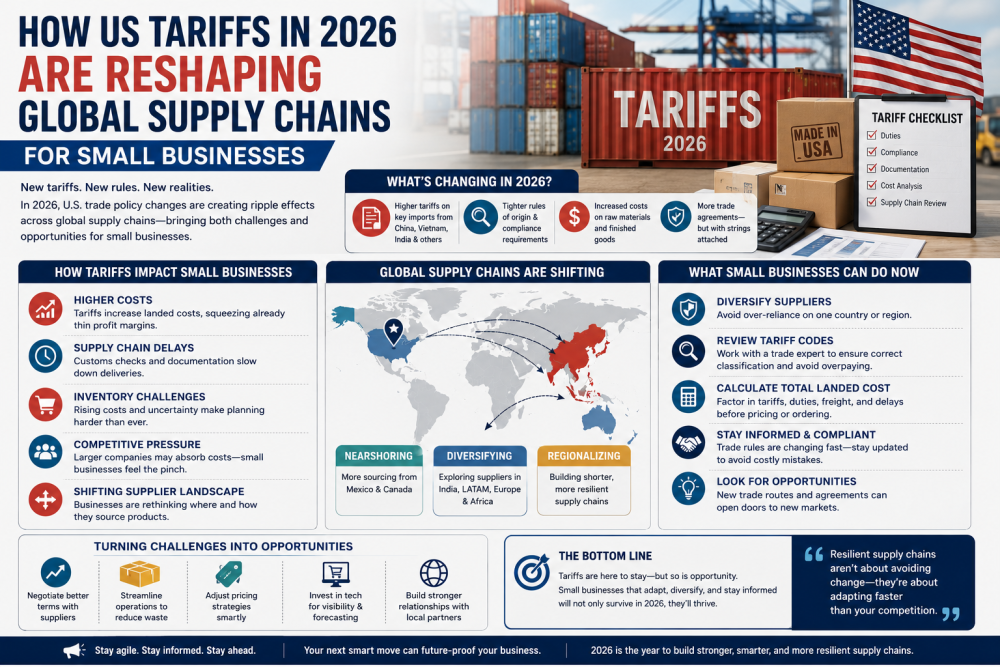
If you run a small business that imports anything—components, raw materials, finished goods, or packaging—2026 has been a year of navigating conditions that change faster than most businesses can adapt to them. The tariff environment is genuinely unlike anything most business owners have experienced in their lifetimes: high rates, legal challenges, court rulings, new rates imposed under alternative authorities, retaliation from trading partners, and underlying uncertainty about whether any current rate will still apply six months from now.
Here's an honest, practical account of what's happening, what it means for small businesses specifically, and what the realistic adaptation options look like.
The Current Tariff Situation: A Moving Target
The tariff landscape in 2026 has been defined by volatility as much as by the rates themselves.
By the end of 2025, US tariff rates stood at their highest level since World War II, led by substantial increases on goods from China, additional rates on steel and aluminum globally, and sector-specific tariffs on electronics components, automotive parts, and a range of manufactured goods.
Then in February 2026, the US Supreme Court ruled that tariffs imposed under the International Emergency Economic Powers Act (IEEPA) were unconstitutional without clear congressional authorization. This stripped the administration of one of its primary tariff authorities. The administration responded by ending the IEEPA program and imposing a temporary 10% global tariff under Section 121 of the Trade Act of 1974.
That 10% global tariff was then ruled unlawful by the US Court of International Trade in May 2026. The administration has challenged those rulings and imposed tariffs under additional alternative authorities.
The practical result: as of late June 2026, businesses are operating in an environment where the specific tariff applicable to a given import may have changed multiple times in the past six months and may change again based on ongoing litigation. KPMG's February 2026 survey found that half of all business leaders reported "low confidence in executing their investment plans and strategy"—a direct consequence of this policy instability.
For small businesses without dedicated trade compliance teams, this environment is particularly difficult to navigate.
How Costs Have Moved
The consumer ultimately pays for tariffs. That's not a political statement — it's the economic mechanism. US companies that import goods pay the tariff at the border. To maintain margins, they raise prices. KPMG's tracking data makes this concrete: the share of businesses passing on more than half of their tariff costs has risen to 34%, up from 13% in May 2025. Moreover, 55% of executives said they plan to raise prices by up to 15% within the next six months.
"The burden of tariffs has now moved squarely onto the consumer," KPMG's industrial manufacturing sector leader stated. "While businesses absorbed the initial shock to their margins, the overwhelming majority are now reshaping their pricing models for a trade environment where cost pressures are the new constant."
For small businesses, this creates a two-sided problem. On one side, input costs are higher — the materials, components, or products you import cost more because of tariffs. On the other side, your customers face higher prices across the economy, compressing their discretionary spending. Raising your prices to offset tariff costs is necessary but not without risk to your competitive position, particularly if your competitors are sourcing differently.
Harvard Business School research has found that US imports from China have returned to near-2001 levels, when China entered the World Trade Organization. That's an extraordinary reversal of two decades of trade growth. For small businesses that built their sourcing around Chinese manufacturing — common in electronics, apparel, home goods, toys, and countless other categories — this represents a fundamental disruption to supply chains that took years to build.
What Small Businesses Are Actually Doing
KPMG's March 2026 survey shows that companies are moving from evaluation to execution on supply chain changes, though the pace varies significantly by business size and resource availability.
Supplier diversification is the most common response. Finding manufacturers or distributors in countries not subject to the highest tariff rates—Vietnam, India, Bangladesh, Turkey, and Mexico—has been the primary short-term strategy. The challenge: alternative suppliers often require longer lead times to qualify, may have different quality standards, and frequently can't immediately match the capacity of established Chinese manufacturing relationships.
Nearshoring to Mexico has been a major trend. US imports from Mexico have grown substantially as companies move production closer to the US border while reducing exposure to China-specific tariffs. Mexico's advantage is its integration into North American supply chains through USMCA and its geographic proximity. The risk: the USMCA is due for review in July 2026, and official statements have hinted at the possibility of the deal being substantially renegotiated, which could disrupt the very sourcing strategies companies have been building.
Domestic sourcing is growing but constrained. 53% of businesses are prioritizing investments in their existing US operations, and 26% of respondents in February 2026 said they were formally planning or actively executing reshoring initiatives—up from 10% in September 2025. But reshoring faces structural barriers: high US labor costs, greater capital investment needs, deeply integrated global supply chains, and skill gaps in manufacturing. The majority of executives say full reshoring would take one to three years, and 13% say it would take longer than three years.
Price pass-through is increasingly unavoidable. Many small businesses have been absorbing tariff costs by compressing margins. That's not sustainable. The businesses that have managed best are those that renegotiated pricing terms with their customers before the full cost impact became visible—building tariff clauses into contracts that allow for price adjustment as tariff rates change.
The Legal Maze: Tariff Refunds and Your Rights
One development from April 2026 that small businesses should be aware of: the US government has opened a process for businesses that paid tariffs to apply for refunds in certain circumstances.
Through the Consolidated Administration and Processing of Entries (CAPE), businesses can apply for refunds on tariffs that were "estimated but not finalized or within 80 days of a final accounting." This is specific to the entries affected by the court rulings that invalidated certain IEEPA-based duties.
If you paid tariffs on imports that were subsequently ruled unlawfully imposed, you may be eligible. The process requires registration with Customs and Border Protection's electronic payment system, submission of a declaration listing the goods, and approval — with refunds potentially taking 60-90 days to arrive if approved. This is worth discussing with a customs broker if you had substantial tariff payments during the relevant periods.
Practical Strategies for Small Businesses in 2026
Audit your supply chain immediately. Map exactly where every significant input or product comes from, what tariff category it falls into, and what the current rate is. This sounds basic, but many small businesses haven't done a systematic tariff exposure analysis. Until you know your specific exposure, you can't make strategic decisions.
Build tariff clauses into contracts. If you have supplier contracts or customer contracts that don't include provisions for tariff cost adjustments, this is a significant vulnerability. Contracts signed before 2025 that fixed pricing in a pre-tariff environment leave you absorbing costs that weren't part of the original calculation. Renegotiate where possible; build adjustment mechanisms into new agreements.
Explore duty drawback programs. These allow businesses to claim refunds on duties paid for goods that are later exported or used in the production of exported goods. If your business has any export component, this is potentially meaningful financial relief.
Consider foreign trade zones. FTZs are secure areas within the US where goods can be imported, stored, and processed without being subject to customs duties until they enter the domestic market. For businesses that import goods and either re-export them or use them in production for export, this can defer or reduce tariff costs.
Work with a customs broker. The current tariff environment is too complex and too rapidly changing for most small businesses to navigate without professional help. A customs broker who specializes in your product categories will know which tariff codes apply, which exemptions might be available, and how to structure import documentation to minimize liability.
Don't panic—invest in reshoring. The instinct to reshore everything to the US is understandable but often economically unjustifiable for small businesses. Reshoring entire supply chains requires capital investment that most small companies don't have, and building a domestic supply chain takes one to three years in the best cases. If the tariff environment changes — which the court rulings suggest it might — businesses that made expensive domestic manufacturing investments could find themselves at a disadvantage against competitors who were more patient.
The Specific Challenge for US Manufacturers Who Import Components
One dimension of the tariff story that's often overlooked: American manufacturers who use imported components in US-made products are also paying tariffs. Steel and aluminum tariffs, along with levies on electronic components, have inflated input costs for American equipment manufacturers. A company making industrial machinery in Ohio that uses imported sensors, steel housings, and electronic control systems is paying tariffs on those imports that raise the cost of the final US-made product.
This is the aspect of tariff policy that industry groups have been most vocal about—the tariffs designed to protect domestic manufacturing are simultaneously raising costs for domestic manufacturers who depend on global components. The United States is already the highest-cost producer of heavy equipment globally, as Fortune noted, and additional tariffs on imported components exacerbate that disadvantage by making US-made equipment less competitive both at home and abroad.
For small manufacturers in this position, the realistic options are limited: raise prices (competitive risk), compress margins (sustainability risk), or find domestic component suppliers (often unavailable or significantly more expensive).
What to Watch for the Rest of 2026
Several developments will determine how the tariff environment evolves:
USMCA review in July. The fate of North American trade rules is being decided just weeks from now. If the deal is meaningfully renegotiated or lapsed, Mexico-based supply chains face new exposure.
Ongoing legal battles. The court challenges to the administration's tariff authorities are not resolved. Further rulings could change the legal basis of current rates or open additional refund opportunities.
The November midterm elections. The partisan politics of tariff policy may shift depending on midterm outcomes. A Congress more resistant to executive trade policy could constrain future tariff increases.
Retaliatory tariff escalation. Canada, Mexico, China, and the EU all have measures in place or planned. If any of those escalate, the categories of US exports affected would shift for businesses on the export side.
For most small businesses, the practical posture is the same as for larger ones but with fewer resources to execute it: audit your exposure, build flexibility into your supply chain, protect yourself contractually, and seek professional guidance on the specific tariff categories affecting your business. The environment isn't going to simplify quickly. The businesses that navigate it best will be those that built agility into their operations rather than betting on a single stable outcome.