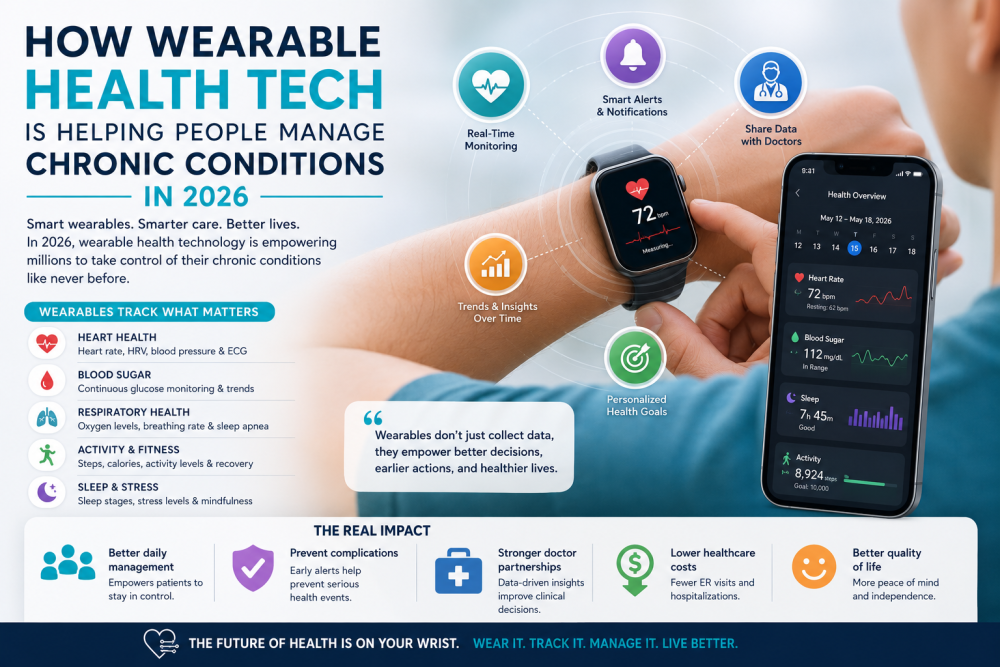
In 2026, an estimated 614.1 million wearable devices will ship globally, with 640 million people worldwide projected to be smartwatch users. The devices are everywhere. The marketing is relentless. But for people managing chronic conditions—diabetes, heart disease, hypertension, epilepsy, COPD, and sleep apnea—the question that actually matters isn't whether wearables are popular. It's whether they work.
The honest answer, increasingly backed by clinical evidence rather than product launches, is yes — in specific conditions, for specific functions, more meaningfully than many physicians expected even five years ago.
Here's what the evidence shows about how wearable technology is changing chronic disease management in 2026 and where the gap between promise and reality still exists.
Continuous Glucose Monitoring: The Clearest Clinical Win
Continuous glucose monitoring (CGM) is probably the single most compelling evidence story in wearable health technology. The Dexcom G7 and Abbott FreeStyle Libre 3 are the dominant devices in 2026, and the clinical picture for both is strong.
These devices use a small sensor inserted just under the skin to monitor glucose levels continuously, every few minutes, throughout the day and night. The readings transmit to a smartphone or dedicated receiver and trigger alerts when glucose goes dangerously high or low. The difference from traditional fingerstick testing—which produces a single reading at the moment of testing—is the continuous curve of glucose behavior, including the trajectory and speed of change.
Research published in May 2026 showed that combining digital self-management education with continuous glucose monitoring helped adults with type 2 diabetes manage their condition more effectively and may reduce the risk for long-term complications. This isn't a new finding—the CGM clinical evidence has been accumulating for years—but the 2026 data strengthens the picture specifically for type 2 diabetes patients who historically used CGM less than those with type 1.
For a person with type 2 diabetes managing their condition through diet, exercise, and oral medication, the value of CGM is in pattern recognition. You can see that a particular meal drives glucose sharply higher, that a certain exercise timing improves overnight control, or that stress consistently pushes readings up in ways that weren't visible with periodic fingerstick testing. That granularity changes behavior in ways that periodic testing simply can't.
Physicians are also beginning to use CGM data in consultations differently—looking at two-week glucose traces rather than single A1c measurements, which capture average glucose over three months but miss the variability that matters for long-term outcomes. The wearable is making the appointment more information-rich rather than less.
Heart Health Monitoring: From Consumer Gadget to Clinical Tool
The Apple Watch's ECG feature was initially treated with skepticism by cardiologists when it launched. A consumer device performing a single-lead electrocardiogram seemed like a product feature dressed as medical technology. The clinical evidence since then has been more compelling than many expected.
A 2026 pilot study published in European Heart Journal Digital Health confirmed that smartwatches reliably provided heart rate and ECG measurements in advanced heart failure patients. The device generates a PDF ECG strip that patients can share at their next appointment or send through a patient portal — a meaningful enhancement to how care is coordinated for patients with paroxysmal atrial fibrillation, whose intermittent episodes may not occur during an office visit.
Findings published in Nature Medicine suggested that smartwatches could support remote monitoring of heart failure exacerbations. Data collected from consumer wearable devices during daily activities showed strong agreement with cardiopulmonary exercise testing measurements, highlighting their potential for estimating cardiorespiratory fitness and supporting remote monitoring strategies.
The clinical workflow this enables is genuinely new. A cardiologist managing a patient with paroxysmal AFib—episodes of irregular heart rhythm that come and go—previously had to hope that the patient happened to have an episode during a Holter monitor period (typically 24-48 hours). Now, a patient wearing a smartwatch continuously may capture an episode that would never have been documented otherwise, enabling appropriate anticoagulation therapy that significantly reduces stroke risk. That's not a marginal improvement in care. It's potentially a life-changing one.
WHOOP 5.0's cardiac strain monitoring adds continuous insight into cardiovascular load, recovery, and stress — useful for patients with heart conditions who need to understand how their daily activity is affecting cardiac workload. Combined with wearable ECG and heart rhythm data, care teams can monitor high-risk patients remotely and reduce unnecessary admissions while keeping them under close watch.
Epilepsy Monitoring: The Seizure Alert System
One of the more medically specific applications of wearable technology involves epilepsy management. The Empatica Embrace2 is an FDA-cleared smartwatch designed specifically for epilepsy patients. Its sensors continuously monitor electrodermal activity, movement, and other physiological data that help identify seizure patterns and provide early warning.
For people with epilepsy and their caregivers, the difference this makes is both practical and profound. A nocturnal seizure in a person living alone, or a child sleeping in their own room, can be dangerous or fatal without intervention. An alert to a caregiver or family member that a potential seizure is occurring changes that risk profile entirely.
The device doesn't replace epilepsy medication or neurological management. What it does is extend the monitoring system beyond the clinic and into the actual environment where the patient lives — a fundamentally different kind of healthcare interaction.
Remote Patient Monitoring for Hypertension and COPD
Hypertension is one of the most common chronic conditions globally and one of the most commonly poorly managed—often because blood pressure is measured infrequently in clinical settings, missing the daily variability that drives long-term cardiovascular risk.
Wearable blood pressure monitors and connected cuffs that transmit readings automatically to a care team address this directly. Remote patient monitoring for hypertension showed a 22.2% average return on investment in clinical studies, and Medicare heart failure patients managed through remote monitoring saw a 52% reduction in monthly costs. These numbers reflect the core value proposition: catching deterioration early, before it requires expensive acute intervention.
For COPD patients, wearable pulse oximeters and motion sensors tracking respiratory rate and activity levels provide continuous data that can flag declining lung function before it progresses to a hospital admission. Hospital-at-home models — where patients are managed remotely rather than in a hospital bed — are increasingly viable for COPD and heart failure patients precisely because wearable monitoring can provide the continuous surveillance that previously required a hospital setting.
Fall Detection for Elderly Patients
One of the less glamorous but genuinely impactful applications of wearable health technology is fall detection in elderly care. Wearables equipped with motion sensors can detect sudden movements consistent with a fall and trigger automatic alerts to caregivers or emergency services.
For elderly patients living independently — a population growing in most developed countries — the ability of a device to detect a fall and summon help without requiring the patient to press a button is the difference between timely assistance and lying on the floor for hours. Apple Watch and comparable devices offer this capability, and the real-world evidence on its effectiveness has improved significantly.
Beyond emergency response, mobility trend data from wearables can indicate declining physical capability before a fall occurs—slower gait, reduced step count, shorter daily active periods—allowing proactive intervention rather than reactive response.
Where the Gaps Still Are
The picture would be incomplete without acknowledging where wearables are still falling short.
The physician adoption gap. Only 11% of physicians currently use wearable data in their clinical practice, according to 2026 data. The technology is generating data that patients find valuable, but the clinical systems for integrating that data into care workflows are still underdeveloped. A patient arriving at an appointment with two weeks of CGM data or a suspicious ECG trace is often better served than their physician's practice systems are prepared to handle.
Data accuracy variability. Not all consumer wearables are validated to medical-grade accuracy standards. Heart rate data from optical sensors is generally reliable at rest but can be less accurate during exercise or with irregular skin contact. Stress scores and sleep staging from consumer devices are based on algorithmic interpretations of physiological signals that don't always match clinical measurements. Cardiologists recommend Apple Watch's ECG feature for specific patient profiles precisely because it meets a higher validation bar than most wearable health metrics.
The equity dimension. The patients most likely to benefit from continuous remote monitoring are often those least likely to have access to it—older patients with limited technology familiarity, lower-income patients without high-speed internet at home, and patients in rural areas with poor connectivity. The device itself is frequently covered by insurance for specific diagnoses (CGMs for type 1 diabetes, for example), but the connectivity and digital literacy requirements create barriers that aren't evenly distributed.
Data security and privacy. Continuous collection of biometric health data raises legitimate privacy questions that haven't been fully resolved at a regulatory or consumer awareness level. Health data is among the most sensitive categories of personal information, and the number of entities with access to wearable health data—device manufacturers, app developers, insurers, and employers in wellness programs—is often unclear to users.
What Patients Should Know in 2026
If you're managing a chronic condition and considering wearable health technology, a few practical points:
Start with what your physician recommends. The devices with the strongest clinical evidence and physician endorsement are CGMs for diabetes, ECG-capable smartwatches for AFib monitoring, and specific medical-grade devices for epilepsy. Consumer fitness trackers have genuine wellness value but lower clinical validation.
The data is only as good as how it's used. A CGM that produces a week of glucose data you never review or discuss with your care team is less valuable than the same device used actively. The technology creates the data. The patient's engagement and the clinical follow-through determine whether it improves outcomes.
Consider what your healthcare provider can do with the data. Before investing in a continuous monitoring device, ask your physician whether your practice uses a patient portal that can receive device data and whether they'd be willing to review it at appointments. The answer is increasingly yes, but it varies.
The trajectory is clear: wearables are becoming clinical tools, not just consumer products. The evidence base is maturing. The integration with healthcare systems is improving. For people managing chronic conditions in 2026, the right device at the right time, used with clinical guidance, is genuinely making a difference.