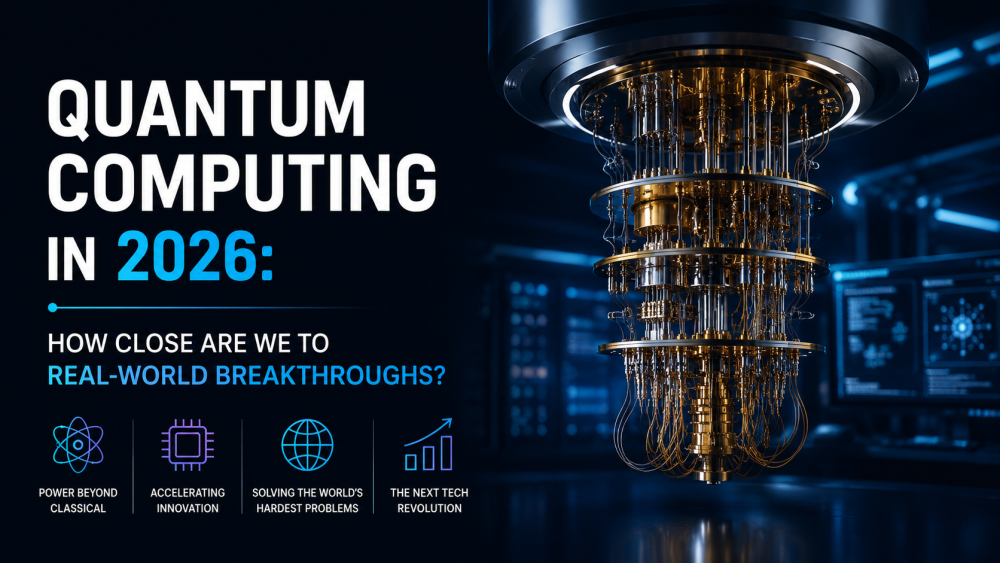
There's a version of quantum computing most people carry around in their heads—a sleek machine that cracks encryption, discovers miracle drugs overnight, and renders today's supercomputers laughably obsolete. That version is both tantalizing and dangerously misleading. The reality in 2026 is more nuanced, more honest, and honestly more interesting than the hype.
Quantum computing is no longer purely a laboratory science experiment. It hasn't crossed into mass deployment either. It's somewhere in the uncomfortable, exciting middle—making moves that researchers have been chasing for three decades while still wrestling with some fundamental engineering problems that don't have easy solutions. If you've been loosely following the space and wondering whether 2026 is the year things finally get real, here's a grounded answer: kind of, in specific ways, more than people expected.
What's Actually Changed in the Last Twelve Months
Let's start with what's new, because a lot has happened.
Google's Willow chip has been the headline act. Announced in late 2024 and running significant experiments through 2025 and into this year, Willow did something the field has been trying to demonstrate for almost thirty years. It achieved what researchers call "below-threshold" quantum error correction—meaning that as you add more qubits to the system, errors actually go down rather than up. That sounds like a small technical detail, but it's not. It's the central unsolved problem in quantum computing. If adding qubits made things worse (as was the case for a long time), scaling up was pointless. Now there's real evidence it can work the other way.
Willow reduced errors exponentially as it scaled up, a breakthrough that cracks a key challenge quantum error correction researchers have pursued for almost 30 years. The chip also ran a standard benchmark computation in under five minutes that would take one of today's fastest supercomputers an almost incomprehensible amount of time. Yes, that's a synthetic benchmark, not a real-world task. But it tells you something important about what the hardware can actually do when pushed.
Then in October 2025, Google went further. The Quantum Echoes algorithm ran 13,000 times faster on Willow than the best classical algorithm on one of the world's fastest supercomputers—described as the first time in history that a quantum computer successfully ran a verifiable algorithm surpassing the ability of supercomputers. That's not nothing.
Microsoft, meanwhile, has been betting on a fundamentally different approach. The Majorana 1 quantum chip, introduced in February 2025, is powered by topological qubits that leverage a new state of matter called topoconductors, providing inherent error resistance and scalability, with the potential to fit 1 million qubits on a single chip. The topological approach is still early, but the underlying theory is compelling—qubits that are structurally resistant to errors rather than requiring elaborate software-level corrections.
And IBM has been steadily plugging away. IBM's roadmap calls for a processor with over 4,000 qubits through a multi-chip configuration connecting three chips via quantum communication links. IBM's approach is less dramatic but arguably more methodical—building the kind of infrastructure that could support genuine quantum cloud services.
The Error Problem, Explained Without the PhD
Here's the thing with quantum computers that trips people up when they read about them. Classical computers use bits—zeros and ones. Quantum computers use qubits, which can exist in superpositions of both at once, giving them enormous potential computational power. But qubits are incredibly fragile. Any vibration, electromagnetic interference, or temperature fluctuation can collapse the quantum state and introduce errors. At scale, with hundreds or thousands of qubits, errors compound fast.
The classic analogy is trying to have a very precise conversation while someone is constantly bumping into you. The solution researchers have pursued is error correction: using many physical qubits to encode a single reliable "logical qubit," such that if some physical qubits make mistakes, the overall logical qubit remains accurate.
The problem is that error correction itself consumes enormous numbers of qubits—a machine capable of truly useful applications like simulating large molecules or breaking widely used cryptography likely requires thousands of logical qubits, far beyond where current hardware sits. The gap between where we are and that destination is significant, though it's narrowing.
What Willow demonstrated is that the path forward is real. Willow's "below-threshold" behavior changes the outlook—it suggests that each generation of hardware can improve logical error rates simply by increasing the size of the error-correcting code, as long as physical performance continues to improve. That's a fundamentally different situation than two years ago, when the engineering community wasn't even sure the math would hold up in practice.
Critics have rightly pointed out that the current error rates, around 0.14% per correction cycle, are still orders of magnitude above what you'd need for truly large-scale fault-tolerant computation. The gap is real. But the direction is right, and that matters.
Where Quantum Computing Is Actually Being Used Right Now
This is where things get more grounded, and maybe less dramatic than the headlines suggest.
The honest answer is that right now, quantum computing's primary real-world value lies in research and simulation—not production workloads. Drug discovery is the most credible near-term domain. Google's Quantum Echoes experiment, in partnership with the University of California, Berkeley, ran the algorithm on Willow to study molecules—one with 15 atoms and another with 28—and the results matched those of traditional NMR spectroscopy while revealing additional information not usually available from NMR. That's a proof-of-concept, but it's a meaningful one. Studying how molecules interact at the quantum level is exactly the kind of problem classical computers genuinely struggle with.
IonQ and Ansys ran a medical device simulation on IonQ's 36-qubit computer that outperformed classical high-performance computing by 12 percent—one of the first documented cases of quantum computing delivering practical advantage over classical approaches in a specific domain.
Twelve percent doesn't sound world-changing. But consider this: pharmaceutical simulations and materials modeling are industries where even small improvements in computational accuracy can shave years off development cycles. A drug that takes a decade to develop costs roughly $2–3 billion by most estimates. If quantum systems can accelerate even one step of that process meaningfully, the economics become interesting very quickly.
Financial services firms are also experimenting. Portfolio optimization, risk modeling, and Monte Carlo simulations are computationally expensive and theoretically well-suited to quantum approaches. Whether current quantum hardware is actually better than classical alternatives for these tasks in production is debatable—most practitioners will tell you it's not there yet. But the experimentation is real and funded.
The Companies Racing to Get There
The quantum landscape has become surprisingly crowded.
IBM and Google are the headline players—both using superconducting qubits, both with serious hardware roadmaps and significant research teams. IBM has the edge on ecosystem and developer tooling (its Qiskit platform has the largest quantum programming community). Google has arguably made the most dramatic hardware leaps.
Microsoft is the contrarian. Its topological qubit bet is high-risk, high-reward. If the Majorana approach scales, it could leapfrog the current generation of superconducting machines. If it doesn't pan out at scale, Microsoft will have spent years on a dead end. The company seems aware of this and has been careful to frame 2025–2026 as an early validation phase rather than a commercial launch.
IonQ uses trapped-ion qubits rather than superconducting ones. The trade-off is slower gate operations but generally higher fidelity. It's not a universal win over superconducting approaches—it's a different set of strengths and weaknesses. IonQ has made a genuine push into commercial applications, particularly in partnership with defense and life sciences customers.
Then there are the infrastructure players—companies building quantum networking, quantum-classical hybrid systems, and the software stack that will eventually sit between raw qubits and useful applications. This layer is often overlooked in media coverage but is arguably as important as the hardware itself.
The global quantum computing market reached between $1.8 billion and $3.5 billion in 2025, with projections indicating growth toward $5.3 billion by 2029 at a compound annual growth rate above 30 percent. The investment flows are real, and they're diversified across hardware, software, cloud services, and applications.
The Thing Nobody Talks About: Post-Quantum Cryptography
Here's a domain where the implications of quantum computing are already arriving, even before quantum computers are powerful enough to cause the specific problem people are worried about.
Current encryption standards—the RSA and ECC algorithms that protect virtually all secure internet communications, banking transactions, and government communications—rely on the difficulty of factoring large numbers. A sufficiently powerful quantum computer running Shor's algorithm could crack them. That capability is probably still a decade or more away. Google has said publicly that Willow is at least 10 years from threatening RSA.
But "a decade away" is not "not your problem." Organizations with long-lived sensitive data need to protect that data today against future quantum decryption—what security researchers call "harvest now, decrypt later" attacks. A hostile actor could be storing encrypted communications right now, waiting for quantum hardware to catch up.
In 2026, the timeline for quantum-enabled attacks is expected to shrink dramatically, pressuring organizations to expedite their adoption of post-quantum cryptography (PQC). The US National Institute of Standards and Technology finalized its first set of post-quantum cryptographic standards in 2024. Migration is slow, expensive, and deeply unglamorous—which is why it isn't getting enough attention outside of specialized security circles.
If you're in IT leadership, the quantum computing question that matters most right now isn't "when can it solve our optimization problems." It's "Are we on a roadmap to post-quantum cryptography?. " Those are very different conversations.
What 2026 Actually Looks Like in Practice
Let's be specific about where things stand today, mid-2026.
Fault-tolerant quantum computing—the kind that runs truly general-purpose algorithms reliably—is not here. Most industry experts put that milestone somewhere between the late 2020s and early 2030s for narrow applications and further out for broad deployment. That's not pessimism; it's a realistic reading of the engineering challenges that remain.
What is happening is what some researchers call "quantum utility"—using imperfect quantum hardware to do useful things in specific domains, often in hybrid configurations alongside classical systems. IBM explicitly frames its current approach around this: IBM has stated that quantum computing is already "a useful scientific tool capable of performing computations that even the best exact classical algorithms can't" and has partnered with RIKEN to use its Heron processor alongside the Fugaku supercomputer to simulate molecules at a utility scale beyond classical computers alone.
That's a humble and probably accurate framing. Not "quantum computers have arrived." More like "quantum computers have found their first real jobs."
The 2026 period is also seeing substantial advances in quantum platforms supporting fault-tolerant computation, as well as significant demonstrations of hybrid quantum-classical applications, with more realistic hardware demonstrations of error correction and complex operations that previous demonstrations were missing.
The hybrid approach matters more than it gets credit for. Nobody is proposing to replace classical computing. The likely shape of things for the next decade is quantum coprocessors—handling specific computationally intensive subroutines while classical hardware manages everything else. Think of it the way GPUs work: you're not running your entire software stack on a graphics card, but you offload the parts that benefit from massive parallelism.
What Still Has to Happen
Scale is the obvious one. Current machines operate with hundreds of physical qubits. Genuinely useful fault-tolerant computing likely requires millions of physical qubits to encode thousands of reliable logical ones. That's a gap of multiple orders of magnitude.
Coherence time needs to improve—how long qubits maintain their quantum state before errors creep in. Willow's hardware improved coherence times by a factor of five over its predecessor, which is meaningful progress. More is needed.
Control systems need to scale. Operating a 100-qubit processor requires incredibly sophisticated classical control electronics. Scaling to a million qubits while keeping those control systems manageable is a serious engineering problem that doesn't get enough attention in the press.
Software and algorithms need to catch up too. Much of quantum computing's theoretical advantage exists in algorithms that assume fault-tolerant hardware. Running those algorithms on today's noisy hardware either doesn't work or produces unreliable results. The field of quantum error mitigation—coaxing useful outputs from imperfect hardware—is active and important but also somewhat limited in what it can achieve.
And manufacturing needs to mature. Future error-corrected quantum computers will need to be built at scale with consistent performance across thousands—or eventually millions—of physical qubits, requiring significant progress in fabrication yields, control systems, and cryogenic infrastructure. The jump from a lab-built prototype to a manufacturable product is enormous. The semiconductor industry spent decades learning how to do that for classical chips.
A Realistic Horizon
If you're an investor, a researcher, or just a curious person trying to figure out what to make of all this, quantum computing in 2026 is genuinely further along than most skeptics expected five years ago and genuinely further from mass deployment than most enthusiasts claimed.
The next eighteen to thirty-six months will likely bring better error correction demonstrations, more credible quantum-classical hybrid applications in pharma and materials science, and continued arms race hardware announcements from the major players. What probably won't happen in that timeframe is a commercially viable general-purpose quantum computer that businesses outside of specialized research can point at a problem and expect results from.
The path is visible now in a way it wasn't five years ago. IBM has stated that real quantum advantage requires industry consensus but that this could be achieved before the end of 2026. Whether "quantum advantage" in any specific domain gets certified and agreed upon by the broader community this year or next, the direction of travel is not in serious dispute among researchers anymore.
That's actually a significant shift. For a long time, quantum computing's commercial future felt like a matter of faith. Now there are published results, peer-reviewed papers, and observable engineering progress. The skeptics aren't gone—and the healthy ones are making the field better by demanding rigor—but the credibility of quantum computing as a near-to-medium-term technology has improved meaningfully.
So: Are We Close to Real-World Breakthroughs?
Yes and no—and the specifics matter.
We are close to, or already at, real breakthroughs in quantum simulation, particularly in chemistry and materials science. We are close to meaningful advances in hybrid quantum-classical optimization. We are years away from the kind of broad, transformative deployment that gets featured in technology prediction articles. And we are already at the point where post-quantum cryptography migration is an active operational concern, not a future one.
The companies building in this space are not running on pure hype anymore. They're running on real results, real peer-reviewed science, and real investment. Whether the big breakthrough—the moment quantum computing obviously changes an industry in a way anyone can see—arrives in 2027 or 2032 depends on engineering problems that genuinely haven't been solved yet.
But here's what's changed: those problems now feel solvable. That's different from where we were even three years ago.
For most people, the practical upshot of 2026's quantum computing landscape is this: pay attention, be skeptical of the hype cycles, understand that the cryptography implications are real and immediate, and watch the hybrid computing space for the first genuinely transformative applications. The revolution isn't here. But it's building toward something real, and the foundation is more solid than it's ever been.