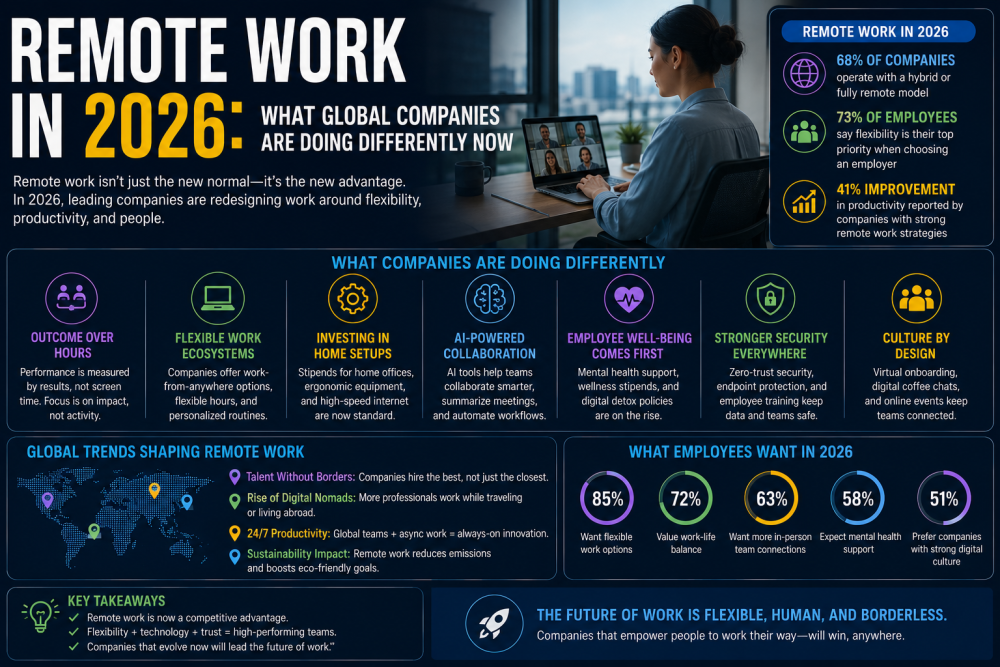
The "return to office" wars of 2023 and 2024 feel like a distant memory now—not because they were resolved cleanly, but because most companies eventually ran out of energy to keep fighting them. What emerged on the other side wasn't a clear victory for either side. It was something messier and more interesting: a genuine rethinking of what work is supposed to accomplish and where it actually needs to happen to do that.
By 2026, the smartest global companies aren't debating remote versus in-person anymore. That debate turned out to be the wrong question. The right question—the one companies that are actually ahead of the curve are asking—is something closer to, "What does each type of work require, and how do we design around that instead of defaulting to habit?"
The answers have led to some genuinely surprising places. Async-first communication structures borrowed from open-source software teams. Results-only work environments that track output instead of hours. Distributed teams deliberately hired across time zones to enable round-the-clock momentum rather than struggling against it. And a growing category of "work infrastructure" that has almost nothing to do with the office and everything to do with how teams think, communicate, and make decisions.
This is what global companies are actually doing differently now—not the PR version, but the ground-level reality.
The Death of the "Hybrid" Experiment (As We Knew It)
For a few years, hybrid work was positioned as the elegant compromise. Three days in, two days out. Or two in, three out. Everyone gets something; nobody's totally happy. In practice, it created a strange new form of inequality: people who lived close to the office were expected to come in, while remote employees either felt like afterthoughts in meetings or found themselves commuting anyway just to maintain visibility.
Most companies running hybrid in 2023 were really running "remote-tolerant office environments." The office was still the default; working from home was the accommodation. Meetings were designed for the people in the room, and everyone on video was fighting through bad audio and the subtle social pressure of being a face on a screen in a room full of people.
What sophisticated companies figured out—gradually and often through a lot of failed experiments—is that hybrid only works well when it's designed as a genuine system, not stitched together out of pandemic habits. The companies doing it well now have almost nothing in common with what "hybrid" meant three years ago.
They've moved to what some are calling "structured flexibility": the office exists for specific purposes (deep collaboration, relationship building, onboarding, and strategic planning sessions), and remote exists for everything else. The key difference is that this is explicit. Written down. Agreed on. Not left to individual managers to interpret in whatever way suits them, which was the real failure mode of most hybrid experiments.
Asynchronous Work Is No Longer Optional
If there's one operational shift that separates advanced distributed companies from everyone else right now, it's the depth of their commitment to asynchronous communication.
This isn't just "use Slack instead of email." Truly async-first organizations have rethought their entire information architecture around the assumption that not everyone is available at the same time—and that this is fine. In fact, often better.
Consider what happens in a meeting-heavy company. A decision needs to be made. Someone calls a meeting. Twelve people's schedules get coordinated. Half of them show up unprepared. The discussion happens, a decision gets made, but three people who weren't there weren't in the loop. Someone has to write up a summary. That summary is never quite right. A follow-up meeting gets scheduled.
Now consider how leading distributed companies handle the same decision. Someone writes a clear, well-structured document laying out the decision that needs to be made, the relevant context, options considered, and a proposed recommendation. Team members have 48–72 hours to read and respond asynchronously. The discussion happens in writing—which means it's automatically documented, searchable, and thoughtful in a way that live conversation rarely is. The decision gets made without requiring everyone to be available at the same time.
Companies like GitLab and Automattic (the company behind WordPress) have been doing this for years, but what's changed in 2026 is that this approach has gone mainstream across companies that wouldn't have considered themselves "tech companies" five years ago. Finance firms, consulting groups, marketing agencies—many are now running async-first for everything except their most collaborative, relationship-dependent work.
The tools have caught up too. AI-generated meeting summaries have reduced the friction of transitioning recorded conversations into written documentation. Project management tools with built-in async discussion threads have replaced the endless email chains. It's not that technology solved the problem—it's that enough companies got serious about the cultural change required, and the tools followed.
Time Zones Are Being Treated as an Asset, Not a Problem
This is perhaps the biggest mindset shift happening at genuinely global companies right now, and it took longer than it should have.
For years, global teams treated time zone distribution as a logistical headache. How do you get the Singapore office and the London office on the same call? Who has to wake up early? Who's staying late? The assumption was that good work required synchronous overlap, and time zones got in the way of that.
Some companies—particularly in software development—started noticing something interesting. Teams deliberately distributed across time zones, when well-coordinated, could maintain near-continuous momentum on complex projects. Work finished in one region gets handed off to the next. Questions asked at the end of one team's day have answers waiting when they return. The "follow the sun" model that call centers have used for decades turns out to apply remarkably well to knowledge work when documentation and handoff discipline are taken seriously.
What's different in 2026 is the intentionality. Companies aren't accidentally distributed anymore—the best ones are deliberately building their teams to cover specific time zone coverage based on what their work actually requires. A product team might have designers and engineers in Europe, QA and documentation in Asia, and customer-facing roles in the Americas. Not by accident, not because of where they happened to find candidates, but because that's the coverage model that makes their specific type of work flow better.
This requires something that most companies are still developing: a genuine handoff culture. The ability to leave work in a state that someone else can pick up, with enough context to move forward without a synchronous call. It sounds simple. It's actually one of the harder organizational habits to build, because it requires both discipline and a certain kind of trust.
What Companies Are Actually Spending Money On
The office real estate conversation has settled into a new equilibrium. Most global companies have meaningfully reduced their permanent office footprint—not eliminated it, but right-sized it for what offices are actually being used for now.
The money that's moved out of leases hasn't disappeared. It's been redirected, and where it goes tells you a lot about how seriously a company is taking distributed work.
Home office stipends have become standard, not perks. The companies that were still offering $500 one-time WFH stipends in 2022 look stingy by current standards. The norm among competitive employers now is somewhere between $1,500 and $3,000 annually for home office equipment and internet quality—with some going higher for roles where video presence and call quality genuinely matter.
Co-working access has expanded dramatically. Rather than maintaining large owned offices, many companies now fund access to co-working networks—either through partnerships with companies like WeWork or IWG or by simply reimbursing employees for local co-working memberships. This gives remote employees flexibility and a "get out of the house" option without the company committing to fixed real estate costs in specific locations.
Company retreats have gotten more serious. This one is interesting. As day-to-day interaction has moved online, the in-person time that remains has become more valuable and more intentional. Companies that once held a perfunctory annual all-hands are now running quarterly team gatherings—smaller, focused, and deliberately designed around the things that remote work handles poorly: relationship building, creative brainstorming, and the kind of informal conversation that's genuinely hard to replicate over video.
A team of twenty people spending three days together in a rented house working on strategy, then returning to remote work for the next three months, often outperforms a team of the same size sitting in an office five days a week but never really connecting—because the investment in actual human time is targeted and meaningful rather than routine and taken for granted.
The Measurement Problem (And How Companies Are Solving It)
One of the most persistent objections to remote work from management has been, "How do I know people are actually working?" This question, despite being framed around productivity, was usually really about control. And it took a while for enough organizations to acknowledge that.
The companies that have moved past this are measuring outcomes instead of activity. Not hours logged. Not messages sent. Not whether someone's status light is green. Actual output: projects completed, quality of work delivered, goals met or not met.
This sounds straightforward, and in some roles it genuinely is. A software engineer either ships the feature or doesn't. A writer either delivers the article or doesn't. But for many knowledge work roles, output is fuzzier—and that turns out to be a useful revelation, because if you can't define what good output looks like for a role, you probably didn't have a clear enough idea of what that role was accomplishing even when the person was sitting in front of you in the office.
The forced clarity of remote work has pushed many companies to define role expectations more rigorously than they ever had before. Not because remote workers demanded it (though many did), but because managing without proximity made vague job descriptions unworkable.
Performance systems built around observable output have also made it easier to identify who's genuinely contributing and who was previously coasting on office presence. This is uncomfortable for organizations to acknowledge publicly, but it's one of the reasons some early remote skeptics have quietly become converts—it turns out the visibility cuts both ways.
Mental Health and the "Always-On" Problem
Here's the part that the productivity-focused conversation about remote work often glosses over: the boundaries problem hasn't been solved, and at many companies it's gotten worse, not better.
When your home is your office, the psychological separation between "work time" and "not work time" requires active effort in a way it never did when you drove somewhere and drove home. Slack notifications at 9pm. A quick email check that turns into an hour of work. The creeping sense that you should be available because, after all, you're already home.
The companies taking this seriously in 2026 aren't just offering meditation apps as a wellness benefit. They're building structures that make disconnection possible—and in some cases, mandatory.
No-meeting days have become common. Many companies have protected Fridays or Wednesday afternoons where no internal meetings can be scheduled, giving people blocks of uninterrupted time that don't get colonized by coordination.
Communication hours policies are spreading. Some companies now have explicit norms around when team members are expected to be reachable and when they're not—and these norms are enforced at the manager level. A manager who sends routine messages at 11pm is creating an implicit expectation that their team should be monitoring at 11pm, regardless of what any policy says.
Right-to-disconnect policies have moved from being a legal requirement in certain European jurisdictions to a voluntary best practice at forward-thinking companies globally. The basic principle: outside of genuine emergencies, employees cannot be expected to respond to work communications outside their defined working hours, and they won't be penalized for not doing so.
None of this is fully solved. But the companies that acknowledge it as a real structural problem—rather than a personal discipline issue for individual employees to sort out—are clearly ahead of where most were even two or three years ago.
What's Changed for Junior Employees and New Hires
This deserves its own section because it's where the remote work model has faced its most legitimate criticism and where companies are still actively figuring things out.
Early-career employees and new hires genuinely lose something in a distributed environment. Not the specific benefit of "being in the office" per se, but the incidental learning that happens when you're near experienced people—overhearing how a senior colleague handles a difficult client call; picking up cultural cues about how decisions actually get made versus how they're supposed to get made; and building the informal relationships that accelerate early career growth.
None of this translates naturally to Slack or Zoom. And companies that pretended otherwise for a few years are increasingly admitting it.
The approaches that are actually working now tend to combine a few things: more deliberate mentorship structures (formal pairing between junior and senior employees, with explicit time blocked for it), more in-person time specifically for new hires in their first few months regardless of the company's general remote policy, and more investment in documentation that makes implicit organizational knowledge explicit.
Some companies have experimented with "digital apprenticeship" models—new hires spend their first few weeks shadowing experienced employees on video calls, with explicit debrief conversations after. It's not the same as physical proximity, but it's considerably better than the remote onboarding of 2020, where people were handed a laptop and a list of Slack channels and largely left to figure it out.
The talent market has permanently shifted.
One practical reality that's easy to understate: the companies that handle remote work well have a genuine competitive advantage in hiring, and the ones that don't have a genuine disadvantage—regardless of what their official policy says.
A software engineer in Lisbon or Lagos who five years ago would have had to relocate to San Francisco or London to work for the best companies in their field now has direct access to global opportunities without leaving. This is extraordinary for the individual, and it means that any company with a rigid in-office requirement in a geography that isn't globally attractive is competing for a narrower pool of talent than it was before the pandemic permanently reshaped expectations.
The flip side is real too. The best remote-first companies have used this access to hire extraordinary people in markets where competition (and compensation expectations) are lower than in traditional tech hubs. A product team that might have struggled to afford senior engineering talent in New York can find equally skilled people in Eastern Europe, Southeast Asia, or Latin America at market rates for those regions.
This isn't exploitation—it's a market working. And it's created a genuinely more globally distributed knowledge economy that, for all its friction, has created real opportunity in places that didn't previously have much access to it.
Where This Is All Heading
Anyone who tells you they know exactly what work will look like in five years is selling something. What we can say with reasonable confidence is that the companies still debating whether remote work is "real work" are already behind—that question got answered, even if the answer turned out to be more complicated than either side wanted.
The more interesting story is what happens as the tools, the culture, and the organizational design all continue to mature together. AI-assisted collaboration tools are reducing coordination costs. Documentation quality is improving as organizations take it more seriously. The management techniques for distributed teams are becoming more refined as a generation of managers gains actual experience with them rather than learning in crisis mode.
The global companies doing this well right now aren't doing something revolutionary. They're doing something disciplined: designing work around what actually needs to happen and where it needs to happen, rather than defaulting to what's familiar. They're measuring what matters. They're building the culture intentionally instead of hoping it emerges on its own.
That's less exciting than the pendulum swings of the last few years. But it's the kind of boring, consistent operational discipline that tends to produce the best outcomes over time—for companies and for the people working inside them.
The remote work experiment that started as a necessity has become a design challenge. The companies treating it that way are the ones worth watching.