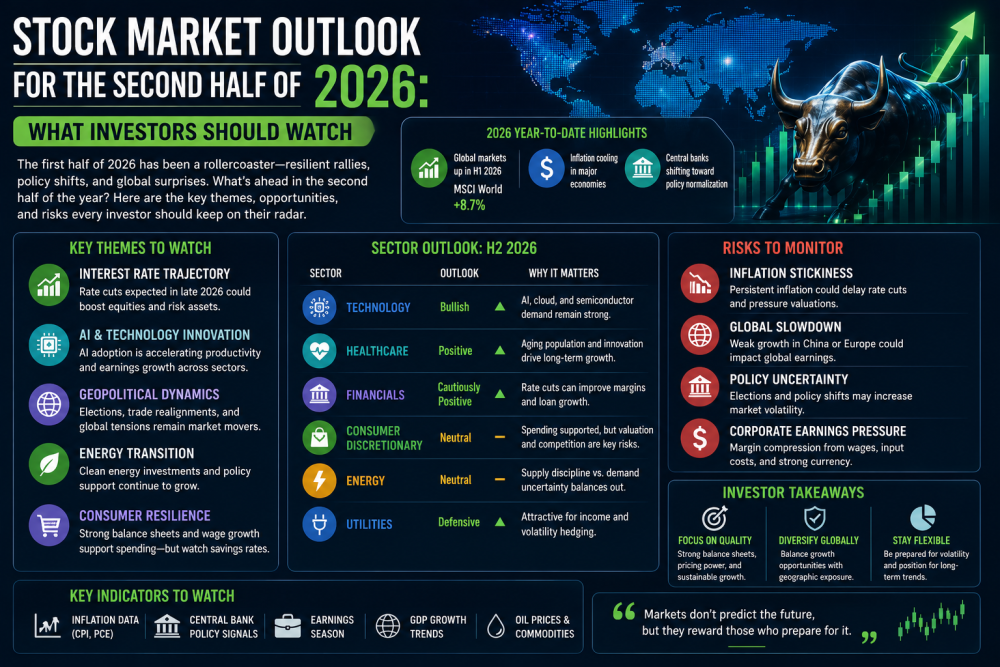
The first half of 2026 delivered something almost nobody predicted at the start of the year: a stock market that climbed to new record highs while navigating a Middle East conflict, elevated interest rates, ongoing inflation concerns, and a tariff environment that was being repeatedly contested in court. The S&P 500 surpassed 7,600 for the first time. The Nasdaq climbed over 11% year-to-date through mid-June. The Dow added about 7%.
Now comes the harder question: what does the second half look like?
The answer — as honestly constructed as it can be from the available evidence — is that the bull case remains intact but the risks are more concentrated and more specific than they were in January. Understanding both matters for anyone deciding how to position the rest of the year.
What Drove the First Half
Before examining the second half, it helps to understand clearly what drove the first half's performance, because those dynamics either continue or change.
Earnings have been the engine. S&P 500 earnings per share grew 27.93% in Q1 on revenue growth of 11.71% — significant operating leverage across corporate America. As of the most recent reporting data, 84% of companies beat their Q1 profit estimates. Wall Street analysts now project S&P 500 earnings growth of 25% for the full calendar year, up from less than 16% at the start of the year. That revision upward — analysts marking estimates higher as the data came in — is the clearest signal of genuine fundamental strength.
AI spending is still accelerating. Meta, Amazon, Microsoft, and Alphabet have collectively committed roughly $725 billion in capital expenditure in 2026 — a 75% increase over 2025 — almost entirely earmarked for AI data centres, chips, and infrastructure. That spending flows into earnings across the semiconductor, networking, and physical infrastructure supply chain. By the end of 2026, AI workloads are expected to consume roughly 70% of global high-end DRAM production, creating pricing conditions that allowed semiconductor stocks to surge — with names like Micron up dramatically year-to-date.
Valuations have been reasonable relative to earnings. The S&P 500 entered 2026 with a forward P/E of around 22, elevated by historical standards. But as earnings have grown faster than expected, that forward P/E has actually moved slightly lower despite price gains. Markets rising while valuations compress is the healthy version of a bull market — earnings growth is justifying price levels rather than multiple expansion alone driving returns.
The Median Year-End Target: 7,850
Wall Street's consensus, drawn from 19 investment banks and research firms surveyed by Reuters and Yardeni Research, shows a median year-end target of 7,850 for the S&P 500. The current level is approximately 7,473 (after the roughly 2.7% pullback that began in early June, concentrated in tech names). That median target implies about 5% upside from current levels, for a full-year return of approximately 15%.
The range around that median is wide. Deutsche Bank expects 8,000 — upside of about 7% from current levels. Goldman Sachs targets roughly 12% gains for the full year. Bank of America was more cautious at 7,100 when the year started, a number the market has already significantly exceeded. Most bullish targets assume the earnings growth trajectory continues, the Iran conflict moderates, and the Fed eventually provides more rate support.
The honest caveat about year-end targets: Wall Street has frequently missed them — both high and low. They're useful as sentiment indicators and directional guides, not precise forecasts. The chart has a median and a range; investors should be aware of the range.
The Upside Case for H2
Several factors support continued market gains through year-end.
Earnings momentum. The consensus estimate for the full year is revenue growth of 11% (the fastest since 2022) and earnings growth of 23% (the fastest since 2021). The sectors contributing most broadly are semiconductors, energy, defense, and financials — not just the Magnificent 7 mega-caps. Roughly 78% of reporting companies have beaten consensus estimates, a healthy clip versus the 10-year average near 74%.
Broadening participation. One of the concerns about the 2024-2025 rally was its narrowness — dominated by a small number of AI-adjacent mega-caps. The first half of 2026 showed some genuine broadening before the June tech pullback narrowed leadership again. If the Iran situation stabilises and the macro environment allows defensive and value sectors to participate, the market's gains become more durable. Charles Schwab's mid-year analysis notes that only about 17% of stocks within the S&P 500 have outperformed the index over the past month — one of the lowest readings in a decade — which historically precedes a broadening in participation.
Rate trajectory. The Federal Reserve is expected to cut rates further in the second half of 2026 if inflation continues its trajectory toward the 2% target. Lower rates reduce the opportunity cost of holding equities, support corporate borrowing costs, and typically provide a tailwind for rate-sensitive sectors like real estate, utilities, and consumer discretionary.
AI secular trend. JP Morgan's market strategists note that almost half of S&P 500 weight is AI-related, and the AI buildout is set to continue "almost irrespective of whether stocks keep performing — as in a sense, this is seen to be a US versus China race, and one can't lose." Capital expenditure projections are only likely to get higher without major players stepping off the accelerator.
The Risks Worth Taking Seriously
The bullish case is coherent. But the risks in the second half are real and specific enough to warrant serious attention rather than dismissal.
The Iran conflict and oil prices. Fidelity's mid-year analysis is blunt: "Investors may be underestimating the severity of global energy supply stress." The Strait of Hormuz has been severely constrained since late February, with tanker traffic reduced from over 100 ships per week to a handful. If oil prices remain above $100 per barrel, the inflationary pressure could push the Fed back toward rate hikes rather than rate cuts — a complete reversal of the expected second-half scenario.
The markets have been resilient to this risk, rebounding quickly to new record highs just weeks after initial strikes. But as Fidelity notes, "what the market views as a temporary shock may have longer-term, far-reaching repercussions" given the time it takes for oil supply disruptions to work through the system.
New tariffs arriving in late July. The current 10% global tariff (itself under legal challenge) is expected to expire or be modified, with the administration signalling a potential increase to 15%. USMCA review in July could add further uncertainty for North American supply chains. Each tariff development creates both direct cost pressures and confidence effects on business investment.
Market concentration risk. The concentration of S&P 500 gains in a narrow group of AI-adjacent names creates specific vulnerability. JP Morgan's strategists identify "the risk of commoditization, concentration risk, and eventually of overcapacity" as the natural risks to the AI bull case. If even one major hyperscaler guides that AI spending down, the supply chain reprices quickly.
Valuation at the top. Despite the healthy P/E dynamics, the market is not cheap by historical standards. The equity risk premium — the extra return equity investors expect over risk-free Treasury yields — is near historically low levels. In the current environment, investors are accepting equity volatility without the usual cushion of excess expected return. That doesn't prevent markets from rising, but it does mean there's less margin of safety if any of the above risks materialises more severely than expected.
Sector Positioning for H2
Looking at the sectors with the clearest fundamental tailwinds for the second half:
Semiconductors remain the runaway leader. AI infrastructure spending has not slowed, and hyperscaler capex guidance continues to step higher. NVDA and AVGO lead the group, both with elevated but defensible multiples given earnings growth rates. The sector risk: a hyperscaler capex pause.
Energy is back in favour as supply discipline meets the geopolitical premium. XOM and integrated energy majors benefit from a combination of constrained global supply and the Iran situation keeping prices elevated. If the Strait of Hormuz opens, energy stocks face a correction; if hostilities persist, the sector outperforms.
Defense and industrials benefit from increased global defense spending and infrastructure buildout. The multi-year defense budget cycle across NATO and allied nations provides revenue visibility that most sectors don't offer.
Financials entered 2026 as one of the more overlooked areas and first-quarter earnings have shifted investor sentiment. Deregulation expectations, improving lending conditions, and AI-driven efficiency gains in financial services are creating earnings upside for the sector.
Laggards worth underweighting: Commercial real estate faces office vacancy and refinancing risk as elevated rates persist. Consumer discretionary companies outside the luxury tier are guiding cautiously as lower-income consumers show spending fatigue. Rate-sensitive REITs struggle in an environment where rate cuts are expected but slow to arrive.
Fixed Income: The Competing Force
For investors considering asset allocation between stocks and bonds, the fixed income picture in H2 2026 is genuinely complex. If the Iran conflict reduces energy supply stress and inflation continues to moderate, the Fed's rate-cutting path accelerates, pushing bond prices higher and yields lower. Bonds would return their traditional function as a portfolio buffer alongside rising stocks.
If instead elevated energy prices push inflation back up and the Fed delays or reverses rate cuts, bonds face pressure alongside equity volatility. The two risks moving in the same direction — stocks down and bonds down — is the scenario that creates the most difficult environment for diversified portfolios.
The consensus view favours the moderate rate-cut scenario. That's reasonable given current trajectories. But the tail risk of the adverse scenario — geopolitical escalation driving sustained energy price elevation — is material enough to warrant maintaining exposure to assets that benefit from inflation protection (energy stocks, TIPS, gold) even in a base-case portfolio.
The Practical Investor Summary
The S&P 500 is up 9% year-to-date. Earnings are the foundation for that gain, not just multiple expansion. The market has climbed what the old phrase calls "a wall of worry" — geopolitical conflict, tariff uncertainty, inflation concerns — and done it on the back of real fundamental performance.
For the second half, the constructive base case is: earnings continue to grow, the Fed delivers additional rate cuts, the Iran situation stabilises, and market participation broadens. In that scenario, the S&P 500 finishes around 7,800-8,000, delivering approximately 15% for the full year.
The risk case is: the energy supply shock intensifies, inflation becomes persistently sticky, the Fed can't cut, and the market concentration in AI names faces a sentiment shift. In that scenario, the June pullback continues and deepens.
Neither scenario is certain. The honest posture for most investors entering the second half is: stay invested in quality companies with durable earnings streams, reduce exposure to highly speculative AI names that have re-rated without earnings support, maintain energy exposure as a geopolitical hedge, and avoid extending credit risk in fixed income given yield curve uncertainty.
This is not a moment for dramatic portfolio repositioning. It is a moment for thinking clearly about what you own and why, and being honest about which risks are genuinely embedded in current prices.