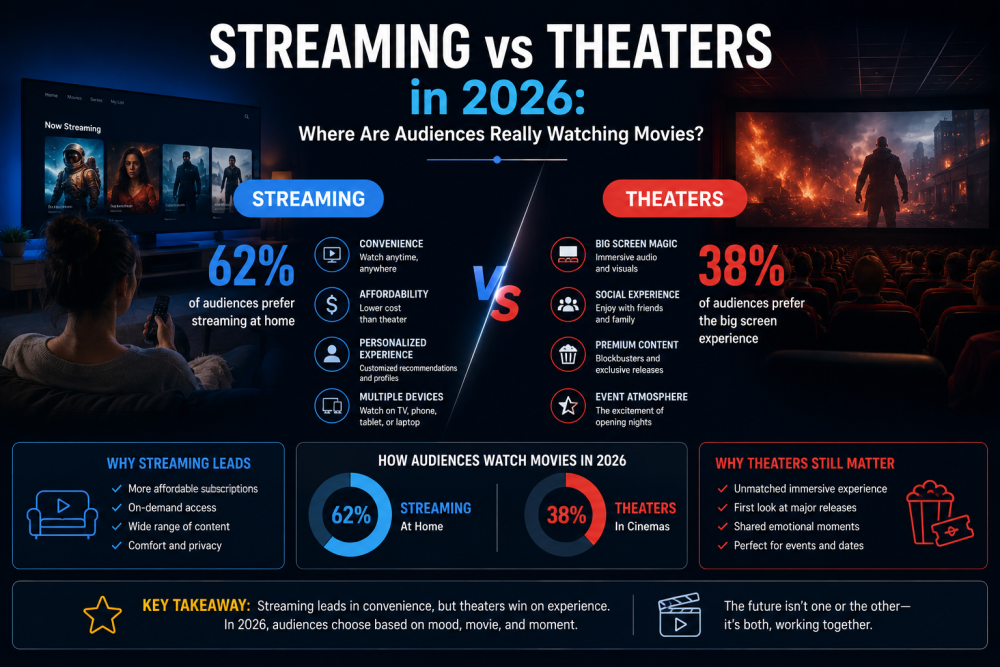
The narrative was supposed to be settled by now. Streaming won. Netflix killed the multiplex the way it killed Blockbuster, and anyone who disagreed was clinging to nostalgia for the smell of popcorn and sticky floors. A few years ago, that take felt pretty bulletproof.
Then 2026 happened. The domestic box office is tracking toward $9.8 billion—the highest post-pandemic figure on record. Project Hail Mary, with no franchise history behind it, opened to $80.5 million on Ryan Gosling's name alone. The Super Mario Galaxy movie crossed $372 million globally in a single weekend. Meanwhile, Netflix sits at 325 million subscribers worldwide, streaming accounts for roughly $277 billion in annual revenue globally, and three quarters of American adults streamed a newly released film at least once in the past year.
So who's winning? Honestly, that's the wrong question. What's actually happening in 2026 is more interesting—and more complicated—than a simple scoreboard.
The Numbers Don't Lie, But They Do Mislead
Let's start with raw scale, because context matters here.
The global streaming market is roughly eight times the size of the global box office. That gap isn't closing—it's widening. Streaming is simply a bigger industry by almost any financial measure you care to use. Netflix alone generated more than $50 billion in revenue in 2025 and is projecting $51.7 billion for 2026. The entire global theatrical market is projected to hit $35 billion this year. By revenue, it's not even close.
But revenue comparisons between these two formats are a bit like comparing the restaurant industry to the grocery industry and declaring groceries the winner. Of course people spend more money on food they eat at home—that's not a verdict on the cultural or commercial importance of restaurants. Theatrical movies and streaming content serve genuinely different functions in people's media lives, and the data starts making a lot more sense once you accept that.
A useful way to frame the 2026 split is to think in terms of viewing mode rather than winner and loser. Streaming is optimized for routine. Cinema is optimized for impact. That's not a marketing slogan—it's actually what the audience behavior data backs up.
What Theaters Have Figured Out
For a few years after the pandemic, theaters were in genuine trouble. Attendance collapsed, studios experimented with simultaneous streaming releases, and the conventional wisdom was that the theatrical window—the exclusive period before a film hits streaming—would eventually disappear entirely.
It didn't. What happened instead was a kind of forced evolution.
Streaming has not killed theaters—it has redefined their strategic importance. The films that perform strongly at the box office now tend to be ones that offer something you simply cannot replicate on a 65-inch TV in your living room. Epic spectacle. Bone-rattling sound. The collective experience of watching something terrifying or thrilling or emotionally overwhelming with 300 strangers who are all reacting in real time.
What's also shifted is the format mix inside theaters themselves. Premium large format screens—IMAX, Dolby Cinema, 4DX, and proprietary formats like AMC's PRIME and Cinemark's XD—now account for more than 16 percent of domestic ticket sales, up from under 14 percent just two years earlier. These screens generate roughly twice the revenue per auditorium of standard screens and command ticket prices averaging $17.69, a 33 percent premium over the general admission mean.
IMAX in particular has had a remarkable run. Despite occupying less than 5% of global screens, IMAX regularly captures up to a quarter of opening weekend box office revenue for major tentpoles. IMAX posted a record $1.28 billion in global box office in 2025, a 40 percent increase over the prior year. Those aren't numbers that suggest a dying format—they suggest an industry that's learned to concentrate its energy where it has a genuine advantage.
4DX and ScreenX auditoriums posted 47% box office growth in North America in the first half of 2025 compared to the same period in 2024—and that trend has continued into 2026. Seats that move, environmental effects, 270-degree panoramic screens: none of this is replicable at home, which is precisely the point.
The theaters that are thriving have essentially given up competing with streaming on streaming's terms—convenience, price, comfort—and doubled down on things streaming structurally cannot offer. It's a smart pivot, even if it took longer than it should have.
The Streaming Landscape: Bigger but Messier
On the streaming side, the picture is robust but increasingly complicated.
Netflix remains king with 325 million subscribers globally, an increase of nearly 24 million from the end of 2024. Disney+ and Hulu posted combined profit growth of 72% to $450 million, while revenue grew 11% to $5.35 billion. Warner Bros. Discovery's streaming arm expects to exceed 150 million subscribers by the end of 2026. The subscriber growth story isn't over—it's just matured.
What's changed is how these platforms compete. The land-grab era of streaming—when the goal was simply to accumulate subscribers at any cost—is finished. The new priority is profitability, which means price increases, crackdowns on password sharing, and ad-supported tiers designed to monetize viewers who won't pay full price. Streaming is a daily habit for 85% of consumers who watch online TV or streaming content every day, and platforms are working hard to convert that habitual viewing into sustainable revenue.
The ad-supported model has become central to this. Netflix's cheaper tier has driven real growth. By 2026, the number of ad-supported viewers for Disney Plus in the United States is estimated to reach 152.8 million. That's a massive pool of viewers who are choosing affordability over ad-free convenience—and that choice tells you something about where the price ceiling for these subscriptions actually sits.
There's also a subtle but important strategic shift happening around content. Here's the counterintuitive finding streaming platforms took too long to acknowledge: theatrical films generate higher streaming viewership than straight-to-streaming films. Films that go to theaters first arrive on streaming with established audiences, word-of-mouth momentum, and cultural footprint already built. The theatrical run, it turns out, functions as a massive marketing campaign for the eventual streaming premiere. That's why studios haven't abandoned the cinema model entirely—they'd be undercutting their own streaming performance if they did.
The middle has mostly disappeared.
Here's something worth paying attention to: the types of films being released theatrically have changed dramatically, and this reshaping of the slate tells the real story of the streaming-vs-theater dynamic.
The theatrical marketplace in 2026 has concentrated around films that offer something screens at home cannot. Blockbusters built for scale. Horror that works on collective audience energy—shared dread in a dark room is a different experience than watching alone on a sofa. Prestige films that benefit from undivided attention. The casual film—mid-range comedy, forgettable thriller, or prestige drama without a star-driven hook—has moved to streaming, where it belongs and where it often performs better anyway.
This is neither a tragedy nor a triumph for either side—it's actually a fairly sensible sorting mechanism. The mid-budget drama that used to get a theatrical release and quietly disappear after two weeks often finds a much larger audience on Netflix, where the friction of watching is lower and the algorithm puts it in front of exactly the people most likely to appreciate it. Meanwhile, a film shot specifically for an IMAX screen, designed for massive speakers and collective viewing, gets to be what it's supposed to be in a context that actually does it justice.
Think about it from the audience's perspective. You're probably not going to haul yourself out on a Tuesday night to see a quiet character study at your local multiplex when you could watch it at home on Friday. But Avengers: Doomsday? You want to see that with a crowd. You want to hear the room react. That communal dimension is genuinely irreplaceable, and audiences seem to understand this even if they can't always articulate it.
What's Driving Box Office in 2026 Specifically
The 2026 theatrical slate is, by most accounts, one of the strongest in years. Spider-Man: Brand New Day, Avengers: Doomsday, Christopher Nolan's The Odyssey, Denis Villeneuve's Dune: Part Three, Toy Story 5, and a live-action Moana headlines a slate that industry forecasters project could push the domestic box office to approximately $9.5 to $9.8 billion—the highest post-pandemic figure.
Christopher Nolan's The Odyssey will be the first feature shot entirely on IMAX film—a project specifically engineered for the theatrical experience in a way that makes a streaming viewing functionally a different, lesser product. This is a growing trend: filmmakers like Nolan and Villeneuve are making creative choices that only make full sense on a giant screen with a premium sound system, which gives audiences a real reason to leave the house.
There's an interesting Netflix subplot here too. Netflix secured a two-week IMAX exclusive deal for Greta Gerwig's Narnia adaptation on 1,000 screens from November 26, 2026, with the film due to start streaming on Netflix on Christmas Day, a month after the theatrical rollout. A streaming platform using theaters as a premium launch vehicle. That's a genuinely new wrinkle, and it suggests even Netflix recognizes that certain films benefit from a theatrical premiere that streaming-only releases simply can't replicate.
The Audience Is More Segmented Than Anyone Admits
One thing that often gets lost in the streaming-vs-theaters framing is that "the audience" isn't a monolith. Different people are making very different choices, and those choices track reasonably well with demographics, income, and geography.
Older audiences, families in suburban areas, and people for whom a night out at the cinema is a genuine event—these groups still go to theaters. They just go less often, and when they go, they want it to feel worth the trip. Premium formats, recliner seating, dine-in options, reserved seating—all of this is a response to the expectation that a $25 ticket (once you factor in parking and concessions) needs to deliver something that a $15/month subscription doesn't.
Younger audiences, particularly 18-to-34-year-olds in urban areas, are the most interesting segment. They stream constantly—it's ambient background to their lives in a way that's qualitatively different from how older generations watch. But they also show up in force for event films, often on opening weekend, often in premium formats. They're not choosing between streaming and theaters so much as doing both, in different contexts, for different reasons.
The AP NORC poll found about three quarters of United States adults streamed a newly released movie at least once in the past year, while about two thirds attended a theater. These aren't mutually exclusive populations—they're largely the same people, doing both things. The either/or framing that dominates media coverage of this topic reflects how we think about competition, not how audiences actually behave.
Where Streaming Still Has a Clear Edge
None of this means streaming's advantages are illusory. They're very real, and they matter enormously for large categories of content.
Convenience is not a small thing. The ability to watch something the moment you want to, pause it, come back tomorrow, watch it in your pajamas without spending $60 for two people between tickets and snacks—that's genuinely compelling. Streaming wins on immediate access, predictable effort, and the sense that you can walk away without losing money. That combination is hard to beat, even when audiences still like the idea of a cinema night.
Streaming also wins decisively on volume and variety. The sheer quantity of content available across Netflix, Max, Disney+, Amazon, Apple TV+, and Peacock is staggering. A theatrical release slate, even a strong one, offers a few dozen titles a year at most. Streaming offers thousands. For casual, habitual viewing—the "I just want to watch something while I eat dinner" mode—there's no competition.
And for certain types of content, streaming is simply the better home. Limited series. Documentaries. International films with no domestic theatrical distribution. Horror movies, in particular, have found a second life on streaming that's arguably more commercially important than their theatrical runs. Straightforward action often performs well on streaming, where audiences gravitate toward familiar and easily watchable titles. A Jason Statham film doesn't need a multiplex to find its people—it finds them on the couch.
What the Next Few Years Actually Look Like
A full return to 2019 box office levels is unlikely in the near term. MMCG research projects the domestic market will grow at a compound annual rate of roughly 2 to 3 percent through 2030, potentially reaching $9.5 billion, but a return to $11 billion appears unlikely absent a fundamental reversal in consumer behavior.
Streaming, meanwhile, is moving toward a consolidation phase. The era of launching new services and hemorrhaging money on content to attract subscribers is winding down. The profitable survivors—Netflix above almost all others, plus Disney's combined streaming empire—will invest heavily in content that works. Netflix has set a target of achieving 430 million subscribers worldwide by 2030, which implies continued international expansion more than domestic growth.
Studios will continue navigating the theatrical window question. Theatrical windows—the time between cinema release and streaming availability—continue to shrink. The standard has settled around 45 days for most releases, though premium films often get longer exclusivity. This is a fragile equilibrium that will keep being renegotiated as individual films test what's possible, as Netflix's Narnia deal already demonstrates.
The Honest Verdict
The streaming vs. the theaters debate produces more heat than light partly because both sides have too much ego invested in being right. Streaming enthusiasts want to declare cinemas obsolete. Theater advocates want to pretend streaming is a phase.
Neither is accurate.
What's actually happened is a genuine specialization. Streaming has become the default medium for most movie and TV watching by volume. Theaters have become an event-oriented medium, where the content on offer and the experience of seeing it together justify the higher price, the planning, and the effort. Both can be commercially viable. Both can coexist. They're already doing it.
The more interesting question isn't which format wins—it's what kinds of stories get told under each model, and whether the films that need a theater to be fully experienced continue to get made with enough ambition and frequency to keep audiences coming back. If the 2026 slate is any indication, the answer to that is still yes.
Go see The Odyssey on IMAX. Watch the quiet drama you almost missed on Netflix at 11pm. There's no contradiction in doing both.