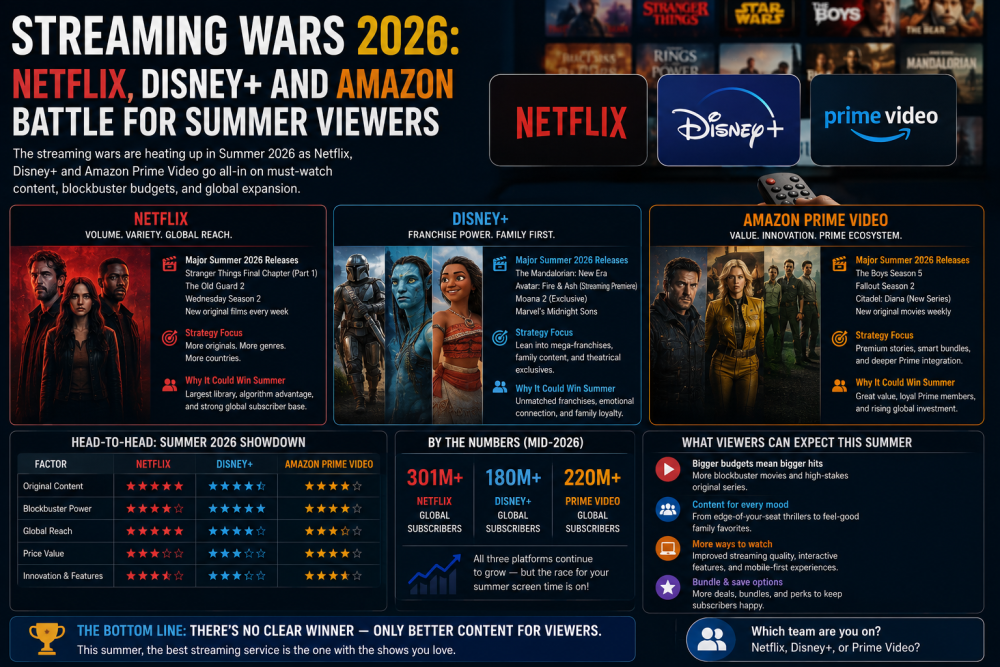
The phrase "streaming wars" conjures an image of platforms ruthlessly undercutting each other, competing for every subscriber. That framing was accurate in 2019 and 2020. In 2026, it's more complicated. The platforms are still competing, obviously — but they're also partnering, bundling, and cooperating in ways that would have seemed counterintuitive even three years ago. One industry analyst described the dynamic as the rise of the ""frenemy"—streaming platforms that are simultaneously rivals and partners.
The summer of 2026 is the sharpest test of this new phase. The World Cup is driving international viewing in ways that benefit sports rights holders. Avatar: Fire and Ash just landed on Disney+. Toy Story 5 is in theaters driving Disney's family subscriber base. And Netflix, sitting atop the mountain with over 300 million global subscribers, is trying to defend its position while quietly reorienting its entire model toward profitability rather than growth.
Here's where things actually stand.
The Market Overall: Growth Has Slowed, But It's Still Enormous
Let's start with the macro picture because it frames everything else. The global subscription OTT streaming market surpassed $165 billion in 2026, according to Ampere Analysis. That's a genuinely enormous number. But growth is slowing — the industry is tracking at roughly 5% global OTT growth in 2026, and projections show that declining to under 2% annually by 2030.
The era of rapid subscriber expansion is effectively over in mature markets. What that means in practice is that the platforms competing this summer are no longer chasing subscriber headcount as the primary metric. The metrics that matter now are engagement (time spent watching), average revenue per member, and profitability. That's a fundamentally different game from "how do we get to 250 million subscribers."
The top five platforms — Netflix, Disney+ with Hulu and ESPN+, Amazon Prime Video, YouTube TV, and Max — already collectively generate nearly two-thirds of all global subscription streaming revenues. The remaining 125 or so streaming services are fighting over the other third. Consolidation is accelerating as a result.
Netflix: Defending the Top Position
Netflix enters summer 2026 as the undisputed audience leader—over 300 million subscribers globally, the most-watched streaming platform across almost every demographic. What's changed is how it's getting there.
The ad-supported tier at $7.99 per month has become a genuine revenue engine rather than a concession to budget viewers. It's priced competitively and draws subscribers who either can't afford or won't pay for ad-free viewing. The catch, as the data shows, is that Netflix keeps raising prices at the higher tiers: the standard ad-free plan jumped to $17.99 in early 2025, a 16% increase in a single move. The premium plan sits at $24.99. Consumer prices are 26% higher than they were in December 2019, and streaming is very much part of that picture.
The summer 2026 content slate for Netflix is substantial. Stranger Things continues to dominate conversation. The platform's approach of releasing multiple global dramas simultaneously—Korean, Spanish, and British series regularly outperforming US-made content in international markets—remains its most distinctive editorial advantage. No other platform has cracked global-local content production the way Netflix has.
One significant near-term development: Netflix walked away from an $83 billion potential acquisition of Warner Bros. Discovery in early 2026 after Paramount Skydance made a higher bid. The consolation prize is that the consolidation happening around Netflix gives it more clearly defined competition and doesn't fundamentally alter its market position.
For summer viewers, Netflix's pitch is simple and has been for years: the most content variety, the most consistent original production, and an app experience that most users find the easiest to use. That combination keeps churn lower than most rivals.
Disney+: Folding Hulu In and Betting on the Bundle
The most structurally significant change in streaming in 2026 is Disney's merger of the standalone Hulu app into Disney+. Throughout 2026, Hulu content is being fully integrated into the Disney+ platform—meaning subscribers access Disney, Pixar, Marvel, Star Wars, National Geographic, FX shows, and next-day TV episodes from major networks all in one place. The standalone Hulu app is being phased out.
This matters because Disney's bundle strategy is essentially the company's answer to the Netflix question. If Netflix offers the widest content variety on one platform, Disney's response is to offer a different kind of breadth: beloved IP for families (Disney Animation, Pixar, Marvel, and Star Wars); adult prestige television (FX via Hulu); and sports (ESPN+), and now the integration means subscribers don't have to toggle between apps.
The pricing tells the story. Disney+/Hulu with ads: $12.99 per month. Disney+/Hulu without ads: $19.99. The full Disney/Hulu/Max bundle (bringing in HBO content too): $20 with ads, $33 without. That bundle can cut a household's total streaming bill by 30–40% compared to subscribing to each service individually—which is exactly the value proposition Disney and Warner Bros. Discovery is hoping to lock in subscribers for the longer term.
The summer content anchors are strong. Avatar: Fire and Ash debuted on Disney+ on June 24 and immediately became the most-watched movie on the platform worldwide — number one in 77 countries within a day of release. The platform's Pixar streams, with Toy Story 5 in theaters driving renewed interest in the back catalog, are performing well. And the integration of The Mandalorian and Grogu as a theatrical film — originally a Disney+ series — demonstrates the fluidity between streaming and cinema that Disney uniquely controls.
The honest assessment: Disney+ is the platform with the highest emotional attachment. People care about Marvel, Star Wars, and Pixar in a way they don't care about any other streaming brand's content. That affinity is real and durable, which is why the platform sustains subscribers even through content gaps or price increases.
Amazon Prime Video: The Quiet Giant
Amazon doesn't talk about Prime Video subscriber numbers the way Netflix does, partly because Prime Video is bundled with the broader Amazon Prime subscription ($14.99 per month), which exists for shopping benefits as much as streaming. This makes direct comparison with Netflix or Disney+ subscriber counts misleading—the viewing figures are genuine, but the subscriber acquisition model is completely different.
What Amazon has that its rivals don't is aggregation scale. Amazon Channels allows Prime members to add individual streaming subscriptions (Paramount+, AMC+, Starz, and many others) directly through the Amazon interface, with Amazon taking approximately 30% of subscription revenue in exchange for its distribution reach. One in three new US streaming subscriptions now originates through aggregators like Amazon. That's a structural advantage no other platform has.
Prime Video's original content strategy in 2026 has matured around a smaller number of significant bets. The Rings of Power, despite its expensive production, hasn't generated the sustained cultural conversation of HBO's best properties. But Prime Video has been quietly consistent with a range of mid-budget prestige dramas, reality formats, and the occasional massive hit that elevates the platform's profile.
For summer 2026, the sports rights are becoming increasingly important to Amazon's positioning. NFL Thursday Night Football continues to drive engagement among subscribers who might otherwise cancel. International sports rights acquisitions are extending the platform's reach in markets where football (soccer), cricket, and tennis rights generate genuine subscriber demand.
Max (HBO): The Critical Darling That Keeps Winning Awards
Max (formerly HBO Max) doesn't have Netflix's subscriber count or Disney's brand affinity. What it has is arguably the highest creative quality ratio of any major streaming platform. House of the Dragon, The Last of Us, The White Lotus, Euphoria — these are shows that generate disproportionate cultural conversation relative to the platform's market share.
The White Lotus's upcoming season and the returning Euphoria are both summer 2026 conversation drivers. Plus, the Ballerina John Wick spinoff lands on Max this summer—a theatrical-to-streaming franchise extension that continues to show the platform's ability to leverage Warner Bros.' cinema IP.
Max raised prices across all tiers in October 2025: the ad-supported Basic plan hit $10.99 per month, Standard (ad-free) went to $18.49, and Premium hit $22.99. These are not cheap. The platform is betting that people who care about quality television will pay for it — a strategy that has worked better for Max than for most of its competitors because the underlying product quality genuinely justifies the premium.
What Viewers Are Actually Paying
Here's the full picture of what households are spending on streaming in 2026, because the sticker shock when you add it up is significant.
If you subscribe to Netflix Standard Ad-Free, Max Standard, and Disney+/Hulu without ads, you're spending $56.47 per month. That's before any live TV, sports, or add-on channels. A few years ago that would have seemed impossibly high for something that was supposed to be cheaper than cable. It is, in many ways, becoming cable.
The bundling options are the meaningful response to this inflation. The Disney+/Hulu/Max bundle at $33 per month without ads is the best value package for someone who wants prestige drama (Max), family content (Disney+), and next-day TV episodes (Hulu). Comcast's StreamSaver offers Netflix with ads, Peacock with ads, and Apple TV+ for $15 per month to Comcast customers — an extraordinary value if you're already on Comcast infrastructure.
The average US household subscribes to 3–4 streaming services. The strategy most financial advisors are recommending in 2026 is picking two or three core platforms and using the natural content release cycles to rotate a fourth subscription in and out—subscribing when a show you want arrives, watching it, cancelling, and repeating. This "subscription cycling" is well-documented in streaming churn data and represents a real challenge for platforms trying to reduce churn rates.
The Competition for Summer Viewers: What's Actually Driving Decisions
Three things are competing for audience attention this summer in ways that are platform-agnostic.
The World Cup in North America is the biggest live event in the world. Fox and Telemundo hold the US broadcast rights, and the matches are drawing enormous live audiences across both platforms. Streaming platforms can't replicate live sports at this scale, which is why several of them are investing heavily in sports rights for precisely this reason — to give subscribers a reason to stay subscribed even in months when the original content slate is quiet.
The theatrical season is strong. Toy Story 5 in theaters is driving family viewing discussions and generating Disney+ interest in the back catalog. Mission Impossible 8 is competing for the family budget alongside streaming options.
And the original content arms race continues. Netflix's Stranger Things, Max's White Lotus, Amazon's tentpole dramas — all are summer players. The platform that produces the summer's single breakout series will see measurable subscriber lifts in August and September.
Who's Actually Winning?
By any conventional subscriber metric: Netflix. By emotional attachment and franchise depth: Disney. By aggregation and ecosystem scale: Amazon. By critical quality ratio: Max.
Nobody has lost yet, because the market is still growing and the platforms that exist today are unlikely to disappear. What's changing is which metrics matter. The streaming war of 2026 is no longer about who can acquire the most subscribers — it's about who can make money sustainably from the subscribers they have, reduce churn, and build bundles that create switching costs.
By that measure, the summer of 2026 belongs to whoever produces the one show everyone is talking about. That's still ultimately what this business runs on.