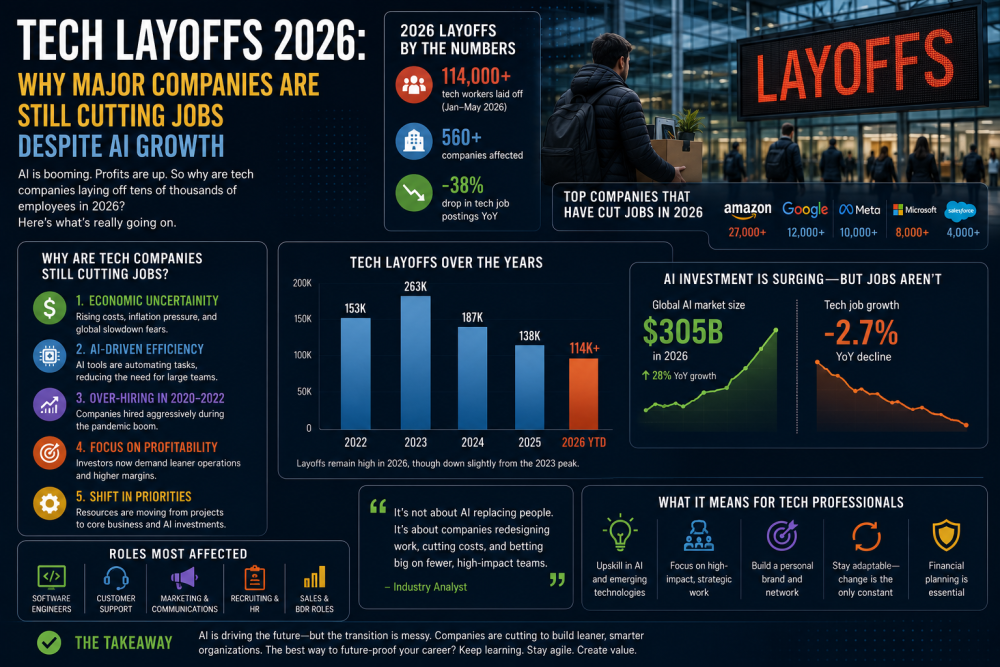
Here's the headline stat that doesn't make sense at first pass: as of late May 2026, more than 113,000 tech workers have been laid off across 179 companies — an average of roughly 825 people per day since January 1. At the same time, Meta, Amazon, Microsoft, and Alphabet have collectively committed roughly $700-725 billion in capital expenditure in 2026, a 75% increase over 2025, almost entirely earmarked for AI data centres, chips, and infrastructure.
Companies are firing people and buying GPUs with the savings. Or at least, that's the blunt version. The full picture is more complicated, more honest, and more important to understand — whether you work in tech, hire in tech, or are trying to make sense of what's happening to the workforce.
The Scale of the Layoff Wave
The numbers from 2026 are striking in their trajectory. AI-related job losses reached approximately 18,000 in 2024. That number increased roughly fivefold to over 100,000 in 2025. In the first six months of 2026 alone, more than 150,000 roles have been cut — roughly 50% above the full-year 2025 total, according to Programs.com.
Depending on which attribution tracker you use, between 48% and 56% of 2026 layoff events now explicitly cite AI, automation, or machine learning as a reason. Challenger, Gray & Christmas found AI was the leading stated reason for job cuts in both March and April 2026, with 21,490 AI-attributed cuts in April alone.
Specific headline examples from TechCrunch's running list of AI-cited layoffs:
-
Amazon: 16,000 jobs cut in January 2026 (9% of workforce). CEO Andy Jassy: "We will need fewer people doing some of the jobs that are being done today."
-
Oracle: 21,000 positions cut between March and June — 13% of the workforce. The company explicitly stated in an annual financial filing that "the adoption and deployment of AI technologies across our operations have resulted, and may continue to result, in reductions to our workforce."
-
Meta: 8,000 employees eliminated in May (10% of workforce), while simultaneously moving approximately 7,000 employees into new AI-focused roles.
-
Block: CEO Jack Dorsey cut the company from roughly 10,000 to fewer than 6,000 employees. His public statement was unusually candid: "This is not driven by financial difficulty, but by the growing capability of AI tools to perform a wider range of tasks." He called it "the largest single workforce reduction explicitly attributed to AI automation in corporate history."
-
Intuit: 3,000 jobs cut (17% of workforce), with CEO Sasan Goodarzi citing reduction of complexity and reallocation toward AI.
-
GitLab: 350 workers cut (14% of staff) to fund AI infrastructure investment, with the CEO describing a "generational rebuild" of its core infrastructure.
-
Cloudflare: 1,100 jobs cut (20% of workforce). CEO Matthew Prince said "the vast majority of those we laid off were measurers" — framing the cuts as eliminating overhead.
-
Salesforce: CEO Marc Benioff said "we no longer need to actively backfill support engineer roles" — a statement that signals AI is not just slowing hiring but eliminating job categories entirely.
The Attribution Problem
Here's where honest analysis matters more than narrative convenience. Not every layoff attributed to AI is genuinely caused by AI.
OpenAI CEO Sam Altman acknowledged "some AI washing where people are blaming AI for layoffs that they would otherwise do." Venture capitalist Marc Andreessen attributed layoffs primarily to pandemic-era overhiring and higher interest rates, adding that companies now have "the silver bullet excuse: 'Ah, it's AI.'" Deutsche Bank analysts wrote in January that "AI redundancy washing will be a significant feature of 2026."
Oxford Economics concluded that firms "don't appear to be replacing workers with AI on a significant scale." Challenger, Gray & Christmas data identifies AI as the fifth most common reason for job cuts — trailing market conditions, restructuring, closures, and cost-cutting — which suggests even in the data from outplacement specialists, AI is a real but not dominant cause.
The cleaner distinction from TechCrunch's analysis is between "real automation" and "financial theatre." Real automation tends to gut a specific, repetitive function and not bring it back — the function is genuinely replaced, not repurposed. Financial theatre spreads cuts broadly, follows an overhiring binge, and conveniently coincides with earnings pressure. The same management team that overhired in 2021-2022 and is now correcting has a cleaner PR narrative if they attribute the correction to AI rather than to their own hiring decisions.
The honest assessment: both things are true simultaneously. Some of the layoffs are genuinely AI-driven — functions that have been automated and won't return. Some of the layoffs are pandemic-era overhiring correction and cost discipline dressed in AI language. The proportions vary by company and function.
Why the Spend-and-Cut Paradox Actually Makes Sense
The apparent paradox — massive AI spending alongside massive layoffs — is less paradoxical when you understand what the money is being spent on.
Capital expenditure on AI infrastructure (data centres, GPUs, networking hardware, power infrastructure) employs construction workers, hardware engineers, data centre technicians, and the supply chains that serve those activities. It does not directly employ the knowledge workers — product managers, customer service representatives, content writers, middle managers — who are being laid off.
The companies are simultaneously:
-
Spending capital to build AI systems that can automate cognitive tasks
-
Laying off the humans whose cognitive tasks are being automated (or can now be done by smaller teams using AI tools)
These two activities are not contradictory. They're actually part of the same strategy: reducing per-unit cost of cognitive output by substituting AI infrastructure capex for human salary cost. The savings from reduced headcount fund additional AI infrastructure investment, which enables further headcount reduction. That's not a paradox — it's a flywheel, at least in theory.
The question that doesn't yet have a clear empirical answer is whether the productivity gains from AI tools are as large as companies claim, or whether the cuts are sometimes outpacing what AI can actually replace.
What's Actually Being Automated
The functions most visibly targeted by AI-driven reduction in 2026 are consistent across industries:
Customer service and support. AI chatbots and automated response systems have genuinely reduced the number of human agents needed to handle standard queries. Salesforce's statement about not backfilling support engineer roles is the explicit version of what's happening implicitly at many companies.
Middle management layers. Google cut more than a third of the managers overseeing small teams (35% fewer managers with fewer direct reports) in a rolling process rather than a single announcement. Amazon's January cuts flattened management layers to accelerate decision-making. Meta moved 7,000 employees into new AI-focused roles while eliminating 8,000 — a net headcount reduction but also a reclassification of what roles the company needs.
Content and marketing production. Writing, editing, image creation, social media, and marketing copy that previously required dedicated human resources are being produced by smaller teams using AI tools at higher output volumes.
Quality assurance and testing. In software development, AI-assisted testing tools are reducing the number of manual QA engineers needed. This follows the pattern of automation in manufacturing — the QA function isn't eliminated, but the human:machine ratio shifts.
Logistics and operational analytics. C.H. Robinson cut 1,400 jobs after rolling out AI-driven tools for pricing, scheduling, and shipment tracking. WiseTech Global cut 2,000 jobs (25% of workforce) citing AI automation of supply chain management tasks.
What This Means for Tech Workers
The situation is difficult, and the honest advice for people currently in tech or trying to enter it isn't particularly comforting in the short term. But it's more nuanced than "AI will take your job."
The roles being created simultaneously. IBM has tripled entry-level hiring in 2026 specifically for roles involving AI oversight, training data curation, and judgment. The companies doing the layoffs are simultaneously creating positions: AI trainers, prompt engineers, AI safety specialists, deployment engineers, and infrastructure architects. The problem is that the skills required for these new roles are different from the skills of the people being laid off — and the supply of people with AI-native skills is smaller than demand.
The skill gap creates opportunity. If you can bridge the gap — if you can demonstrate that you use AI tools to multiply your output rather than compete with them — job security improves considerably. IBM's recognition that AI needs human oversight, training data curation, and judgment is not unique to IBM. Every company deploying AI at scale has the same need.
The startup ecosystem is different. While large companies cut, AI-native startups continue hiring. The trend toward smaller teams enabled by AI tools means more companies can be built with fewer people — but it also means more companies are being started, creating opportunities for those displaced from larger organizations.
The displacement is uneven. The workers most at risk are those in well-defined, high-repetition cognitive roles: customer support, data entry, routine content creation, standard QA testing. The workers most insulated are those in roles that require judgment, creativity, interpersonal relationships, or physical presence — clinical roles, complex sales, engineering leadership, research, and strategic decision-making.
The Bigger Picture Question
The largest question hanging over this moment is whether AI represents a genuine technological displacement of a different character from previous automation waves — or whether the patterns of job destruction followed by job creation that characterised the internet, mobile, and cloud revolutions will repeat.
The optimistic historical view: every major technological revolution (the internet, mobile, cloud computing) initially destroyed jobs in specific categories before creating more in categories that didn't yet exist. The pessimistic counter-argument: AI isn't just automating manual tasks — it's automating cognitive work, which is exactly where previous displaced workers went after earlier automation waves. Where do knowledge workers go when knowledge work itself is being automated?
The answer will emerge over the next 12-24 months as the companies that aggressively cut headcount in 2026 either prove that AI can genuinely replace those workers at scale — or discover that they cut too deep and face the operational consequences of having eliminated judgment and institutional knowledge that AI still can't replicate.
That uncertainty is uncomfortable. It's also the honest state of where things stand.