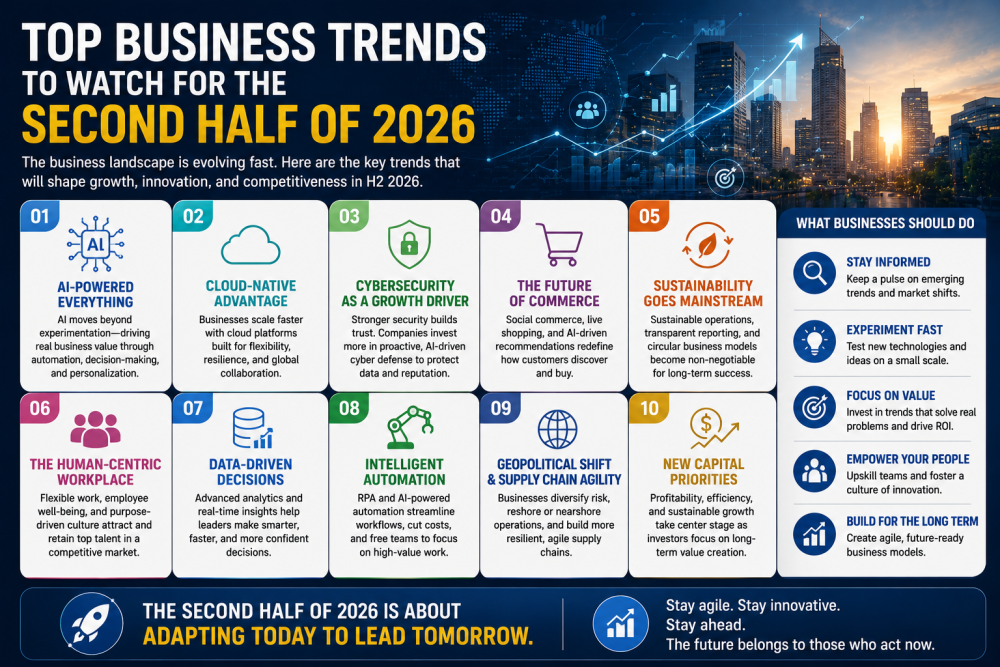
The first half of 2026 has been, diplomatically speaking, eventful. Tariff disruptions. Geopolitical uncertainty. A crypto bear market running on macro headwinds. A World Cup and a 250th anniversary drawing global attention to the US. And underneath all of it, a fundamental business environment that is genuinely different from a year ago in ways that are still being absorbed.
The second half of 2026 carries its own distinct set of pressures and opportunities. These aren't speculative forecasts—they're trends already in motion, documented by major research institutions, and visible in the strategies of leading companies. Here's an honest look at what matters.
1. AI Moves From Pilot to ROI — or Gets Defunded
The question that hung over enterprise AI in 2024 and 2025 was simple but consequential: does this actually produce returns? Companies spent heavily on AI infrastructure, deployed generative AI tools across teams, and launched dozens of internal pilots. The honest answer is that results were mixed, and the patience of boards and CFOs has limits.
The second half of 2026 is when that reckoning arrives in earnest. Deloitte's Tech Trends research puts it directly: "The focus has moved from endless pilots to real business value, and there's a sense of urgency behind it all." One CIO quoted in the report captured the pressure: "The time it takes us to study a new technology now exceeds that technology's relevance window."
The companies that will win the second half aren't the ones with the most AI tools—it's the ones who've identified the specific workflows where AI drives measurable improvement and doubled down there. Harvard Business School faculty suggest that 2026 will feature innovation that is "AI-augmented, not AI-automated." Winners treat AI as a collaborator that accelerates search, prototyping, and decision cycles while maintaining strong human judgment for selection and implementation.
For business leaders, the practical implication is this: if your AI initiatives are still in pilot mode without clear performance metrics, the pressure to demonstrate value or scale back is going to intensify through Q3 and Q4. This is a moment for honesty about which AI deployments are genuinely working and which were launched because they seemed obligatory.
JP Morgan's Business Leaders Outlook survey of midsize businesses confirms that AI has moved into daily operational use: the most common applications are process automation (62%), predictive analytics (44%), and market intelligence (42%). These aren't experimental — they're becoming infrastructure.
2. Tariff and Trade Costs Are Baked In — Now What?
The 2025 tariff actions created a cost shock that is now fully embedded in the operating environment. Harvard Business School pricing research found that the 2025 tariff increases have already pushed up retail prices of imported goods by about 5.4% compared to their pre-tariff trend. That's not a temporary disruption — it's the new baseline.
The second half of 2026 is when companies move from absorbing the initial shock to making structural decisions: which supply chains to reroute, where to reshore production, and which cost increases to pass through to customers versus absorb into margins.
JP Morgan's 2026 Business Leaders Outlook found that 61% of respondents report a negative impact on their costs from tariffs, while 30% remain unaffected. Tariff-related issues are now the third most commonly cited business challenge, tied with workforce and labor concerns. That's a significant structural shift from a challenge that wasn't in most companies' top-five lists eighteen months ago.
For businesses in manufacturing, retail, and any sector with significant imported inputs, the strategic priority for H2 2026 is building portfolio approaches to sourcing—reducing single-country concentration, identifying alternative suppliers, and incorporating tariff and trade risk as a standing agenda item at the board level rather than an occasional topic.
One specific opportunity worth watching: companies that have invested in domestic manufacturing capability or near-shoring alternatives are increasingly positioned as premium suppliers to larger firms seeking supply chain resilience. The reshoring trend has real commercial momentum for those able to serve it.
3. The "10x Founder" Moment — Velocity as Competitive Advantage
Harvard Business School's trend report describes 2026 as "the year of the 10x founder — founders who operate with a level of velocity and productivity that is an order of magnitude greater than in prior generations." This isn't aspirational language—it's a description of what's already happening.
AI tools are compressing product development cycles. What used to take a startup six months to validate, prototype, and take to early customers now takes six weeks for founders who have integrated AI into their development workflow. Product-market fit is being found faster than ever as cycles of customer discovery, prototyping, and iteration continue to compress.
This velocity effect is not limited to technology startups. It applies to any knowledge-intensive business where the bottleneck has historically been time to produce—content businesses, professional services firms, consulting, marketing agencies, and product development functions in larger companies. AI doesn't eliminate the need for human judgment about what to build and why, but it dramatically reduces the time between having an idea and having something testable.
The implication for businesses in H2 2026: if your competitors are moving to AI-augmented development and you're not, the gap compounds every quarter. 82% of small businesses using AI increased their workforce over the past year, according to the US Chamber of Commerce—a counterintuitive finding that suggests AI adoption correlates with growth rather than substituting for it.
4. Agentic AI Arrives in Enterprise Operations
The most significant near-term shift in how AI affects business operations is not large language models responding to queries — it's autonomous AI agents taking multi-step actions across business systems without human intervention at each step.
Agentic AI can handle tasks like monitoring a customer inbox and automatically escalating urgent items, scheduling and rescheduling meetings based on changing priorities, updating CRM records based on email content, generating initial proposals based on client parameters, and routing them for review. These aren't future capabilities — they're available today through platforms like Zapier's agent features, Microsoft Copilot Studio, and standalone tools.
The second half of 2026 is when enterprise deployment of agentic AI starts scaling from pilot programs to operational infrastructure. Companies that have successfully deployed first-generation AI tools (chatbots, writing assistants, and code generators) are the most positioned to extend into agentic AI because they already have the organizational muscle of AI integration and the data infrastructure agents need to operate.
Deloitte notes that "security models built for perimeter defense don't protect against threats operating at machine "speed"—meaning that as AI agents gain access to enterprise systems, cybersecurity architecture needs to evolve alongside the capability deployment. This creates immediate demand for AI security expertise and governance frameworks that most organizations are still building.
5. The Dollar Weakness Story and Its Business Implications
One structural trend that's been building through 2026 and will intensify in H2 is the weakening US dollar. The dollar went from near parity with the euro (1.03 in early January 2025) to being worth 14% less (approximately 1.17) by January 2026. Over a longer horizon, the dollar's role as the global reserve currency has diminished from 70% in the early 2000s to around 56%.
For businesses with international exposure, this matters in both directions. US exporters benefit—their products become more competitively priced in foreign markets. US businesses with significant non-dollar revenue see those revenues worth more when converted to dollars. But businesses with dollar-denominated import costs face additional input cost pressure on top of tariff effects.
The practical advice from European strategists, who are navigating dollar exposure more directly: map your exposure to a lower dollar across the supply chain, not just transactionally. Build financial hedging into your pricing model where possible—sourcing inputs in the same currency as sales, pricing in local currency in major international markets, and incorporating fixed adjustment clauses into long-term contracts.
For US-based businesses looking internationally, H2 2026 may present attractive entry points in international markets where dollar weakness makes US investment costs relatively lower.
6. Hyper-Personalisation at scale becomes table stakes.
McKinsey research found that 71% of consumers expect personalized interactions from businesses, with 76% expressing frustration when they don't receive them. This expectation has been building for years, but the gap between consumer expectations and what most businesses deliver has remained stubbornly wide because personalization at scale was expensive.
AI has changed that cost structure. AI-powered platforms analyze customer behavior and automate personalized marketing at a fraction of traditional costs. Platforms like Klaviyo create automated flows for personalized email and SMS campaigns that respond to individual customer behavior—not just segment-level rules. Customer service tools can personalize responses based on customer history, purchase patterns, and communication preferences without requiring a human agent for each interaction.
The competitive implication for H2 2026: businesses that are still treating customers as segments rather than individuals are increasingly at a disadvantage against competitors who have implemented even basic personalization. The technology is now affordable for small and medium businesses — the constraint is implementation, not cost.
The flip side: personalization raises expectations. A customer who experiences excellent personalization from one provider will judge every other interaction against that standard. As more businesses implement AI-driven personalization, the baseline expectation rises, and businesses that lag fall further behind the curve.
7. Workforce Reshaping — Not Just Replacement
The conversation about AI and employment in 2025 was often framed as binary: AI will take jobs, or it won't. The 2026 reality is more nuanced and arguably more interesting.
JP Morgan's Business Leaders Outlook found that while 27% of business leaders anticipate some headcount impact from AI in 2026, nearly half (48%) still plan to expand their workforce despite AI adoption. The Chamber of Commerce finding that 82% of businesses using AI increased their workforce over the past year suggests that AI is operating more as a growth accelerator than a workforce reducer at the current stage.
What is changing is the nature of roles. AI is eliminating high-volume, low-judgment tasks from existing roles rather than eliminating the roles themselves. A marketing team that previously needed three people to produce a given volume of content can now produce more with two — but those two people are doing substantially different, more strategic work than before.
For business leaders, the H2 2026 workforce priority isn't whether AI will reduce headcount—it's investing in developing the skills that make human workers more valuable in an AI-assisted environment. This means judgment, domain expertise, relationship management, creative strategy, and the ability to direct and quality-check AI output effectively. These are not easily automated, and businesses that develop them within their teams will have durable advantages.
8. Cybersecurity Spending Goes Up — Because It Has To
As AI gets deployed more broadly in business operations, it creates new attack surfaces and amplifies the speed at which existing threats operate. AT&T's chief information security officer put it clearly: "What we're experiencing today is no different than what we've experienced in the past. The only difference with AI is speed and impact."
AI-powered attacks are faster and more targeted than traditional approaches. Phishing emails generated by AI are dramatically more convincing than previous templates. Deepfake technology makes voice and video impersonation attacks more viable. And as AI agents gain privileged access to enterprise systems, the potential blast radius of a compromised agent is larger than that of a compromised human employee.
The business implication is a structural increase in cybersecurity spending through H2 2026 and beyond. Organizations must secure AI across four domains—data, models, applications, and infrastructure—while also using AI-powered defenses to fight threats operating at machine speed. This creates genuine demand for cybersecurity expertise, AI governance specialists, and audit frameworks for AI deployments.
For businesses that have lagged on cybersecurity infrastructure, the increasing AI integration of business systems makes this the wrong moment to keep deferring investment.
9. Sustainability Under Scrutiny — But Not Disappearing
The 2026 business environment has pushed environmental sustainability somewhat off the top of the agenda, replaced by more immediate pressures from tariffs, geopolitical uncertainty, and AI governance. INSEAD faculty noted that "environmental concerns are being forced to take a back seat due to more urgent concerns."
But "taking a back seat" is different from disappearing. Investor pressure on ESG metrics has moderated but not reversed. Regulatory requirements — particularly in Europe, where the Corporate Sustainability Reporting Directive is requiring more rigorous disclosure — continue to create compliance obligations for businesses operating internationally. And supply chain pressures related to energy costs are making the economics of renewable energy more compelling for businesses that can access it.
For H2 2026, the more realistic business framing on sustainability is that the question has shifted from "should we do this?" to "what can we afford and what's mandatory?" Companies aligning their sustainability investments with regulatory requirements and energy cost reduction (rather than positioning them primarily as reputation management) tend to get more durable traction.
The Through Line
What connects most of these trends is a common underlying theme: the gap between businesses that have successfully integrated AI into their operations and those still experimenting is widening, and the compounding effects of that gap are becoming more visible.
This doesn't mean every business needs to be a technology company. It means that the cost structure, speed, and personalization capabilities enabled by AI are increasingly determining competitive position across sectors. The business leaders who navigate H2 2026 best won't be those who followed every AI trend—they'll be the ones who identified where AI creates real leverage in their specific business and executed there with discipline.
The urgency is real. But so is the risk of distraction from tools that don't fit, strategies that don't connect to actual business problems, and AI investments that produce press releases rather than results.