Summer 2026 in the United States is not a typical travel season. The country is simultaneously celebrating its 250th anniversary and hosting the biggest sporting event on the planet—the FIFA World Cup, spread across 11 American cities, drawing fans from every corner of the world. Whether you're a football fan working your travel around match schedules or simply someone trying to navigate the best domestic summer trip, the landscape is more interesting — and in some cases more logistically complicated — than any recent summer.
The good news is that the US offers enough geographic and cultural variety that the right destination for your summer depends entirely on what kind of trip you're after. City energy, national park solitude, beach relaxation, cultural depth, desert drama, mountain cool — all of it is available within a domestic flight or a decent road trip.
Here are the destinations that genuinely stand out this summer, and the honest reasons why each one earns its place.
Atlanta, Georgia: The Smartest Value City in America Right Now
According to WalletHub's rankings of 100 US metro areas across 41 indicators—travel costs, local costs, attractions, weather, activities, and safety—Atlanta ranked as the single best summer travel destination in the country for 2026. This is a city that sometimes gets underestimated by travelers who've never been, and that's a mistake worth correcting.
Atlanta is a proper city with a serious food scene, excellent museums (the National Center for Civil and Human Rights alone is worth the trip), meaningful history, outstanding live music, and neighborhoods that reward exploration. The Beltline — a converted rail corridor turned walking and cycling path winding through diverse neighborhoods — is one of the best urban green spaces in the South. Ponce City Market, Inman Park, and the Old Fourth Ward feel genuinely lived-in rather than touristy, which is the mark of a city confident in its own identity.
The value argument is real. Short direct flights from major East and West Coast cities can cost as little as $317 return, and once you're there, dining, accommodation, and entertainment run significantly cheaper than New York, Los Angeles, or Miami. For families especially, Atlanta offers a remarkable range of attractions—the Georgia Aquarium (one of the world's largest), Zoo Atlanta, Legoland—without the premium pricing that makes equivalent experiences in other major cities feel punishing.
And this summer, Atlanta is also a World Cup host city. Matches at Mercedes-Benz Stadium mean the city will have an international festival atmosphere layered over its existing summer programming. If you're combining a domestic city trip with some football, Atlanta lets you do both without compromises.
New York City: The Classic, for Good Reason
New York ranked 16th on WalletHub's summer list—high on attractions and activities, realistically expensive on local costs. That's the honest summary of what New York is: extraordinary to experience, expensive to sustain for more than a few days unless you're strategic about it.
But summer transforms the city in ways that make it worth the cost. Street performers everywhere. The rooftop bars that open across Manhattan from April to October and close in winter. Central Park becoming a genuine green heart of city life rather than just a landmark to photograph. The Shakespeare in the Park program is running through July at the Delacorte Theater (free tickets, worth queuing for). Hudson River Park events, outdoor concerts at SummerStage, and the Brooklyn Bridge Smorgasburg food market on Saturday mornings in Williamsburg.
For first-time visitors—especially international travelers coming from Europe who have the World Cup itinerary in mind—New York remains the quintessential American city experience. Walk across the Brooklyn Bridge early morning before the crowds arrive. Take the Staten Island Ferry at dusk for the skyline views that don't cost anything. Spend a night in a Brooklyn neighborhood that isn't the tourist circuit.
New York is also one of the World Cup's marquee host venues, with MetLife Stadium in East Rutherford hosting matches including the final on July 19. The city will be charged with an international football energy that hasn't been seen since the 1994 World Cup hosted the US. If you're going, expect elevated hotel prices and book well ahead, particularly for the final weeks of the tournament.
Sedona, Arizona: Desert Drama at Its Best
There's a version of Sedona that sounds like a wellness retreat brochure—red rock vistas, energy vortexes, and spiritual retreats. All of that exists, and for a certain kind of traveler, it's genuinely wonderful. But Sedona's appeal is broader and more grounded than that marketing language suggests.
The landscape is simply extraordinary. The red sandstone formations rise around the town in configurations that seem too dramatic to be natural—Cathedral Rock, Bell Rock, Courthouse Butte, and the red-orange formations that catch the late-afternoon light in ways that make any photograph look like it was taken by a professional. Sedona receives around 3 million visitors a year because the scenery genuinely justifies the attention.
In summer, early mornings and evenings are the times to be outside. Midday temperatures climb into the 90s, so the strategy that works is hitting the trails by 7 AM, retreating to air-conditioned galleries, restaurants, or your accommodation through the middle of the day, and emerging again for the golden-hour light that makes Sedona look like another planet. The Tlaquepaque Arts and Shopping Village in the heart of town is genuinely worthwhile — not the kitsch souvenir experience you might expect, but a proper collection of galleries and artisan shops in a Spanish-inspired complex.
The short drive north to Oak Creek Canyon and Slide Rock State Park adds a different dimension: a creek running through red-walled canyon walls where swimming holes have been carved by the current over millennia. Swimming in Slide Rock on a hot afternoon is one of the better experiences available in the American Southwest.
For travelers combining Sedona with a broader Southwest trip—Phoenix, the Grand Canyon (two hours north), Monument Valley—it slots in perfectly as the overnight base that makes the region's highlights accessible.
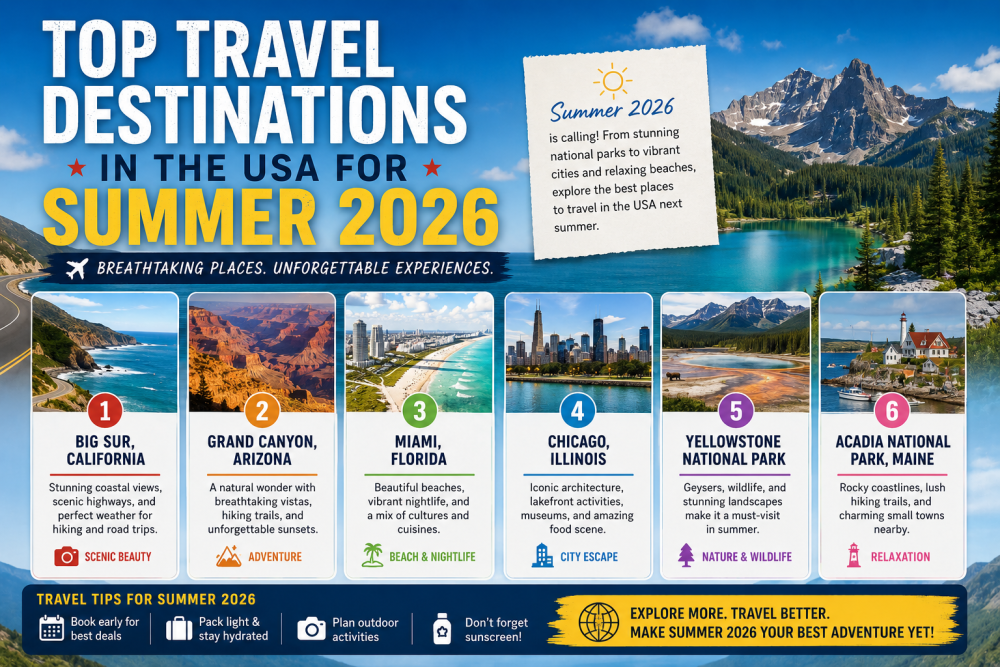
Miami, Florida: Sun, Culture, and More Layers Than You'd Expect
Miami has a reputation that precedes it: beaches, nightlife, South Beach, and the glittering excess associated with a certain kind of Instagram travel content. All of that exists. But Miami in 2026 is more interesting than any single description captures.
The Wynwood arts district, which began as a guerrilla street art project a decade and a half ago, has developed into one of the most vibrant creative neighborhoods in the US. The murals still dominate the exterior walls of warehouses and galleries. The restaurants, coffee shops, and independent stores that have opened around them reflect a genuinely creative local culture rather than a manufactured experience. In the Design District nearby, the world's best luxury brands sit alongside genuinely excellent art galleries and restaurants where the food justifies the prices.
Little Havana remains one of the most atmospheric neighborhoods in any American city. Walk down Calle Ocho on a Saturday and you'll find dominoes being played outside, live salsa music spilling from doorways, coffee being poured through ventanitas into tiny cups, and a cultural identity that hasn't been diluted despite the broader changes to the city around it.
The beaches themselves are genuinely beautiful—South Beach's white sand and turquoise water are the real thing, not just the marketing version. Mornings on the beach before 10 AM, before the crowds and the heat arrive at full force, are as pleasant as any coastal experience in the US.
Miami is a World Cup host city, and the combination of its existing international character, its large Latin American communities, and the influx of World Cup visitors will make it one of the tournament's most electric off-pitch environments. Argentina play their round of 32 fixture in Miami. The city will feel like a Copa América with a World Cup budget.
Asheville, North Carolina: The Sleeper That's Becoming Everyone's Favourite
Hilton's search data, which tracks year-over-year increases in searches for longer stays, flagged Asheville as one of the summer's biggest trending destinations for travelers looking to stay five days or more. That tells you something important: people aren't visiting Asheville for a weekend and leaving. They're building trips around it.
Nestled between the Blue Ridge Mountains and the Great Smoky Mountains, Asheville operates as a kind of cultural capital for the region—a mid-sized city (about 90,000 people) that somehow has the arts scene, food culture, and craft beverage scene of somewhere three times its size. The River Arts District has dozens of working artist studios open to the public. The downtown area, centered on Pack Square, has the walkability and variety that makes a small city feel genuinely alive rather than just functional.
The outdoor access is exceptional. Dozens of hiking trails are within 30-45 minutes of the city center. The Blue Ridge Parkway — one of America's great scenic drives — runs directly through the region, and the autumn section near Asheville is widely considered one of the most beautiful stretches of road in the Eastern US. In summer, the mountain elevation (approximately 2,100 feet) keeps temperatures notably cooler than the surrounding lowlands, making outdoor activity genuinely comfortable through most of the day rather than a pre-dawn commitment.
The food and drink scene consistently surprises people. Asheville has more craft breweries per capita than almost any city in the US, and the restaurant scene reflects the broader Southern Appalachian culinary tradition—serious about local ingredients, barbecue with multiple regional interpretations, and a farm-to-table culture that predates the trend.
For families, couples, and solo travelers with enough days to settle in, Asheville rewards slower travel better than almost anywhere else in the Eastern US. It's the kind of place that has a second restaurant you want to go back to before you've finished your meal at the first.
Yellowstone National Park: The American Original
Every US summer travel list has Yellowstone. There are good reasons for that, and there are good reasons to be practical about it.
The reasons it deserves its place are obvious to anyone who's been: the Grand Prismatic Spring is genuinely one of the most startling natural sights in the world—a thermal pool with concentric rings of color from orange to yellow to green that looks like something from a science fiction film. Old Faithful is the most famous geyser on Earth and does not disappoint. The Lamar Valley offers the best wildlife viewing in the contiguous United States — bison herds that fill valleys, wolves that were reintroduced in 1995 and have transformed the ecosystem, bears, elk, and pronghorn visible from the road with basic patience.
The practical reality of summer 2026 in Yellowstone is that the park is genuinely crowded. The Grand Loop Road sees traffic at levels that require serious planning: arrive early, be flexible about timing, and consider visiting the park's less-trafficked sections—the Bechler region in the southwest corner, the Gallatin corridor, and the northeast entrance via Cooke City—which offer comparable wilderness with a fraction of the visitors.
Booking accommodation and campsites in and around the park months in advance isn't optional; it's necessary. Same for the park entry reservation system, which has been active for several years and controls visitor volume at peak times. None of this should deter you. It should simply be part of how you plan rather than a reason not to go.
The Lamar Valley and the northern range of the park in the early morning—before 8 AM—are as close to experiencing a wild North American landscape as any easily accessible destination in the country.
A Note on the World Cup Effect
Eleven US host cities are carrying a particular energy this summer: Atlanta, Boston, Dallas, Houston, Kansas City, Los Angeles, Miami, New York/New Jersey, Philadelphia, San Francisco Bay Area, and Seattle. If your travel is flexible, the weeks when your nearest host city has matches scheduled are worth considering as travel windows — not because the matches themselves necessarily require attending (tickets are long sold out for most games) but because the city-wide atmosphere, fan festivals, and international crowds make for an unusually vibrant urban experience.
The 250th anniversary of the United States is also generating programming across major cities throughout the summer, with Washington, DC, and Philadelphia as focal points for the anniversary events. If American history is part of your interest, both cities have strong programming built around the anniversary.
Matching the Destination to What You Actually Want
Before booking anywhere, the honest question is what kind of summer experience you're after.
For iconic urban energy and flexibility with time zones and connections: New York, Miami, Los Angeles, Chicago.
For outdoor adventure and scenery that justifies the trip on its own: Yellowstone, Yosemite (best in June before peak crowds), Olympic National Park in Washington state, and the Southwest combination of Sedona, the Grand Canyon, and Monument Valley.
For a relaxed mid-sized city that rewards slower travel: Asheville, Savannah, Portland (Oregon), and Boulder.
For unbeatable value with serious city substance: Atlanta.
For World Cup energy combined with a proper destination: Miami, Dallas, Houston, or Los Angeles.
The US is large enough that any of these options can stand alone as a full trip or combine with others across a longer itinerary. That flexibility — the ability to pair a three-day city stay with a two-day national park detour within the same trip — is what makes summer in the United States particularly compelling in 2026.