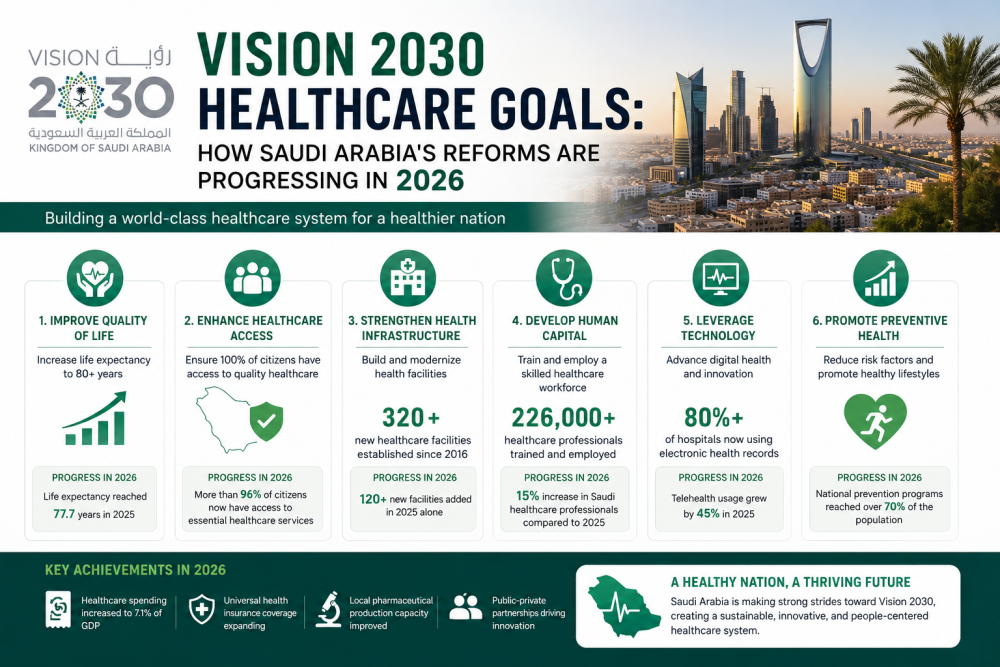
When Vision 2030 launched in 2016, the ambitions for healthcare were stated in bold, specific terms: transform a system historically dominated by government-funded hospitals and curative care into one built around prevention, primary care, private sector participation, and digital innovation. The target date is four years away. The question worth asking honestly in 2026 is how much of that transformation has actually happened, what the data shows, and where the genuine gaps remain.
The short answer: more progress than many external observers expected, in some areas significantly ahead of the original timeline and in others still catching up with where the ambition pointed.
The Numbers That Define Progress So Far
The 2025 Annual Report of the Health Sector Transformation Program, released in June 2026, provides the clearest current picture of where the Kingdom stands.
Life expectancy has risen to 79.7 years — approaching the Vision 2030 target of 80 years. For context, life expectancy in Saudi Arabia was 64 years in 1970. The compound improvement over five decades reflects investments in public health, sanitation, maternal and child health, and, increasingly, chronic disease management and prevention. Reaching 79.7 by 2025 puts the target practically within reach before 2030.
Primary healthcare coverage reached 97.5% of populated areas across all regions, including remote communities. That figure represents one of the program's most significant achievements and arguably its most equitable one—access to basic healthcare in areas that previously had limited or no provision. The 2.5% gap represents genuinely difficult-to-reach populations, and closing it entirely will require continued investment in mobile health units and telemedicine infrastructure.
Traffic-related deaths have declined by approximately 60% since Vision 2030 launched in 2016. This is one of those statistics that sounds administrative but represents thousands of people alive who might not have been. The campaign combined enforcement, infrastructure improvement, education, and trauma care investment into what became a genuinely effective public health intervention.
Health emergency readiness across regions hit 92% — achieving the 2030 target early. The Saudi government explicitly noted this as a goal met ahead of schedule, reflecting the infrastructure investment and pandemic-era learning that positioned the Kingdom to respond to health emergencies systematically.
Healthcare workforce: over 803,000 health practitioners are now operating in the system, with more than 35,000 physicians completing Saudi Board certification programs. The number of Saudi healthcare professionals has risen by 65% since Vision 2030 launched, addressing one of the structural dependencies the program specifically targeted: reducing reliance on expatriate healthcare workers to provide the core of clinical capacity.
The SEHA Virtual Hospital: A Genuine Innovation Story
Among Vision 2030's healthcare initiatives, the SEHA Virtual Hospital stands out as the one that has generated the most international attention—and rightly so.
Launched in 2022, SEHA has grown into the world's largest virtual hospital network, now connecting over 241 healthcare facilities and serving more than 365,000 beneficiaries. It offers over 30 specialized health services remotely, allowing patients across the Kingdom—including those in remote areas without access to specialist care—to consult with specialists without travelling to a major city.
The concept addresses a structural problem that Saudi Arabia shares with many large, geographically diverse nations: excellent specialist care concentrated in major urban centers (Riyadh, Jeddah, and Dammam) while patients in smaller towns and rural regions face significant barriers to accessing it. A virtual hospital that connects those patients with the same specialists that urban patients would see in person closes an equity gap that physical infrastructure alone could never fully address.
The clinical scope has expanded significantly since 2022. Initial services focused on telemedicine consultations and telestroke care. The network now includes teleradiology, remote monitoring of chronic conditions, ICU telemedicine allowing remote specialists to supervise critical care in hospitals that lack on-site intensivists, and specialist consultation pathways across cardiology, oncology, neurology, and maternal health.
The scale has also attracted interest from other countries exploring what a national virtual hospital infrastructure could look like. Saudi Arabia has positioned itself as something unusual for a country that has historically been a net importer of healthcare expertise: a knowledge exporter in digital health, with delegations from other nations studying the SEHA model.
The Digital Health Ecosystem: Apps, Data, and AI
Vision 2030 made digital transformation a core pillar of healthcare reform, and the results are visible in the platforms that Saudi citizens now use routinely.
The Sehhaty app has reached over 31 million users. The platform allows users to book appointments, access medical records, receive health reminders, manage chronic conditions, and access telehealth consultations. For a country of approximately 35 million people, that adoption rate is remarkable and represents a fundamental shift in how citizens interact with the healthcare system.
The Mawid appointment booking app processed tens of millions of bookings annually even in its early phases, and the adoption of digital scheduling across the Ministry of Health's network has reduced waiting times and improved no-show rates—two metrics that sound administrative but translate directly into how efficiently the system uses its clinical capacity.
On artificial intelligence, the Kingdom established the Saudi Data and AI Authority (SDAIA) to drive adoption across sectors, including healthcare. In practical terms, AI is being deployed in radiology (flagging anomalies in imaging), pathology (automating routine analysis), administrative functions (scheduling, billing, and patient flow management), and increasingly in predictive analytics—identifying patients at high risk of deterioration before they require emergency intervention.
The government has invested USD 1.5 billion specifically in health information technology, and 10 teleradiology enterprises have been established to deploy AI-assisted remote radiology services nationally. Surgical robotics, which improves precision and reduces recovery times, is being introduced in several major hospitals.
The Privatisation Agenda: Slower Progress, More Complexity
One of Vision 2030's most ambitious healthcare targets is the privatization of a substantial portion of the publicly operated healthcare system. The plan called for privatizing 290 hospitals and 2,300 health institutions, moving from a model where the government directly operates most clinical facilities toward one where private operators manage those facilities under regulated conditions.
Progress has been real but slower than the original timeline envisaged. The creation of the National Centre for Privatization and PPP and the Private Sector Participation Law established the legislative framework that investors need to engage confidently with the process. Several major public-private partnership agreements have been signed—the Ministry of Health granted Altakassusi Alliance Medical a PPP to improve radiology services at seven hospitals—and the Health Holding Company (HHC) has been established as the government entity that oversees the transition.
The challenge, as researchers and policy analysts note, is that healthcare privatization is genuinely complex to execute well. It requires supportive legislation (now in place), confidence from private investors (building), workforce development to ensure Saudi professionals are ready to work within private management structures (ongoing), and effective revenue cycle management to make private operations financially sustainable without reducing access for lower-income populations.
The kingdom's approach includes developing health clusters—integrated networks of hospitals and primary care centers managed as cohesive units rather than isolated facilities. This clustering model, which creates economies of scale and allows specialist resources to be shared across networks, is considered a more sophisticated model than simple privatization of individual hospitals.
Prevention and the Chronic Disease Challenge
One of the structural drivers of Vision 2030's healthcare agenda is the chronic disease burden that Saudi Arabia faces. Diabetes prevalence in the Kingdom is among the highest globally. Cardiovascular disease, obesity, and hypertension are significant public health challenges, partly a function of dietary change across a wealthy, urbanizing society over recent decades.
The Health Sector Transformation Program's prevention-first orientation is explicitly designed to address this. The logic is straightforward: every riyal invested in screening, vaccination, and chronic disease management is expected to yield multiples in avoided hospitalization costs. Prevention is not just the ethically preferable approach — it's the fiscally rational one in a system trying to be sustainable without indefinitely expanding government expenditure.
Primary healthcare centers are being expanded and upgraded to serve as the first point of patient contact, reducing unnecessary emergency department visits and hospital admissions. The goal is to shift the majority of healthcare encounters to community settings—clinics, primary care centers, and telehealth—rather than expensive tertiary hospital facilities where most care has historically been concentrated.
The Sehhaty app's preventive health features—screening reminders, chronic disease management programs, and vaccination scheduling—are part of this same logic: making prevention convenient enough that people actually engage with it.
Results in this area are harder to measure on a short timeline than coverage metrics or building projects. Chronic disease prevalence doesn't change in response to new primary care infrastructure quickly. But the foundation is being laid, and the investment in public health infrastructure is genuine.
Workforce Development: The Essential Variable
Healthcare systems are built by people, not just infrastructure, and the workforce development component of Vision 2030 has been one of its most sustained areas of investment.
The 65% increase in Saudi healthcare professionals since 2016 reflects a deliberate policy of expanding medical and nursing education capacity, raising the number of Saudi graduates entering clinical roles, and creating incentive structures that make healthcare careers attractive to Saudis who might otherwise pursue other sectors.
Saudi Board programs—structured postgraduate training pathways for physicians across specialties—have expanded significantly, with over 35,000 physicians completing training. This is the pipeline that produces the specialists the country's growing population will need over the next decade.
The ambition to reach a position where Saudi nationals form the core of the healthcare workforce—rather than being heavily dependent on expatriate professionals—is both a nationalization objective and a sustainability one. A healthcare system where clinical capacity depends heavily on foreign workers is vulnerable to external labor market conditions in ways that a predominantly Saudi system is not.
Healthcare workforce development is described by analysts as the area where "digital infrastructure is maturing faster than the workforce and institutional reforms, creating an asymmetry that policymakers will need to address." Digital tools, apps, and virtual hospitals can scale quickly. Training sufficient numbers of clinicians with appropriate specializations takes years. Closing that asymmetry is the next phase's central challenge.
Where Real Gaps Remain
An honest assessment of Vision 2030's healthcare progress also requires acknowledging where the challenges persist.
Non-communicable disease prevalence—diabetes, obesity, cardiovascular disease—remains high by regional and international standards. The prevention infrastructure is being built, but the behavioral change that prevention programs ultimately require takes time to manifest in population-level outcomes.
Mental health services remain underdeveloped relative to demand. Mental health carries cultural stigma in many societies, including Saudi Arabia, that affects both help-seeking behavior and investment levels. The Kingdom has been expanding mental health infrastructure, with digital platforms and telehealth expanding access, but it remains an area where the supply of services lags behind identified need.
Consistency of implementation across the country's diverse geography is a genuine challenge. What's available at a major hospital in Riyadh or King Faisal Specialist Hospital may not yet be standard practice at a regional facility in a smaller city. The health cluster model is designed to address this, but standardization across 290 hospitals and thousands of primary care centers is a long project.
The private sector investment pace has not matched the original ambitions on the timeline. Attracting private operators willing to manage public healthcare facilities at the scale envisioned requires building investor confidence over time, not just establishing legislation. That process is underway but ongoing.
The Regional Leadership Dimension
Saudi Arabia's healthcare transformation matters beyond its borders. The Kingdom's healthcare investment, its digital health infrastructure, and the SEHA model have positioned it as a regional benchmark at a time when health systems across the Gulf and broader Middle East are seeking models for their own modernization.
Saudi Arabia's healthcare system ranks 26th globally — a position that reflects the significant improvements of the past decade while also indicating the distance to the top tier that continued reform is aimed at closing. By 2030, the ambition is a system that compares favorably with OECD nations on both outcomes and efficiency metrics.
Against those OECD comparators, Saudi Arabia's progress on digital health adoption and virtual care infrastructure is genuinely impressive, though gaps remain in health outcomes metrics such as life expectancy, infant mortality, and non-communicable disease prevalence. The trajectory — where it came from and where it's heading — may matter more than the point-in-time ranking.
An Honest Summary of Where Things Stand
Four years from Vision 2030's target date, Saudi Arabia's healthcare transformation is real, substantial, and in several specific areas ahead of schedule. Life expectancy approaching the 80-year target. Healthcare coverage at 97.5% nationally. A virtual hospital network serving hundreds of thousands of patients. A digital health ecosystem used by tens of millions. A healthcare workforce 65% larger than it was in 2016.
The ambitions on privatization, chronic disease prevention, and workforce specialization depth have been slower to materialize than the infrastructure and digital investments, and those are the areas where the next four years will matter most.
What the Saudi healthcare transformation under Vision 2030 has demonstrated—regardless of where specific metrics sit relative to targets—is that a purposeful, adequately funded, strategically coordinated reform program can reshape a healthcare system faster than most comparable societies have managed. The program's trajectory through 2025–2026 confirms continued progress, with the more difficult, slower-burn elements of the reform still ahead.