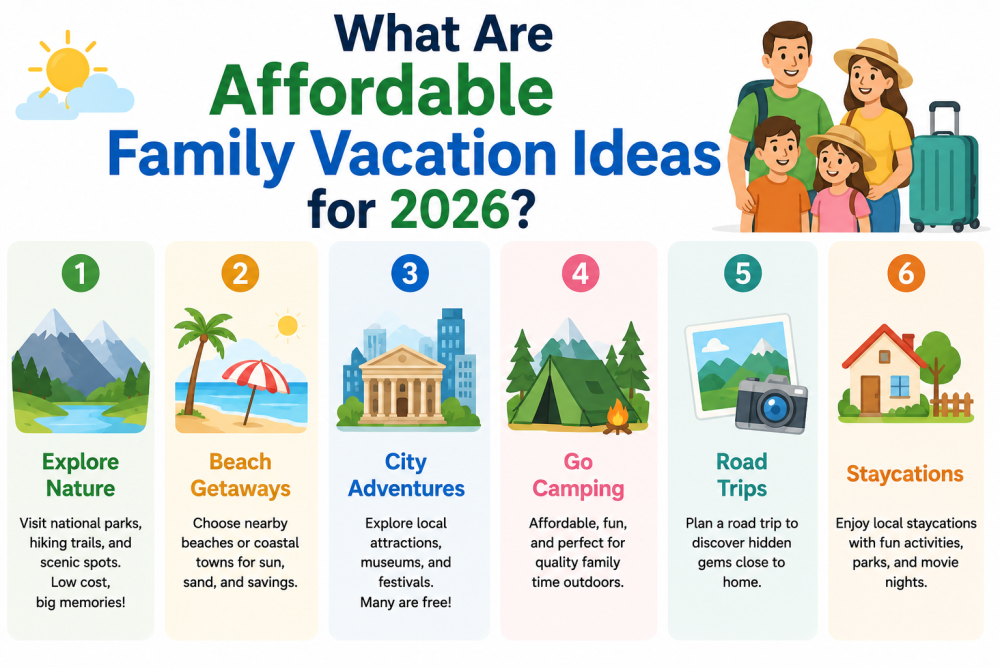
Family travel math is brutal, and nobody warns you: every cost gets multiplied by heads. The flight isn't $400; it's $1,600. Dinner isn't $30; it's $110 with a side of someone refusing to eat theirs. Which is why affordable family vacations aren't found by hunting deals on the same trip everyone takes; they're built differently from the ground up, around three levers that actually move the total: sleep somewhere with a kitchen, shrink the transport bill, and anchor the days around things that are free.
Every idea below runs on those three levers. Real trips, the kind kids remember better than the expensive ones anyway, ask any adult about their childhood vacations and count how many memories involve a hotel buffet versus a lake, a campfire, or the back seat of a long drive. Right then, the ideas, roughly the cheapest first.
The Parks and Cabins Tier: The Best Money in Family Travel
National and state parks, and their equivalents in Canada and the UK, remain the single best value proposition in all of family travel, and 2026 hasn't changed that. Entry costs are trivial; an annual America the Beautiful pass covers a US carload for the year for less than one theme park ticket, and the product is the actual best stuff on the continent: canyons, lakes, wildlife, beaches, mountains, and junior ranger programs that occupy children for hours, free.
Sleeping is where the versions split. Camping runs $20 to $40 a night for a family and, done honestly, is its own adventure; kids adore it disproportionately to its cost. The comfort upgrade, and the one I'd point most families at, is the cabin: state park cabins, forestry lodges, and their kin rent for $70 to $150 a night, sleep the whole family, and come with the kitchen that saves the food budget, which for a family of four runs to serious money over a week of restaurants. A week at a lake cabin, swimming and fires and board games, is the platonic, affordable family vacation, and the good ones book out months ahead; that's the one catch: plan early.
The Kitchen-First City Break
Cities and families can mix affordably under one rule: book the apartment, not the hotel rooms, plural, that a family now requires, and pick a city where the headline attractions are free.
The free-museum cities are the cheat codes. Washington DC's entire Smithsonian complex, air and space, natural history, the zoo cost nothing, ever, and London's great museums, Natural History, Science Museum, British Museum, Tate, run the same policy, meaning the two most expensive-sounding capitals hide some of the cheapest family days on earth once the bed is sorted. Add city parks, free walking, and the reliable delight of trains, ferries, and cable cars as attractions in themselves, and the pattern generalizes: one apartment with breakfast at home, packed lunches, one paid attraction per day maximum, dinner cooked or cheap, and a big city trip lands at a fraction of its reputation.
The Honest All-Inclusive Math
Here's where I defend something budget articles usually sneer at: for certain families, the all-inclusive resort is genuinely the affordable option, and pretending otherwise is bad arithmetic. When the price includes every meal, snacks, kids' clubs, and entertainment, a family that would otherwise bleed $150-plus a day on food and activities can come out ahead, especially with teenagers, who eat like a rugby squad, and especially off-peak.
The math works when it's booked for shoulder season, compared honestly against the true daily cost of the alternative, and located somewhere the flight doesn't erase the savings. For UK families, that's the Spain-Greece-Turkey belt, Turkey's family all-inclusives being maybe the best value in the Mediterranean; for Gulf families, Turkey's and Egypt's Red Sea resorts sit a short flight away at strong prices; for North Americans, Mexico and the Dominican Republic play that role. The all-inclusive fails the math when it's peak-week pricing or when your family would happily eat street food and explore anyway. Know which family you are.
The Big Swings That Cost Less Than They Look
House swapping and home exchange went properly mainstream in the past few years, and for families it's the closest thing to a cheat: your home for theirs, a membership fee of a hundred-something a year instead of thousands in accommodation, and you get a whole house, kitchen, toys, and sometimes a trampoline you'll wish was yours. It asks some trust and flexibility and repays it absurdly.
The overseas value play also deserves a family-shaped mention. We've covered Europe's budget destinations in depth on the site, and several of them are quietly perfect for kids: Albania's beach towns at half-Greek prices, Portugal's family-mad culture where children are welcomed everywhere, and Turkey's mix of beaches and bazaars and boats. The flight is the hurdle, so the rule from our travel guides applies double for families: let flight prices choose among your shortlist; a fare sale for four seats is the trip-deciding itself.
And the humble road trip is still the champion of memories per dollar: pick a loop, not a marathon, with two hours max between stops with kids; string together a lake, a weird roadside attraction, a state park cabin, and a small town with an ice cream situation, and you've built the vacation they'll describe at Thanksgiving in twenty years. Fuel plus cabins for a week undercuts a single day at a major theme park, which is not a coincidence this article is willing to leave unexamined.
Timing: The Lever Families Think They Don't Have
School calendars feel like handcuffs, but there's more slack than it seems. The shoulder edges of school breaks, the first days and last days, are priced softer than the middles. Half-term and spring windows beat summer peak by wide margins for the identical resort. Traveling Saturday-to-Saturday is often the most expensive possible pattern; midweek-to-midweek flights and rentals are priced kinder. And the counterintuitive one: for beach trips, early June and late August deliver summer at shoulder prices in most of the Northern Hemisphere, exactly when school calendars in many regions actually permit.
Book the sleep early; this is the theme of the whole article. Cabins, apartments, and family rooms are the scarce resources, while activities and food need no advance commitment at all. That's the family version of the booking rule, and it's worth more than any discount code.
The Bottom Line
Affordable family vacations in 2026 come from the three levers, kitchen, transport, and free anchors, applied to a handful of proven shapes: the park-and-cabin week at the top of the value table; the apartment-based free-museum city break; the honestly-matched all-inclusive for the families it genuinely suits; home exchange for the flexible; the value corners of Europe when flights cooperate; and the eternal road-trip loop. None require deprivation, most outprice the expensive alternatives, and all of them reward the same single habit: booking the beds early and letting everything else stay loose.
The expensive family vacation industry runs on the assumption that you won't do the math. Do the math. The lake was winning all along.
FAQs: Affordable Family Vacations
What is the cheapest family vacation that's actually good?
The state or national park cabin week, $70 to $150 a night, sleeps everyone; the park itself supplies world-class days for almost nothing, and the kitchen keeps food costs domestic. Camping halves even that if your family's game. It consistently produces the trips kids rank highest, which is the quiet scandal of family travel pricing.
Are all-inclusive resorts good value for families?
Sometimes, genuinely, yes, run the honest comparison. Off-peak, with big appetites and kids'-club-aged children, a package covering all meals and entertainment can beat the true daily cost of a "cheaper" trip. Peak-week bookings and families who'd rather explore and eat locally usually do better with an apartment and the kitchen-first approach.
How far in advance should families book for 2026?
Book the accommodation early and everything else late: family-sized cabins, apartments, and connecting rooms are the scarce inventory, three to six months ahead for summer and longer for famous parks. Flights reward fare-alert patience, and activities rarely need booking at all outside marquee attractions.
What are the best affordable overseas destinations for families?
For UK and Gulf families, Turkey leads the value table, all-inclusive strength, beaches, and genuine welcome for kids, with Egypt's Red Sea close behind for the Gulf and Albania as the adventurous bargain. For North Americans, Mexico beyond the marquee resorts and Portugal for the culture-plus-beach mix. In every case, let a flight sale for the whole family make the final call.
How can we save on food during a family vacation?
One structural choice does most of it: accommodation with a kitchen. Breakfast at home, packed lunches on the day's adventure, dinners split between cooking and one modest restaurant, and the grocery run on arrival as the first family activity. The difference over a week for four people typically exceeds what most families save through any amount of deal hunting.
Are theme parks ever affordable for families?
They can be contained: one day rather than the whole trip, shoulder-season dates, tickets through official advance pricing rather than gate rates, and food smuggled in where rules allow it, in the proud tradition. The affordable pattern treats a theme park as the single splurge inside a cheaper trip built on the other ideas here, not as the destination itself.