Somebody has to say this at the top of a passive income article, and it might as well be me: almost nothing on the internet labeled "passive income" is passive. It's either front-loaded work, your money working, or a job wearing a relaxing costume.
That's not a reason to close the tab. It's the reason to keep reading, because once you accept that trade, work now or capital now, income later, the genuinely good options sort themselves out fast, and the scams light up like warning flares. With little money, your currency is time and effort upfront. Fine. Let's spend it well.
Quick ground rules for what follows. "Little money" means under a few hundred dollars to start, and often zero. I'm ranking by honesty, meaning I'll tell you how passive each idea actually is and what it realistically pays, because a list without numbers is just a mood board. And the usual line, meant sincerely: I'm not a financial advisor, this is general information, and anything involving investing carries risk, size it accordingly.
The Only Truly Passive Tier
Two things on this entire list require essentially no ongoing work. Both involve your money, not your time, which is exactly why they make small money slowly.
High-yield savings accounts. Park cash in one and it pays you interest for existing. Rates in recent years have been the best in over a decade, and even as they drift, this remains the world's easiest income. The catch is arithmetic: meaningful monthly income needs meaningful principal. A thousand dollars might make you a few dollars a month. That's not a mockery, it's a start, and it's the correct home for your emergency fund anyway.
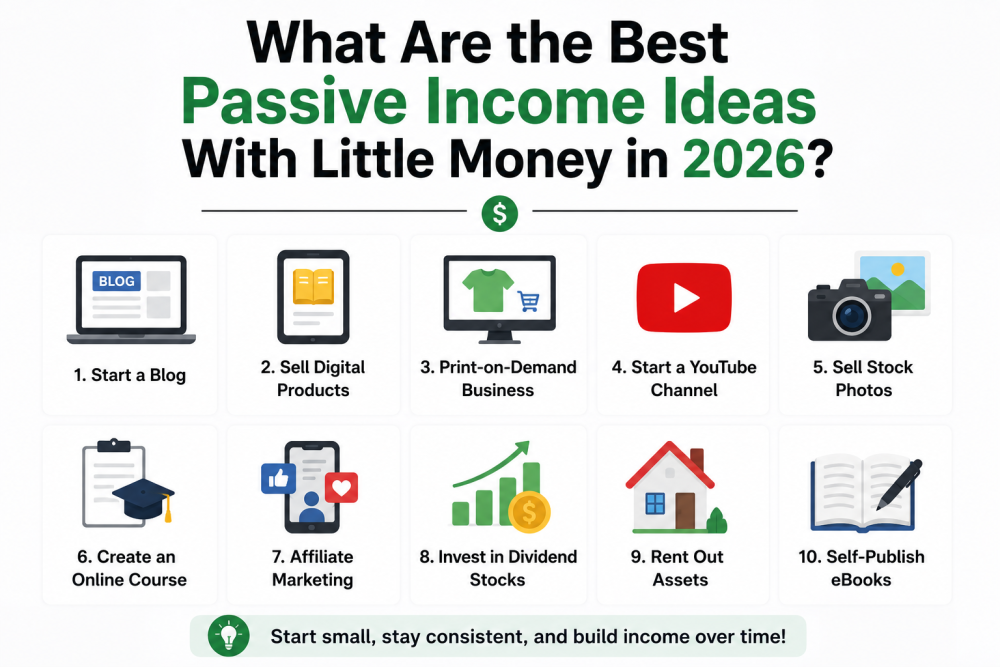
Dividend ETFs. A fund holding hundreds of dividend-paying companies, bought through any broker with no minimum worth mentioning, paying you a small percentage yearly, typically somewhere in the 2 to 4 percent range depending on the fund. Fifty dollars a month invested consistently becomes a real income stream, in about a decade. I know. But every large dividend portfolio you've ever envied started as exactly this, and the reinvest-and-wait years are the unskippable part. Prices fluctuate, dividends aren't guaranteed, and anyone who tells you otherwise is selling a course.
Notice the pattern of this tier: real, safe-ish, boring, slow. The rest of the article is about trading effort for better speed.
The Build-Once Tier, Where Little Money Goes Furthest
This is the heart of honest passive income for people without capital: make a thing once, sell it repeatedly, let the internet run the shop while you sleep. The work is real and front-loaded. The "passive" arrives in month six, not week one.
Digital products. Templates, planners, spreadsheets, presets, printables, sold on Etsy or Gumroad. The best niches are painfully specific, a budgeting spreadsheet for freelancers with irregular income beats a generic budget planner every time, because specific people search with their wallets out. Startup cost is roughly zero if you build with Canva or Google Sheets. Realistic arc: a shop with 15 to 30 good products, promoted a little, grinding toward a few hundred dollars a month within a year. The people making thousands exist and mostly got there by treating it as a real product business, not a weekend fling.
Stock photos, video clips, and design assets. If you already shoot or design, upload libraries earn drips per download, and the drips never fully stop. Emphasis on already, building the skill just to sell stock is the slow road.
Self-publishing on Kindle. Write once, sell forever, the purest version of the model and the most crowded. Nonfiction that solves a narrow problem outsells the novel you're imagining, and the authors earning real money treat it as a catalog game, several books compounding, not one lottery ticket.
And the content route, a niche blog or YouTube channel, which I include with an asterisk the size of a billboard. Yes, ad and affiliate income from content is the classic. It's also twelve-plus months of unpaid publishing before meaningful money, which makes it the least passive thing ever marketed as passive. Do it if you'd enjoy the making itself. The enjoying is the salary for year one.
The Rent-What-You-Have Tier
Underrated, immediate, and requiring no audience whatsoever: renting idle assets.
A spare room on Airbnb is the heavyweight, hundreds a month in many cities, semi-passive once your systems are set, and check your local rules first because cities increasingly have opinions. Your car on Turo when you're not driving it. Storage space, a garage, even a driveway near a stadium or a station, on platforms built for exactly that. Camera gear, tools, the paddleboard gathering dust.
None of this is fully passive, things break, guests message, cars need cleaning. But it monetizes stuff you already paid for, starts earning this month rather than next year, and the "little money" requirement is met by definition. For a lot of people this tier quietly out-earns everything else on the list in year one.
The Sprinkles Tier
Small, genuinely passive, not life-changing, worth stacking. Cash-back credit cards, if and only if you pay the balance in full, the interest otherwise erases years of rewards in a month. Round-up investing apps that skim your spare change into ETFs, painless and slow. Cash-back portals for shopping you'd do anyway. Individually trivial, collectively a nice dinner every month for zero effort. Just don't mistake sprinkles for the meal.
The Traps, Because 2026 Is Full of Them
The phrase "passive income" is bait on half the internet, so here's the field guide.
Anything guaranteeing returns. Guaranteed plus high yield equals scam, in every decade, in every asset class, no exceptions you'll be the lucky one on. Crypto staking and yield platforms promising double-digit "passive" returns sit high on this list, ask the customers of the several that froze withdrawals and vanished. MLMs, where the passive income is your upline's, funded by you. Courses about passive income costing $500 to $2,000, sold by people whose actual passive income is selling courses about passive income, the snake eating its own tail as a business model. And "done-for-you" stores or automation services, where you pay thousands for someone to allegedly run an Amazon or dropshipping empire on your behalf, a category with an FTC complaint file thick enough to stop a door.
The tell is always the same: real passive income asks for your effort or your patience. Scams ask for your money and promise you can skip both.
What I'd Actually Do With $100 and Ten Hours a Week
Because principles without a plan are just vibes. Open the high-yield savings account today, that's the emergency fund's new home earning its keep. Start the $25-or-whatever weekly auto-buy into a broad dividend ETF, then genuinely forget it exists. Then spend the ten weekly hours building one, exactly one, thing from the build-once tier, picked by matching what you can already make to a specific audience you understand. Twelve products in the shop by summer. And if you've got a spare room, a car that sits, or a garage, list it this week, that's the fastest hundred-plus a month available to you and it requires no building at all.
Check back in a year. The savings and ETF will have done their small honest work, the rental income will have paid for itself many times over, and the digital product shop will either be growing into something real or will have taught you precisely what to build instead. That's the portfolio version of passive income, and it's the only version that reliably exists.
The Bottom Line
The best passive income ideas with little money in 2026 come in four honest flavors: interest and dividends, truly passive, growing at the speed of your deposits. Build-once digital assets, products, books, content, where effort now buys income later. Renting what you already own, the fastest real money on the list. And the small automatic stuff, cash-back and round-ups, stacking quietly in the background.
Everything promising to skip both the effort and the waiting is selling you the dream as the product. Pick one thing from each tier you can start this month, give the building tier a real year, and let boring compound into something that pays you while you sleep, eventually, which was always the honest version of the promise.
FAQs: Passive Income With Little Money
What is the most passive income idea that needs the least money?
A high-yield savings account, which pays interest on any balance with zero effort, followed by dividend ETFs bought in small recurring amounts through any free brokerage. Both are genuinely passive; both scale with how much you put in, so with little money they start small and grow with your deposits.
How much money can beginners realistically make?
Honest ranges for year one: a few dollars monthly from savings interest and dividends on a small balance, potentially a few hundred monthly from a well-run digital product shop after months of building, and often the most, a hundred to several hundred monthly, from renting a spare room, car, or storage space. The four-figure-months screenshots you see online are either years in or fiction.
Is passive income from blogging or YouTube still worth it in 2026?
Only if you'd enjoy the creating itself, because meaningful income typically takes a year or more of consistent unpaid publishing first. It remains one of the highest-ceiling options and the single least passive one on any honest list. Treat the first year as building an asset, not earning an income.
What passive income scams should I avoid?
Anything with guaranteed high returns, crypto platforms promising double-digit yields, MLMs, expensive courses teaching passive income, and done-for-you automated store services. The common thread: they ask for money upfront and promise you can skip both the effort and the waiting, which is precisely what real passive income never lets you skip.
Can I build passive income with no money at all?
Yes, through the build-once tier: digital products made with free tools, self-published ebooks, a blog or channel built on free platforms. The cost is time instead of money, typically six to twelve months of consistent effort before income arrives. With zero budget, your effort is the investment, so aim it at one specific project rather than scattering it.
How long until passive income replaces a salary?
Longer than the internet implies. Stacking several streams, investments compounding, a digital product catalog maturing, an asset or two rented out, replacing a full salary typically takes years of consistent building, not months. The realistic near-term goal is a few hundred extra monthly within a year, which is genuinely life-easing, and the foundation the bigger numbers grow from.