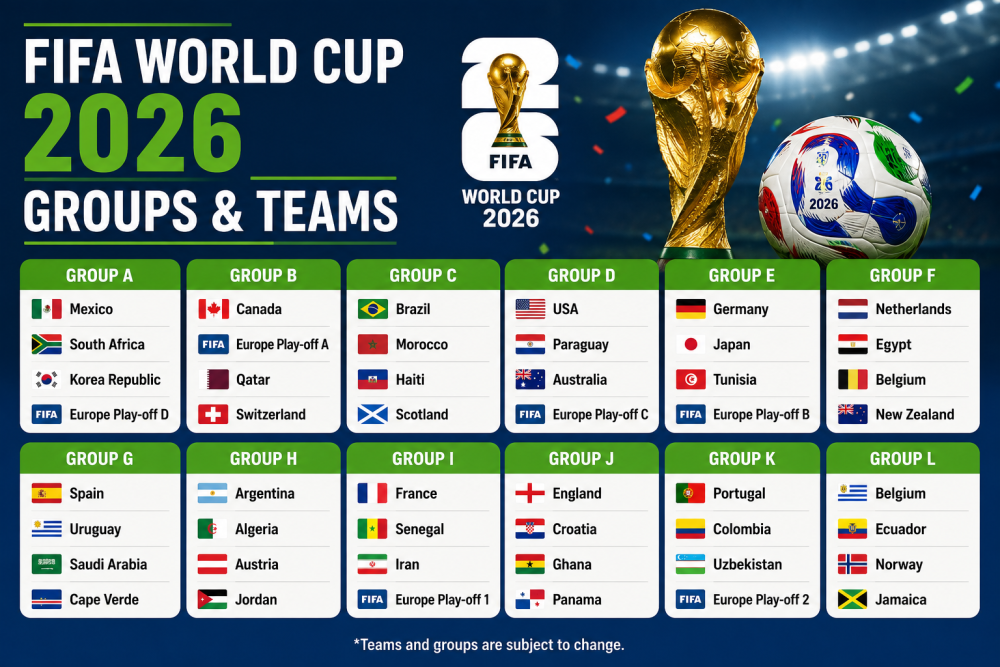
Twelve groups, 48 teams, 72 matches, and now that the group stage has fully resolved and the tournament stands at its final week, here's the complete reference: every group's final table, who advanced through the top-two lane and the third-place cutline, and the stories the standings tell: three perfect records, one team reaching the knockouts without winning a match, and a group where the top two never lost.
All standings below are the verified final tables. For what happened next, the knockout drama that followed, our favorites and players guide the bracket through to this week's semi-finals.
Groups A-D: Hosts' Territory
Group A belonged utterly to Mexico: three wins from three, nine points, and the only host to sweep its group, with South Africa advancing second on 4 points and Korea Republic (3) and Czechia (1) going home. The Estadio Azteca's tournament opened with the home side looking like contenders, a story that lasted until a five-goal classic in the round of 16.
Group B went to Switzerland, unbeaten on 7, with host Canada second on 4, edging Bosnia and Herzegovina, also 4, on the tiebreakers, with Bosnia advancing anyway through the third-place lane, and Qatar finishing bottom with 1.
Group C produced the group stage's heavyweight duel: Brazil and Morocco both finished on 7 points, unbeaten, separated only by tiebreakers for the group crown, with Scotland (3) and a winless Haiti behind them. Both giants advanced, and remarkably, both were gone by the quarterfinals: Brazil to Norway in the shock of the tournament and Morocco after eating one host and meeting France.
Group D saw the USA top the table on 6 points despite a defeat, ahead of Australia (4) and Paraguay (4), with Türkiye's 3 not enough. Paraguay's third place carried them into the knockouts, where France awaited; the USA's group win bought a home round-of-16 date with Belgium that went very wrong, 4-1 wrong.
Groups E-H: The Draws Festival
Group E finished with Germany and Ivory Coast level on 6 points, Germany taking the group on tiebreakers despite a defeat each, Ecuador's 4 sending them through third, and tournament debutants Curaçao is taking a point home with pride.
Group F belonged to the Netherlands, unbeaten on 7, with Japan second on 5, having never lost, two wins' worth of draws, and Sweden's 4 enough for the third-place lane while Tunisia went home without a point.
Group G was the strangest table of the twelve: Belgium won it with a single victory, 5 points from one win and two draws; Egypt matched the 5 and advanced second; and Iran drew all three matches, three draws, 3 points, a perfectly symmetrical group stage that left them sweating the third-place mathematics. New Zealand's 1 point closed the group.
And Group H produced the tournament's great overachiever: Spain won it unbeaten on 7, as champions should, but second place went to Cape Verde, the islands of half a million people, on three draws and 3 points, ahead of Uruguay and Saudi Arabia, both on 2, meaning the Cape Verdeans reached a World Cup knockout stage without winning a single match, and two former finalists in Uruguay couldn't catch a team that never beat anyone. Football's arithmetic has rarely been more charming.
Groups I-L: The Perfect Records and the Powers
Group I was France at full cruise: nine points, three wins; Norway's 6, built on the Haaland-Ødegaard engine, was comfortably second; Senegal's 3 fell short; and Iraq was pointless. Norway's second place, of course, was merely the prologue to their round-of-16 demolition of Brazil.
Group J matched it: Argentina perfect on 9, the defending champions strolling; Austria and Algeria level on 4 behind them with Austria taking second on tiebreakers and Algeria advancing third anyway; and Jordan's debut ending at zero points but with the photographs of a lifetime.
Group K went to Colombia, unbeaten on 7, over Portugal, who advanced second on 5 without losing, with DR Congo's 4 squeezing into the third-place lane and Uzbekistan's debut ending pointlessly. Portugal's reward for the cautious group: Spain in the round of 16, an Iberian derby the Spanish edged 1-0.
And Group L: England on top, unbeaten, 7 points; Croatia second on 6; Ghana third on 4 and through the back door; Panama pointless. England's group win set up the host-slaying run, Mexico, then Norway, that has them in tomorrow's semifinal against Argentina.
The Third-Place Cutline, Explained
The format's novelty, covered fully in our 48-team format guide, resolved like this: twelve third-place teams, eight tickets. The seven teams who finished third on 4 points, Bosnia, Paraguay, Ecuador, Sweden, Algeria, DR Congo, and Ghana, all advanced, and the eighth ticket came down to the 3-point third-placers, Korea, Scotland, Iran, and Senegal, separated by goal difference on the final table, with Uruguay's 2 points never in the conversation. The final match day spectacle of teams calculating their survival across six simultaneous groups was exactly the chaos the format promised and, as the format guide argues, mostly the good kind.
The headline arithmetic of the whole stage: three perfect records (Mexico, France, and Argentina); five unbeaten group winners besides; two teams through without a win between them (Cape Verde's three draws and Iran drawing all three only to sweat the cutline); and 32 of 48 teams surviving to the knockouts, exactly the two-thirds the expanded format was built to deliver.
Where It All Led
For the reference's completeness, the arc since the round of 32 and 16 removed all three hosts, Canada to Morocco, Mexico to England, and the USA to Belgium, plus Brazil to Norway; the quarterfinals then cleared Morocco, Belgium, Norway, and Switzerland, and the final four stand as France-Spain and England-Argentina, semifinals this week, and the final at MetLife on July 19. The groups above are where every one of those stories started, which is what makes the tables worth keeping: Cape Verde's three draws, Norway's quiet 6 points behind France, and England's unbeaten cruise—all of it reads differently now than it did in June.
The Bottom Line
The FIFA World Cup 2026 groups, finally tallied: Mexico, Switzerland, Brazil, USA, Germany, Netherlands, Belgium, Spain, France, Argentina, Colombia, and England won groups A through L, with Mexico, France, and Argentina perfect on nine points; Cape Verde authoring the great overachievement; and the third-place lane waving through the seven four-point finishers plus one survivor of the goal-difference mathematics. Forty-eight teams arrived, thirty-two advanced, and four remain.
Bookmark the tables; they're the tournament's foundation document, and follow the rest of the story through our favorites, players, and trip guides as the biggest World Cup ever staged plays its final week.
FAQs: World Cup 2026 Groups
Who won each group at the World Cup 2026?
A through L: Mexico, Switzerland, Brazil, USA, Germany, Netherlands, Belgium, Spain, France, Argentina, Colombia, and England, with Mexico, France, and Argentina posting perfect nine-point records and Switzerland, Brazil, the Netherlands, Spain, Colombia, and England winning their groups unbeaten.
How many teams advanced from the 2026 group stage?
Thirty-two of the forty-eight, the top two from each of the twelve groups plus the eight best third-placed teams, ranked against each other by points and goal difference, exactly two-thirds of the field, as the expanded format was designed to deliver. The full mechanics live in our 48-team format guide.
Which team advanced without winning a match?
Cape Verde, the tournament's great overachievers: three draws in Spain's Group H, 3 points, and second place ahead of Uruguay and Saudi Arabia, sending the island nation into a World Cup knockout stage without a single victory. Iran matched the three-draws feat in Group G but finished third and had to sweat the cutline mathematics.
Did any host nation win its group?
All three did, in fact, top their groups: Mexico perfectly with nine points; the USA with 6; and Canada, second in Group B behind Switzerland, was the exception, advancing as runner-up. The symmetry that followed was crueler: all three hosts exited in the round of 16, to England, Belgium, and Morocco, respectively.
How did the best third-place teams qualify?
All twelve third-placed teams were ranked in one table, points first, then goal difference and goals scored. The seven who finished on 4 points, Bosnia, Paraguay, Ecuador, Sweden, Algeria, DR Congo, and Ghana, advanced together, and the eighth spot was decided on goal difference among the four 3-point teams: Korea, Scotland, Iran, and Senegal.
Which group was the hardest at the World Cup 2026?
By the final tables, Group C's Brazil-Morocco duel, both unbeaten on 7 points and both genuine contenders, produced the strongest top two, while Group E (Germany and Ivory Coast, level on 6) and Group L (England and 2018 finalists Croatia) ran it close. The retrospective answer is crueler: whatever Norway's Group I lacked fame; it made up for by containing the team that would eliminate Brazil.