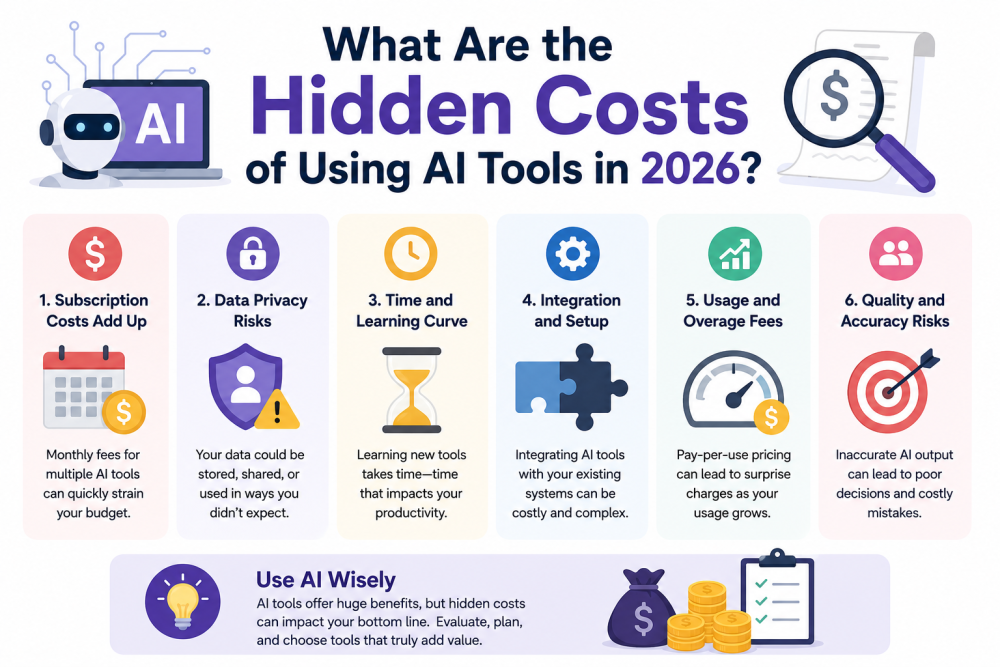
The pricing page says $20 a month. The pricing page is not lying, exactly. It's just answering a much smaller question than the one you're asking.
Because the real cost of AI tools in 2026, for a small business, a freelancer, a content operation, anyone using this stuff seriously, sits mostly off the invoice: the subscription pile that grows while nobody's counting, the hours spent checking work that arrived looking finished, the quiet dependency on a vendor who can reprice you at will, the data you fed into something you didn't fully read the terms of. None of it appears at checkout. All of it appears eventually.
This isn't an anti-AI article, we use these tools daily and they earn their keep, it's a full-invoice article. Seven costs the pricing page skips, what each one actually runs, and the cheap habits that contain them. Consider it the conversation the vendor's sales deck schedules for never.
Cost One: Subscription Sprawl, the Quiet Multiplier
Nobody buys eleven AI subscriptions. Everyone ends up with eleven AI subscriptions. It happens one reasonable decision at a time: the assistant, then the image tool, the transcription thing, the SEO add-on, the video one you used twice, the "AI features" tier your existing software quietly moved you onto. Twenty dollars here is nothing. Twenty dollars, nine times, forever, is a part-time salary in some of the countries this site serves.
The containment is boring and works: a quarterly audit, one line per tool, what it costs, when you last genuinely used it. The standing rule from our AI tools guide applies, adopt one tool at a time and cancel anything untouched in 30 days, and the overlap check matters more than the price check, because in 2026 half these tools do each other's jobs, and you're often paying twice for one capability wearing two logos.
Cost Two: The Verification Tax
Here's the one nobody budgets, and it's frequently the biggest. AI output arrives looking finished. Looking is the operative word. The model states wrong things with the same confident fluency as right things, invented statistics, misremembered rules, plausible nonsense in a nice suit, so every serious use carries a checking cost: reading the contract summary against the contract, testing the code, verifying the numbers before they reach a client.
That tax is real time, and worse, it's skippable, which is precisely the trap. Skip it and nothing happens, nothing happens, nothing happens, and then something happens, the wrong figure in a proposal, the fabricated citation, the confidently wrong tax answer, and the cleanup bill dwarfs every hour the tool ever saved. The honest accounting: AI turns six hours of drafting into two hours of drafting-plus-checking, a genuine win, but the vendors sell it as six-to-zero, and businesses that believe them are running on borrowed luck. Budget the checking. It's not overhead on the savings, it's the price of them.
Cost Three: Usage Pricing, Where Bills Learn to Surprise
Flat subscriptions are the tame part. The wild part is usage-based pricing, API calls, per-resolution support bots, credits, tokens, "compute", where the bill scales with activity and nobody's watching the meter. Every developer has a story about the automation that ran all weekend; every operations person has met the support agent whose per-conversation pricing looked cute until volume tripled.
Usage pricing isn't a scam, it's often the fairest model going, but it converts a fixed cost into a variable one, and variable costs need what fixed ones don't: alerts, caps, and a monthly five-minute look at the dashboard. Set the spending alert the day you set up the tool, not the day after the surprise. Every serious platform offers one. Almost nobody turns it on.
Cost Four: The Data You're Paying With
Some of the cost isn't money. Consumer tiers of AI tools have historically fed your inputs back into training by default, and while business tiers generally exclude that, "generally" is carrying weight, the terms differ by vendor, by tier, sometimes by toggle buried three menus deep. Feed a consumer chatbot your client list, your contracts, your customers' personal details, and you've paid with something you can't refund, and possibly stepped on privacy law while doing it, GDPR and its cousins do not care that the tool was convenient.
The containment costs nothing but attention: business tiers for business data, the training-exclusion box actually checked, a plain one-line team rule about what never gets pasted anywhere, customer personal data, credentials, anything contractually confidential. Ten minutes of policy against a breach-shaped bill. The exchange rate on that has never been better.
Cost Five: Lock-In and the Rising Floor
Two slow costs that compound quietly. Lock-in first: build your workflows, prompts, automations, and team habits around one vendor, and switching later costs weeks even when a better-cheaper rival appears, which, in this market, is roughly quarterly. You can't avoid lock-in entirely, and shouldn't try, standardizing is where the productivity lives. You can keep it shallow: your data exportable, your prompts and processes documented somewhere that isn't inside the tool, your critical workflows using standard formats a rival could ingest.
Then the rising floor: this industry's prices have moved one direction, the feature you use most has a habit of migrating to a higher tier, and the introductory price you signed at is a courtship, not a marriage. Treat any AI line item as likely to cost more next year, and re-run the "is this still worth it" math at each renewal instead of letting it auto-roll. The auto-renewal is where sprawl and the rising floor shake hands.
Cost Six: The Skill You Stop Practicing
The awkward one, and it deserves adult discussion rather than panic. Lean on AI for all first drafts and your drafting muscle softens. Let it write all the code and debugging skills fade exactly when you need them, which is the day the AI's code breaks. Junior staff who never do the grunt work never build the judgment the grunt work was secretly teaching. None of this argues for abstinence, calculators didn't end arithmetic, but the businesses handling it well are deliberate: humans stay in the loop on judgment tasks, juniors still do reps on fundamentals, and the AI handles volume, not the whole craft. The cost of ignoring this is invisible for a year and structural after three.
Cost Seven: The Slop Discount
Last one, specific to anyone publishing or client-facing: undisclosed, unedited AI output has a market price, and it's falling. Readers bounce off it, clients push back on paying human rates for it, and platforms keep tuning against the mass-produced version of it. The cost isn't using AI, it's shipping the raw feed, and it gets paid in reputation, the currency with the worst exchange rate back. The fix is the same edit-and-add-experience discipline we've written about elsewhere on the site, which, conveniently, is also what the verification tax already bought you. The two costs share a receipt.
The Bottom Line
The full invoice for AI tools in 2026 reads: the visible subscriptions, plus sprawl across forgotten ones, plus the verification tax on everything that matters, plus variable usage bills, plus data risk, plus shallow-or-deep lock-in on a rising price floor, plus slow skill erosion, plus the reputational discount on unedited output. Written out like that it sounds damning. It isn't, the tools still win the math for most serious users, sometimes enormously.
But they win it the way any powerful tool does: for operators who count everything. Audit quarterly, budget the checking time, set the usage alerts, keep business data on business tiers, document your workflows outside the tool, keep humans on judgment, and edit what ships. That's the whole discipline, an hour a month, roughly, and it's the difference between AI as leverage and AI as a subscription-shaped leak with excellent marketing.
FAQs: The Real Cost of AI Tools
What is the biggest hidden cost of AI tools?
For most serious users, the verification tax: the human time spent checking AI output before it's trusted, since models state errors as fluently as facts. It's rarely budgeted because the output looks finished on arrival, and skipping it works right up until one unchecked error costs more than the tool ever saved.
How much do AI tools really cost a small business per month?
The visible stack for a typical small business runs $50 to $200 monthly, but the honest total adds sprawl (unused subscriptions surviving on auto-renewal), any usage-based billing, and the labor hours of checking output. A quarterly audit of tools against actual use is the single cheapest way to keep the real number near the visible one.
Is my business data safe in AI tools?
It depends on tier and terms, not on the brand: business plans generally exclude your data from training while consumer tiers may not, and the details vary by vendor. The working rules: business tiers for business data, training-exclusion settings checked rather than assumed, and a standing team policy that customer personal data, credentials, and confidential material never go into consumer tools.
How do I avoid surprise bills from usage-based AI pricing?
Set spending alerts and caps the day you adopt the tool, both are standard features and almost universally ignored, and check the usage dashboard monthly. Usage pricing is fair but variable, and variable costs surprise precisely the businesses that treat them as fixed.
Does using AI make my team less skilled over time?
It can, if AI absorbs the tasks that were quietly building judgment, drafting, debugging, doing the fundamentals. The businesses avoiding it are deliberate: juniors still do foundational reps, humans keep the judgment calls, and AI handles volume rather than the entire craft. Treated that way, the tools raise a team's ceiling instead of lowering its floor.
Are AI tools still worth it despite these costs?
For most serious users, clearly yes, the time savings are real and often large. The point of counting hidden costs isn't to abandon the tools, it's to keep the math honest: budget the checking time, audit the subscriptions, contain the data and lock-in risks, and the leverage stays leverage. The users who lose money on AI are almost always the ones who only read the pricing page.