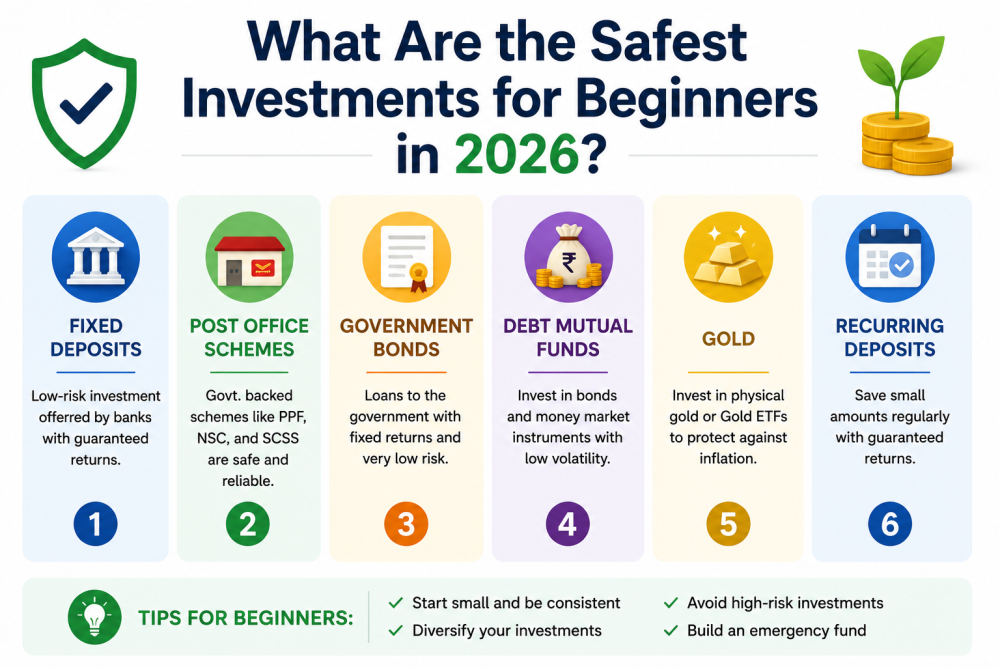
The safest investments for a beginner in 2026 are the unglamorous ones your grandmother would recognize: a high-yield savings account, government-backed bonds and treasury bills, certificates of deposit, and money market funds. Nothing in that sentence will make you rich, and everything in it will still be there next year, which is precisely the point of the word "safe."
But here's the thing this article has to do that most don't bother with: define safe honestly. Because the finance internet uses "safe" to mean whatever it's selling this week, and beginners get hurt in the gap between the word and the reality. So we'll rank the genuinely safe stuff, name its one hidden enemy, explain where index funds fit, they're the most recommended beginner investment on earth and they are not "safe" in the short run, and finish with the traps wearing safety costumes.
The disclaimer, stated plainly because it matters: I'm not a financial advisor, this is general information for education, not a recommendation for your specific situation, and rules, rates, and account types differ between the US, UK, Canada, and the Gulf. For decisions involving serious money, a licensed advisor in your country beats any article, including this one.
What "Safe" Actually Means, and Its Hidden Enemy
An investment is safe to the degree your money comes back. By that measure, the safest things on earth are backed by governments and large insured banks, and the ladder below is ordered exactly that way.
But every safe investment shares one quiet enemy: inflation. Money sitting in a truly safe place grows slowly, and if prices rise faster than your interest, you're losing buying power while the balance grows, the most polite form of losing money ever invented. This is the trade at the heart of all investing: the safest options protect your money from loss while exposing it to inflation; growth options fight inflation while exposing you to losses. A beginner's real job isn't picking the one perfect vehicle. It's putting different money in different places based on when you'll need it. Hold that thought, the whole article rests on it.
The Safety Ladder, Rung by Rung
High-yield savings accounts sit on the top rung. Deposit-insured in most of our readers' countries, up to the local coverage limit, instantly accessible, and, in the rate environment of recent years, paying interest that would have looked fantastical a decade ago. This is where your emergency fund lives, full stop, three to six months of expenses, before a single dollar goes anywhere more adventurous. The emergency fund isn't an investment. It's the thing that stops you from selling investments at the worst moment.
Government securities come next: treasury bills and bonds in the US, gilts in the UK, and their equivalents elsewhere, loans to your government, which repays with the reliability that makes them the global benchmark for "risk-free." Short-term bills in particular have become a beginner favorite, small minimums, terms of a few months to a year, and rates competitive with the best savings accounts. Buy them directly through government platforms or via funds in any brokerage.
Certificates of deposit, fixed deposits in much of the world, are the same idea through a bank: lock money for a fixed term, receive a fixed rate, insured up to the limit. The lock is the feature and the cost, break it early and you forfeit interest. Good for money with a known date attached, the car you're buying next spring, the fees due in a year.
Money market funds round out the safe tier, funds holding ultra-short government and bank paper, paying competitive short-term rates with next-day access. Not deposit-insured in the way accounts are, but conservatively run and widely used as the cash-parking spot inside brokerage accounts.
That's the safe list. Genuinely, that's it. Notice what isn't on it.
Where Index Funds Fit, the Honest Version
Every credible voice tells beginners to invest in broad index funds, and every credible voice is right, and "safe" is still the wrong word for them, and both things are true at once. Let me untangle it.
A broad index fund, one purchase holding hundreds or thousands of companies, is the sane way to own the stock market: no picking winners, tiny fees, automatic diversification. Over long periods, decades, the diversified stock market has historically outgrown every safe option and beaten inflation, which is why it's the standard engine for retirement money.
But over any short period, it can and does fall, sometimes 20, 30 percent or more, and it makes no promise about being back by the date you need it. That's not a flaw, that's the price of the higher returns. Which produces the only rule a beginner needs: money you'll need within a few years belongs on the safety ladder above; money you won't touch for many years can ride in index funds, ideally drip-fed in monthly, the dollar-cost averaging habit that removes timing decisions and their regret. Many countries sweeten the long-term deal with tax-advantaged wrappers, retirement accounts in the US, ISAs in the UK, TFSAs in Canada, worth using before ordinary accounts, and worth ten minutes of reading in your country's specifics.
So the honest sentence reads: index funds are the best long-term investment for most beginners, and the safety ladder exists for every dollar that can't wait that long.
The Traps Wearing Safety Costumes
Now the section your future self thanks you for, the things routinely marketed to beginners as safe that aren't.
Anything with "guaranteed" high returns. Real guarantees pay modest, boring rates, because that's what safety costs. Guaranteed 1 percent a month is not an investment, it's a scheme with your name in its ledger, whatever asset it claims to hold.
Crypto sold as savings. Whatever you believe about crypto's future, its defining feature is violent price movement, which is the exact opposite of the job safe money does. Yield platforms promising steady interest on crypto deposits have a well-documented habit of freezing withdrawals on their way to bankruptcy court. Speculate if you choose, knowingly, with money you can lose, never with the emergency fund.
Single stocks as a starting point. Even wonderful companies halve in value from time to time, and a beginner's first experience shouldn't depend on one boardroom's decisions. The index fund exists precisely so you never have to be right about individual companies.
And complexity itself. Options, leverage, forex signals, anything a stranger on social media is excited to teach you, the safest response to complexity aimed at beginners is a closed tab. Nobody with a genuine money-printing machine sells seats to it.
Putting It Together: A Beginner's Order of Operations
The sequence, because order matters more than selection. Clear any expensive debt first, paying off a 20-something percent credit card is the best guaranteed return you will ever see, nothing on this page competes. Build the emergency fund in a high-yield savings account. Sort money by date: anything needed within a few years goes to the ladder, savings, treasuries, CDs, matched to when you'll need it. Then, and only then, start the long game: a broad index fund, inside your country's tax-advantaged wrapper if one exists, fed automatically every month, ignored heroically thereafter.
That sequence is boring and it is bulletproof, and boring-and-bulletproof is the entire promise of the word "safest."
The Bottom Line
The safest investments for beginners in 2026 are the insured and government-backed tier: high-yield savings, treasury bills and their local cousins, certificates of deposit, money market funds, with the honest footnote that their safety costs growth, and inflation collects that cost quietly. Index funds are the long-term answer, powerful and genuinely not safe over short horizons, which is why the sorting rule, safe money for near dates, market money for far ones, does more for a beginner than any product pick.
Start with the debt and the emergency fund, sort the rest by date, automate the long game, and walk past everything guaranteed, glamorous, or complicated. Safe investing isn't a secret. It's a sequence, and now you have it.
FAQs: Safe Investing for Beginners
What is the single safest place for my money in 2026?
A deposit-insured high-yield savings account, up to your country's insurance limit, with short-term government securities effectively tied for the crown. Both return your money with near-certainty; both grow it slowly, which is the unavoidable price of that certainty.
Are index funds safe for beginners?
They're the standard long-term recommendation and the wrong tool for short-term money, both at once. Broad index funds fall hard from time to time, 20 to 30 percent drops are normal history, not disaster, but have historically outgrown safe options over decades. The rule that reconciles it: only money you won't need for many years belongs there.
How much money do I need to start investing safely?
Almost none in 2026. Savings accounts have no meaningful minimums, government securities sell in small denominations, and most brokerages offer fractional index fund investing from a few dollars monthly. The barrier isn't money, it's sequence: expensive debt cleared and an emergency fund built come before the first invested dollar.
Is crypto a safe investment in 2026?
No, and it isn't trying to be. Crypto's defining trait is extreme price swings, which disqualifies it from the job safe money does, whatever its long-term prospects. Treat any crypto involvement as speculation with money you can afford to lose, and treat platforms promising steady "interest" on crypto deposits as the red flag their track record has earned.
What returns should I expect from safe investments?
Modest ones that roughly track your country's interest rates, in recent years, meaningfully better than the near-zero of the 2010s, but still in low single digits. If someone promises safe double-digit returns, the word doing the lying is "safe." The realistic goal for the safe tier is protecting money and keeping pace with inflation, while long-term index investing does the growing.
Should I pay off debt or invest first?
High-interest debt first, always, paying off a credit card charging 20-plus percent is a guaranteed return no legitimate investment matches. Lower-interest debt, like reasonable mortgages, generally coexists with investing. The clean order: expensive debt, then emergency fund, then date-sorted saving and investing, adjusted with professional advice for your specifics.