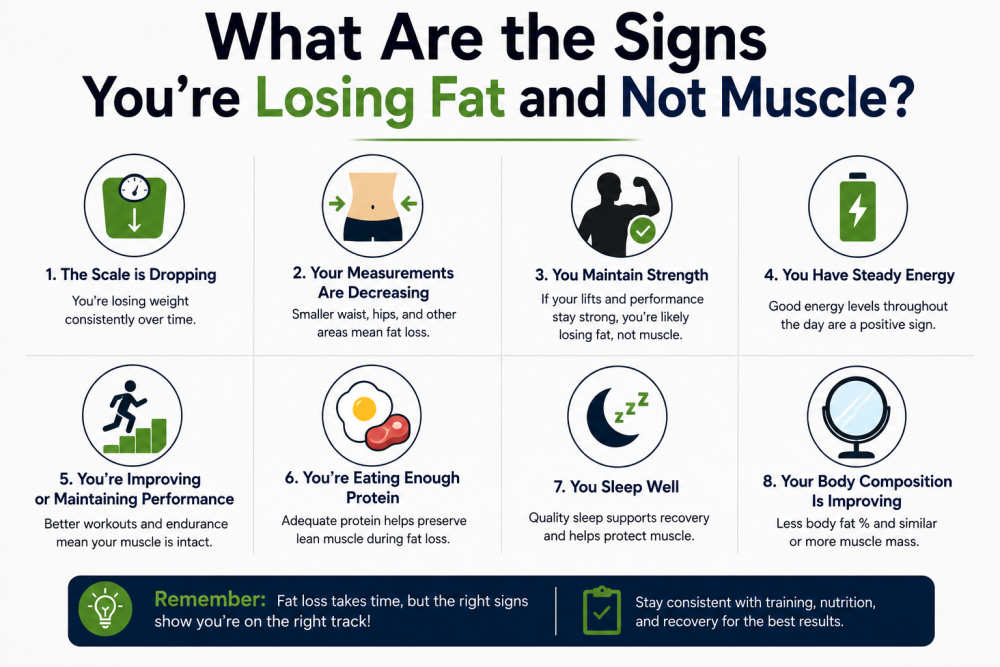
The scale can't tell you, and that's the whole problem. It reports weight leaving, not what the weight was made of, and those are wildly different victories: lose fat and you get leaner, stronger-looking, healthier; lose muscle and you get a smaller, softer, hungrier version of the same shape, with a slower metabolism as the parting gift. Same scale reading. Opposite outcomes.
The good news is your body publishes the real answer constantly, in signals that cost nothing to read, and this article is the reading guide: the five signs the loss is fat, the red flags it's muscle, the simple weekly measuring protocol that settles it, and the steering corrections when the flags show up. Everything here runs on the same engine as the rest of our health guides, and that consistency is deliberate, it's one system.
The standing line, plainly: general information, not medical advice, and anyone with health conditions or any history of disordered eating should be doing this with a professional rather than a checklist, the measuring habits here are tools for healthy dieters, not scorekeeping for restriction.
Sign One: Your Strength Is Holding
The single most reliable signal, and it's free: what's happening to your lifts, your push-ups, your carry-the-groceries strength. Muscle is the machinery of strength, and when a deficit starts eating machinery, performance sags, the weights feel heavier, the reps drop, the last set disappears. When strength holds steady, or even creeps up, through weeks of weight loss, that's the strongest available evidence the loss is coming from fat, because the muscle is demonstrably still there, doing its job.
This is also why our diet plan guide insists on strength training during any deficit: lifting isn't just protection, it's instrumentation. Two to four sessions a week give you a weekly strength reading, and no gym is required, the home versions in our belly fat coverage produce the same data. Track a few key movements, and let the trend speak. Flat or rising: fat. Sliding for weeks: muscle, and time for the corrections below.
Sign Two: The Tape Tells a Shrinking-Waist Story
Fat and muscle live in different neighborhoods, which makes a tape measure a surprisingly sharp diagnostic. Fat loss shows up first and fastest at the waist, while muscle loss shows up as shrinkage everywhere, including the places you'd rather keep, arms, shoulders, thighs.
The protocol, once a week, same morning, same conditions: waist at the belly button, plus one or two keep-sites, an arm, a thigh. Waist trending down while the keep-sites hold: textbook fat loss. Everything shrinking together at speed, especially with the other red flags: muscle is going along for the ride. Bonus signal from your wardrobe, jeans loosening while shirts fit the same across the shoulders is the tape story told in cotton.
Signs Three, Four, and Five: Rate, Energy, and the Mirror
The rate check: fat has a withdrawal limit. The body can only mobilize so much stored fat per day, which is why the healthy band our whole cluster uses, roughly a quarter to three-quarters of a percent of body weight per week, exists: inside it, the loss is mostly fat by physiological default; consistently well beyond it, the body is making up the difference with muscle and water, whatever the crash-diet marketing claims. A quick weekly average, weight change divided by body weight, tells you which side of the line you're living on.
The energy check: fat loss done right feels surprisingly normal, workouts still there, mood stable, hunger present but civilized. Muscle-losing deficits feel like the lights dimming, dragging sessions, constant cold, sleep fraying, food becoming the only thought. Your daily experience is data, and "I feel wrecked" outranks any spreadsheet.
And the mirror-and-photos check, with its famous trap: fat loss gradually reveals shape, muscle loss just shrinks it, "lean" versus "deflated." Photos monthly, same light, same pose, because the mirror lies daily and remembers nothing, and mid-journey there's a phase where fat softens before shape emerges that fools everyone. The photos, four weeks apart, don't get fooled.
What About Body Fat Scales and Scans?
The gadget question, answered honestly. The bioelectrical scales and watches that promise a body fat percentage are individually inaccurate, readings swing with hydration, meals, and time of day, but trend-useful: same scale, same conditions, weekly, and the direction over months means something even when the absolute number doesn't. Treat the percentage as a weather vane, not a measurement. The clinical scans, DEXA being the reference standard, are genuinely accurate and genuinely unnecessary for most people, a before-and-after pair months apart is interesting if accessible and affordable, and everything above delivers the same verdict free. The strength log plus the tape plus the rate check outperforms every gadget under a hundred dollars, and it isn't close.
The Red Flags, and How to Steer Back
Collecting the warning side in one place: strength sliding for multiple weeks, scale dropping faster than the healthy band sustained, everything on the tape shrinking including the keep-sites, energy and sleep deteriorating, hunger going from present to feral, and the deflated look advancing. Two or more of those together is the body announcing it's burning furniture to heat the house.
The corrections are the cluster's greatest hits, applied deliberately. Protein to the working range, 1.6 to 2.2 grams per kilo daily, the number our diet, breakfast, and metabolism guides all carry, because it's the muscle-defense budget. Deficit shrunk, not abandoned: ease toward the healthy band, often just a few hundred calories of correction, and the loss slows to the speed the body can pay in fat. Lifting continued or started, the signal that tells the body the muscle is employed and off-limits. And sleep repaired, per our sleep guide's central finding: short-sleeping dieters lose dramatically more muscle at the same deficit, which makes seven to nine hours a body-composition intervention wearing pajamas.
Give the corrections two to three weeks, then reread the signals. Strength stabilizing and energy returning while the waist keeps trending: back on course, carry on.
The Bottom Line
The signs you're losing fat and not muscle, on one page: strength holding through the deficit, the waist shrinking while arms and shoulders hold, the rate living inside a quarter to three-quarters of a percent per week, energy and mood staying recognizably yours, and photos showing shape emerging rather than air leaving. The reverse pattern, fading lifts, everything shrinking, crash-speed losses, dimming lights, is muscle burning, and it steers back with the same four levers every time: protein, a saner deficit, lifting, sleep.
None of it needs a gadget, all of it fits in ten minutes a week, and the payoff is the entire point of dieting in the first place: arriving at the lower weight as the strong version, not the smaller one.
FAQs: Fat Loss vs Muscle Loss
How do I know if I'm losing muscle instead of fat?
The clearest tell is strength: lifts and reps sliding for multiple weeks during a diet means muscle is being spent, especially alongside rapid scale drops, shrinking arms and shoulders, crashing energy, and feral hunger. Fat loss, by contrast, keeps strength roughly steady while the waist leads the shrinking and daily energy stays recognizable.
How fast can I lose weight without losing muscle?
The evidence-backed band is roughly a quarter to three-quarters of a percent of body weight per week, sustained by a modest calorie deficit with high protein and regular strength training. Consistently faster than that, the body increasingly pays the difference in muscle and water, which is why crash rates produce smaller-but-softer results and rebound metabolisms.
Can I lose fat and keep muscle without lifting weights?
Protein helps and cardio-only dieting still costs meaningful muscle; some form of resistance work, gym, bands, or the bodyweight training in our home workout coverage, is what signals the body to keep the machinery. It doubles as your measurement tool, since stable strength is the best free evidence the plan is working.
Are body fat scales accurate?
Individually, no, readings swing with hydration and timing, and the absolute percentage shouldn't be trusted. As a trend tool, used on the same scale under the same weekly conditions, the direction over months has some value. The free trio, a strength log, a weekly tape measurement, and monthly photos, outperforms consumer gadgets for answering the fat-versus-muscle question.
Why do I look smaller but not leaner while dieting?
Two usual causes: a mid-journey phase where fat softens before underlying shape shows, which monthly photos rather than daily mirrors will see through, or genuine muscle loss producing the deflated look, confirmed if strength is also sliding and everything on the tape is shrinking together. The first resolves with patience; the second with the corrections, more protein, gentler deficit, lifting, sleep.
What should I eat to make sure I lose fat, not muscle?
The same architecture our diet guides run on: protein at 1.6 to 2.2 grams per kilo daily, anchored at every meal, a modest deficit of a few hundred calories rather than a crash, and the rest built from whole foods that keep training fueled. Protein is the muscle-defense budget, the gentle deficit is the speed limit, and together with lifting and sleep they make fat the body's default currency.