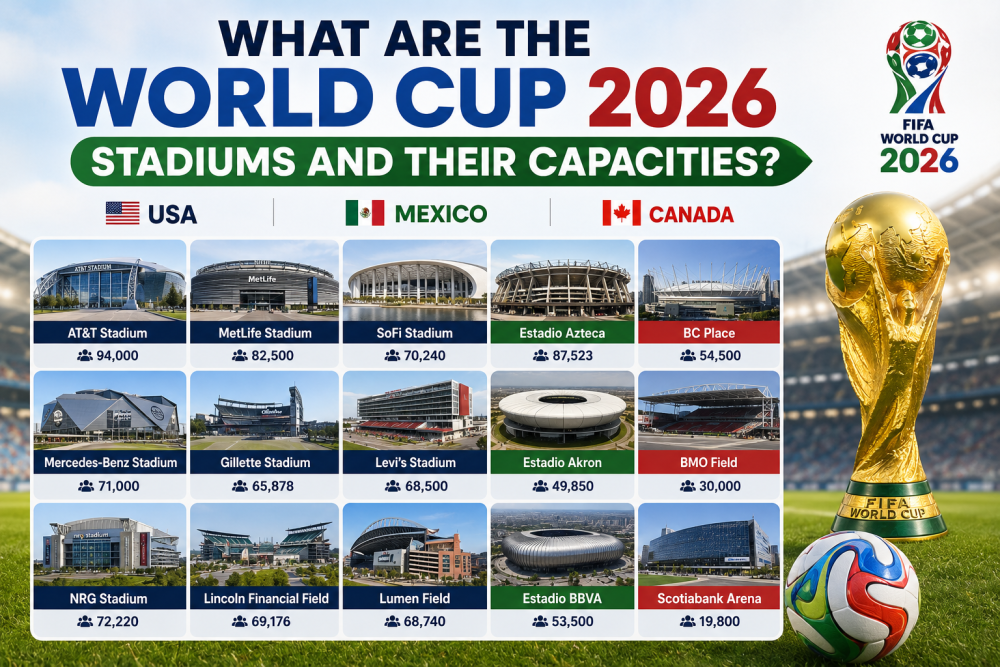
Sixteen stadiums, and together they make this the biggest-capacity World Cup ever staged, over a million seats across the venue list, with the smallest ground bigger than some tournaments' mid-tier and the largest pushing past 90,000 when configured for the football.
Here's the full venue guide: every stadium, its capacity, its character, and what it's hosting, organized by country. One note on the numbers before we start, because capacity is slipperier than it looks: tournament configurations differ from the stadiums' everyday numbers, seats get lost to media and safety zones, some venues added temporary sections, so the figures below are close approximations of the World Cup setups, and the official match-day numbers wobble around them. Treat them as the right neighborhood rather than a notarized count.
The United States: Eleven NFL Giants
The American venues are all NFL stadiums, which means the baseline is enormous, nothing under roughly 65,000, and several were built with days exactly like this in mind.
AT&T Stadium, Arlington, the Dallas venue, is the tournament's monster: around 80,000 seats in its everyday life, expanded past 90,000 for World Cup configuration, the biggest crowd capacity of the tournament, and fittingly it drew the biggest match load, nine games including a semi-final under Jerry Jones' famous retractable roof and that preposterous hanging video board.
MetLife Stadium, East Rutherford, seats about 82,500 and hosts the whole point of the tournament, the final on July 19, plus a heavy knockout slate. No roof, huge bowl, and the biggest single-match audience in the sport's history by television if not by seat.
The rest of the American eleven, capacity-ordered, roughly: Arrowhead in Kansas City around 76,000, and the loudest of the sixteen, that's measured fact, not local bragging. NRG in Houston about 72,000, roofed and air-conditioned, mercifully. Mercedes-Benz in Atlanta about 71,000, the other semi-final venue, with the camera-shutter roof and arguably the best football sightlines in the country. SoFi in Los Angeles around 70,000 for this configuration, the $5 billion one, which hosted the US team's opener. Lincoln Financial Field in Philadelphia near 70,000. Lumen Field in Seattle about 69,000, second-loudest and litigating the title. Levi's Stadium near San Francisco about 70,000 with its temporary additions. Gillette outside Boston around 66,000. Hard Rock in Miami about 65,000, the smallest of the US set and compensating with a marquee knockout slate including the third-place match.
Mexico: History, Altitude, and the Best-Looking Ground
Estadio Azteca, Mexico City, is the spiritual heavyweight regardless of what the counters say: roughly 83,000 to 87,000 depending on configuration era, renovations trimmed the historical number, sitting at 2,200 meters of altitude, and the only stadium on earth to host matches at three World Cups, including this tournament's opener. Numbers aside, it's the venue every neutral wanted a ticket to.
Estadio BBVA, Monterrey, seats about 53,500 and wins the beauty contest outright, the open end framing the Cerro de la Silla mountain remains the tournament's best camera shot. Estadio Akron, Guadalajara, is the smallest venue of the sixteen at roughly 48,000, and what it gives up in size it repays in noise, Chivas' home ground with a World Cup crowd is a proper cauldron.
Canada: The Expanded and the Roofed
BMO Field, Toronto, is the tournament's great expansion story: a 30,000-seat soccer ground in ordinary life, built out to roughly 45,000 with temporary stands for the World Cup, and the site of Canada's first-ever home World Cup match. Intimate by this tournament's standards, lakeside, and for the home fixtures, absolutely feral.
BC Place, Vancouver, seats about 54,500 under its retractable roof, handled the west-coast slate including a healthy knockout share, and delivers the postcard establishing shots, mountains one way, harbor the other.
The Capacity Table, In One Place
For the skim readers, the sixteen from biggest to smallest, tournament-configuration approximations: Dallas (AT&T) 90,000-plus, New York/New Jersey (MetLife) 82,500, Mexico City (Azteca) 83,000-87,000 by configuration, Kansas City (Arrowhead) 76,000, Houston (NRG) 72,000, Atlanta (Mercedes-Benz) 71,000, Los Angeles (SoFi) 70,000, Philadelphia (Lincoln Financial) 70,000, San Francisco (Levi's) 70,000, Seattle (Lumen) 69,000, Boston (Gillette) 66,000, Miami (Hard Rock) 65,000, Vancouver (BC Place) 54,500, Monterrey (BBVA) 53,500, Toronto (BMO, expanded) 45,000, Guadalajara (Akron) 48,000.
Two asterisks worth their ink: FIFA strips sponsor names during the tournament, so tickets and broadcasts say Dallas Stadium, Los Angeles Stadium, and so on, same buildings, cleaner names. And the "which is biggest" pub argument has two defensible answers, Dallas by tournament configuration, the Azteca by history and by its classic numbers, so pick your weapon.
What the Capacities Actually Meant
A few consequences of all this size, watching the tournament unfold. The attendance records were inevitable and duly arrived, a 48-team tournament played mostly in 65,000-to-90,000-seat buildings does arithmetic no previous World Cup could match. The huge bowls also explain the dynamic pricing behavior our tickets guide covered, 80,000 seats is a lot to fill for a group game between mid-seeds, which is precisely why patient buyers found softening prices on the right fixtures. And the roofed venues, Dallas, Houston, Atlanta, Vancouver, earned their engineering in a North American summer, the difference between football and heatstroke theater at certain kickoff hours.
The intimacy counterpoint deserves a line too: the two smallest grounds, Guadalajara and expanded Toronto, produced some of the tournament's best atmospheres per seat, a reminder the sport has known forever, capacity fills highlight reels, density fills eardrums.
The Bottom Line
Sixteen venues, from the 90,000-plus tournament build of Dallas's AT&T Stadium down to Guadalajara's 48,000-seat cauldron, with the final set for MetLife's 82,500, the semis split between Dallas and Atlanta, and the Azteca holding the history no capacity chart can measure. Eleven American NFL giants, Mexico's three characters, Canada's expanded pair, over a million seats in all, the biggest World Cup ever built, in the most literal sense.
The numbers above are tournament-configuration approximations, match-day official counts drift a little around them, and the buildings, unlike the counts, are permanent: most of these venues will be hosting the sport's growth in North America long after July 19. The tournament borrowed them. The football, on the evidence of this summer, is keeping them.
FAQs: World Cup 2026 Stadiums
Which is the biggest stadium at the World Cup 2026?
By tournament configuration, AT&T Stadium in Arlington, the Dallas venue, expanded past 90,000 seats and hosting nine matches including a semi-final. By everyday numbers and by history, Mexico City's Estadio Azteca, in the low-to-mid 80,000s after renovations, holds the other defensible claim, so the pub argument has two right answers.
What stadium hosts the World Cup 2026 final?
MetLife Stadium in East Rutherford, New Jersey, capacity about 82,500, on July 19. FIFA brands it New York New Jersey Stadium for the tournament, and it sits across the river from Manhattan, firmly on the New Jersey side.
What is the smallest World Cup 2026 stadium?
Estadio Akron in Guadalajara at roughly 48,000, with Toronto's BMO Field close by at about 45,000 after its temporary expansion from a 30,000-seat soccer ground. Both proved the tournament's loudest lesson: smaller bowls, when full, out-roar the giants.
Why do the stadiums have different names during the World Cup?
FIFA removes corporate sponsorship from venue names at its tournaments, so AT&T Stadium becomes Dallas Stadium, SoFi becomes Los Angeles Stadium, Lumen becomes Seattle Stadium, and so on. Identical buildings, sponsor-free names on tickets, broadcasts, and official material.
Which World Cup 2026 stadiums have roofs?
The climate-controlled quartet: AT&T in Dallas and NRG in Houston (retractable), Mercedes-Benz in Atlanta (the camera-shutter design), and BC Place in Vancouver (retractable). In a North American summer tournament with afternoon kickoffs, those roofs were competitive infrastructure, not luxury.
Are the capacities exact?
No, and no honest list's are: World Cup configurations differ from everyday setups, seats disappear to media and security zones, temporary stands appear (Toronto's expansion being the largest), and official match-day figures drift around the published numbers. The figures here are close tournament-configuration approximations, right neighborhood, not notarized counts.